




Which of the following gives the slope of a velocity time graph?
${\text{A}}{\text{.}}$ the distance
${\text{B}}{\text{.}}$ the displacement
${\text{C}}{\text{.}}$ the acceleration
${\text{D}}{\text{.}}$ the speed
Answer
 Verified
628.8k+ views
Hint: Here, we will proceed by defining the terms velocity and acceleration which are widely used in physics. Then, we will discuss the various features of a velocity time graph including its slope.
Complete step-by-step answer:
Velocity is simply defined as the rate of change of the position of any object with respect to time. Velocity of any object is a measure of the speed of that object and the direction of motion of that body.
i.e., Velocity v = $\dfrac{{dx}}{{dt}}$ where x represents the position of the object and t represents the time
Acceleration is defined as the rate of change of velocity of an object with respect to time
i.e., Acceleration a = $\dfrac{{dv}}{{dt}} = \dfrac{{{d^2}x}}{{d{t^2}}}$
where v represents the
velocity of the object, x represents the position of the object and t represents the time
Velocity-time graphs are used to explain the motion of moving bodies in a straight line. You can use them to show acceleration and to work out displacement.
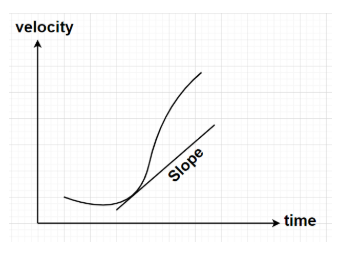
In a velocity-time graph, the graph line 's slope, or steepness, reflects acceleration. If the line slopes upwards, velocity increases, so acceleration is positive. If the line is horizontal, there is constant velocity, and zero acceleration. If the line descends, the velocity decreases, and the acceleration is negative. Deceleration is termed negative acceleration.
In a velocity time graph, velocity is taken along the y-axis and time is taken along the x-axis. Since, the slope of any curve represents the rate of change of the quantity along the y-axis with respect to the quantity along x-axis. So, the slope of the velocity time graph will represent the rate of change of velocity with respect to time which is acceleration.
Slope of velocity time graph = $\dfrac{{dv}}{{dt}}$ = Acceleration
Therefore, the slope of the velocity time graph gives the acceleration.
Hence, option C is correct.
Note: It is also important to note that there exist two important cases of velocity time graph. For constant velocity (or zero acceleration), there will be a horizontal line in the velocity time graph. For constant acceleration, there will be a linear line passing through the origin and inclined at 45 degrees with both the velocity and time axes.
Complete step-by-step answer:
Velocity is simply defined as the rate of change of the position of any object with respect to time. Velocity of any object is a measure of the speed of that object and the direction of motion of that body.
i.e., Velocity v = $\dfrac{{dx}}{{dt}}$ where x represents the position of the object and t represents the time
Acceleration is defined as the rate of change of velocity of an object with respect to time
i.e., Acceleration a = $\dfrac{{dv}}{{dt}} = \dfrac{{{d^2}x}}{{d{t^2}}}$
where v represents the
velocity of the object, x represents the position of the object and t represents the time
Velocity-time graphs are used to explain the motion of moving bodies in a straight line. You can use them to show acceleration and to work out displacement.
In a velocity-time graph, the graph line 's slope, or steepness, reflects acceleration. If the line slopes upwards, velocity increases, so acceleration is positive. If the line is horizontal, there is constant velocity, and zero acceleration. If the line descends, the velocity decreases, and the acceleration is negative. Deceleration is termed negative acceleration.
In a velocity time graph, velocity is taken along the y-axis and time is taken along the x-axis. Since, the slope of any curve represents the rate of change of the quantity along the y-axis with respect to the quantity along x-axis. So, the slope of the velocity time graph will represent the rate of change of velocity with respect to time which is acceleration.
Slope of velocity time graph = $\dfrac{{dv}}{{dt}}$ = Acceleration
Therefore, the slope of the velocity time graph gives the acceleration.
Hence, option C is correct.
Note: It is also important to note that there exist two important cases of velocity time graph. For constant velocity (or zero acceleration), there will be a horizontal line in the velocity time graph. For constant acceleration, there will be a linear line passing through the origin and inclined at 45 degrees with both the velocity and time axes.
Recently Updated Pages
Master Class 11 English: Engaging Questions & Answers for Success

Master Class 11 Maths: Engaging Questions & Answers for Success
Class 11 Question and Answer - Your Ultimate Solutions Guide
Master Class 11 Biology: Engaging Questions & Answers for Success
Master Class 11 Physics: Engaging Questions & Answers for Success
Master Class 11 Accountancy: Engaging Questions & Answers for Success
Trending doubts
Differentiate between an exothermic and an endothermic class 11 chemistry CBSE
One Metric ton is equal to kg A 10000 B 1000 C 100 class 11 physics CBSE
In what year Guru Nanak Dev ji was born A15 April 1469 class 11 social science CBSE
Difference Between Prokaryotic Cells and Eukaryotic Cells
There are 720 permutations of the digits 1 2 3 4 5 class 11 maths CBSE
Draw a diagram of a plant cell and label at least eight class 11 biology CBSE