




Which of the following figures represents the correct method of pressing plants to form herbarium sheets?
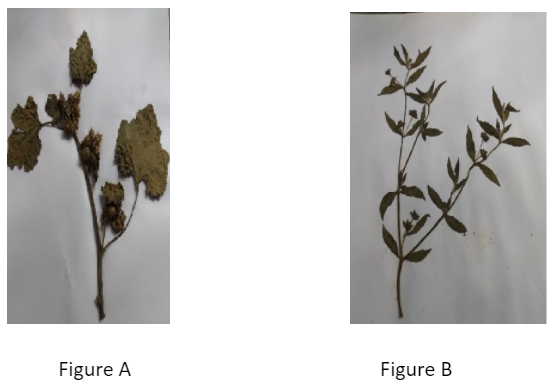
A. Figure A as the plant’s parts are folded
B. Figure B as every plant part is unfolded
C. Both figure A and B as folding or unfolding does not matter
D. None of these
Answer
 Verified
581.1k+ views
Hint: A herbarium is a gathering of plant specimens and associated data used for scientific study. The specimen can be a whole plant or just be a part of plants. These specimens usually are in dried form paste or mounted on a sheet of paper.
Complete answer:
Here are the basic steps to prepare herbarium are:
> Collection and pressing of specimens: Collect the 2-3 (of same plant species) fresh plant specimens. After collection, the plant needs to be unfolded and then pressed in plant press in herbarium press. It can press in “N” or “V” manner if the specimen is large. The specimen should be dust-free.
> Drying of specimens: Drying can be done in two ways that are by natural way or by artificial heat. In case of nature, the plant specimen is kept in herbarium press for 24 hours. Repeated this step for 24 to 72 hours.
> Mounting of specimen: Herbarium sheet size is. The dried specimens are mounted on the sheet with help of the glue diluted in 1%. Cello-tape or ethylcellulose and resin also are used instead of glue.
> Labelling of specimen: Labelling is done after the mounting process. Labeling is done to provide information regarding the plant. This can be done in the order of-
Serial number, botanical name, family, genus, species, local name, place, habit, date of collection, place of collection and collected by.
> Storage and filling of sheet: The herbarium sheets are preserved for future record. The sheets are arranged according to Bentham and Hooker’s, Engler and Prantl’s classification system. Indexing is also important and very useful for easy operation of the herbarium.
> Protection of herbarium sheet: Fumigation is done with proper insecticides or other chemicals so that mounted specimens are not destroyed by the insect or beetles.
From the given steps for preparing the herbarium, we can conclude that every part of the plant is unfolded before pressing. Therefore the correct answer is option B.
Note: The main purpose of the herbarium is to understand the geographic distribution of plants, to study about the plant taxonomy and also to stabilize the nomenclature. It has a great significance and value to science. It is a good source of molecular phylogenetics and plant DNA for use in taxonomy.
Complete answer:
Here are the basic steps to prepare herbarium are:
> Collection and pressing of specimens: Collect the 2-3 (of same plant species) fresh plant specimens. After collection, the plant needs to be unfolded and then pressed in plant press in herbarium press. It can press in “N” or “V” manner if the specimen is large. The specimen should be dust-free.
> Drying of specimens: Drying can be done in two ways that are by natural way or by artificial heat. In case of nature, the plant specimen is kept in herbarium press for 24 hours. Repeated this step for 24 to 72 hours.
> Mounting of specimen: Herbarium sheet size is. The dried specimens are mounted on the sheet with help of the glue diluted in 1%. Cello-tape or ethylcellulose and resin also are used instead of glue.
> Labelling of specimen: Labelling is done after the mounting process. Labeling is done to provide information regarding the plant. This can be done in the order of-
Serial number, botanical name, family, genus, species, local name, place, habit, date of collection, place of collection and collected by.
> Storage and filling of sheet: The herbarium sheets are preserved for future record. The sheets are arranged according to Bentham and Hooker’s, Engler and Prantl’s classification system. Indexing is also important and very useful for easy operation of the herbarium.
> Protection of herbarium sheet: Fumigation is done with proper insecticides or other chemicals so that mounted specimens are not destroyed by the insect or beetles.
From the given steps for preparing the herbarium, we can conclude that every part of the plant is unfolded before pressing. Therefore the correct answer is option B.
Note: The main purpose of the herbarium is to understand the geographic distribution of plants, to study about the plant taxonomy and also to stabilize the nomenclature. It has a great significance and value to science. It is a good source of molecular phylogenetics and plant DNA for use in taxonomy.
Recently Updated Pages
Master Class 12 Economics: Engaging Questions & Answers for Success

Master Class 12 Physics: Engaging Questions & Answers for Success
Master Class 12 English: Engaging Questions & Answers for Success
Master Class 12 Social Science: Engaging Questions & Answers for Success
Master Class 12 Maths: Engaging Questions & Answers for Success
Master Class 12 Business Studies: Engaging Questions & Answers for Success
Trending doubts
Which are the Top 10 Largest Countries of the World?
What are the major means of transport Explain each class 12 social science CBSE
Draw a labelled sketch of the human eye class 12 physics CBSE
Why cannot DNA pass through cell membranes class 12 biology CBSE
Differentiate between insitu conservation and exsitu class 12 biology CBSE
Draw a neat and well labeled diagram of TS of ovary class 12 biology CBSE