




Which of the following features is not present in Periplaneta americana?
(a) Schizocoelom as a body cavity
(b) Indeterminate and radial cleavage during embryonic development
(c) Exoskeleton composed of N-acetylglucosamine
(d) Metamerically segmented body
Answer
 Verified
662.1k+ views
Hint: Periplaneta americana is the American cockroach, and it is an arthropod that undergoes protostome development. Organisms are distinguished by their embryonic development as protostome and deuterostome.
Complete step by step answer:
- The cockroach undergoes protostome development. Most coelomate invertebrates undergo either protostome or deuterostome development.
- Protostomes include mollusks, annelids, and arthropods. Deuterostomes include echinoderms and chordates.
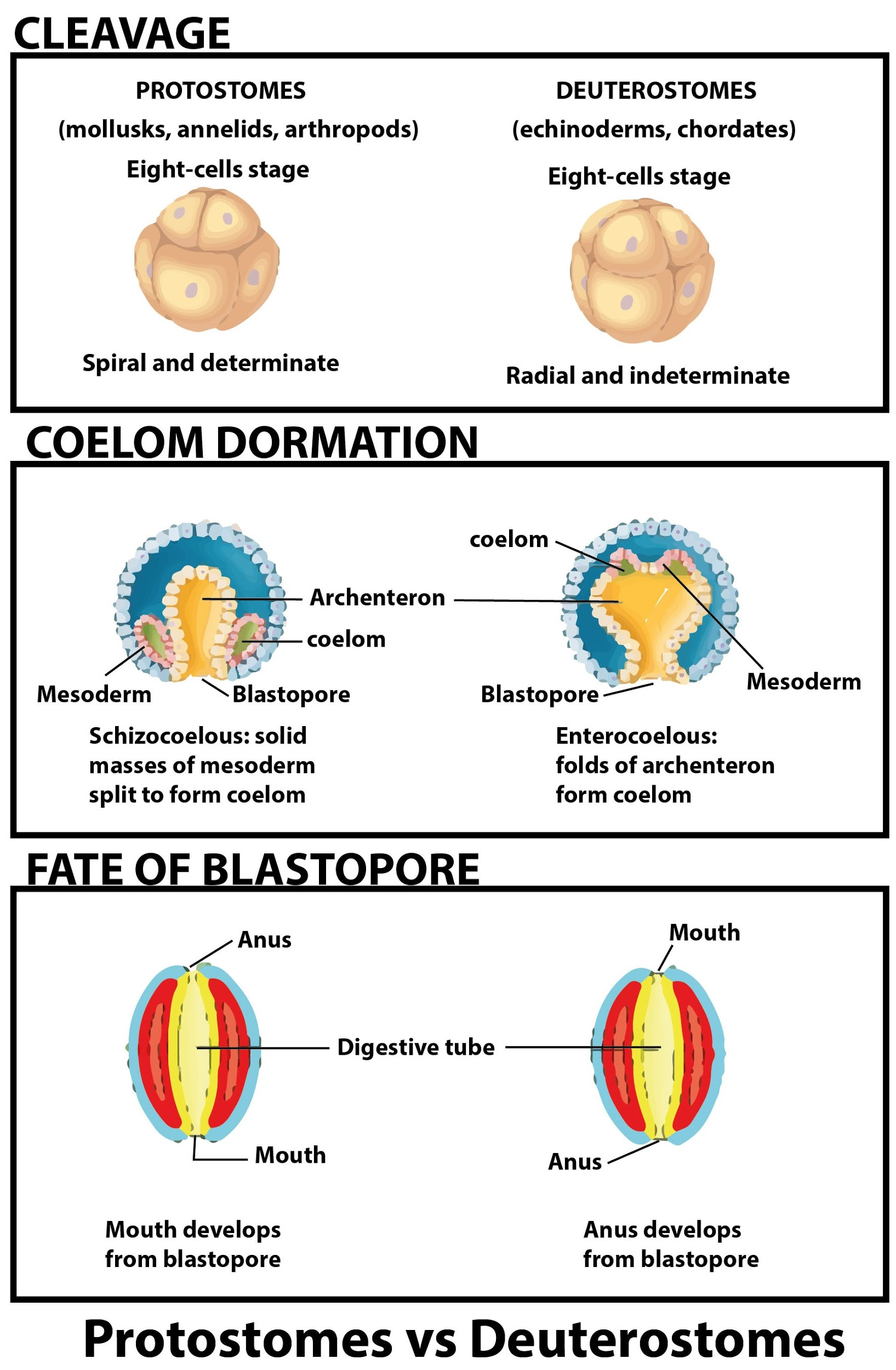
- Protostomes undergo spiral cleavage at the eight-celled stage and show determinate development, in which the development fate of each cell in the adult organism is already determined.
- On the other hand, deuterostomes undergo radial cleavage at the eight-celled stage and show indeterminate development, where each separated cells from the eight-celled stage display the ability to develop into complete organisms.
So, the correct answer is ‘Indeterminate and radial cleavage during embryonic development’.
Additional Information:
- Cockroaches are arthropods, hence they are schizocoelomates, the coelom develops from the split in mesoderm found in annelids, arthropods, and molluscs.
- The exoskeleton of cockroach is composed of chitin, which is a long-chain polymer of N-acetylglucosamine.
- Animals belonging to the phylum Annelida and Arthropoda display metameric segmentation. It is defined as the division of an animal's body into a number of compartments (segments or metameres) and each contains the same organs. Arthropods display this segmentation internally.
Note: As mentioned before, most coelomate invertebrates develop as protostomes where the oral end of the animal develops from the first developmental opening, the blastopore. In the deuterostomes, the oral end of the animal evolves from the second opening on the dorsal surface of the animal, while the blastopore develops into the anus.
Complete step by step answer:
- The cockroach undergoes protostome development. Most coelomate invertebrates undergo either protostome or deuterostome development.
- Protostomes include mollusks, annelids, and arthropods. Deuterostomes include echinoderms and chordates.
- Protostomes undergo spiral cleavage at the eight-celled stage and show determinate development, in which the development fate of each cell in the adult organism is already determined.
- On the other hand, deuterostomes undergo radial cleavage at the eight-celled stage and show indeterminate development, where each separated cells from the eight-celled stage display the ability to develop into complete organisms.
So, the correct answer is ‘Indeterminate and radial cleavage during embryonic development’.
Additional Information:
- Cockroaches are arthropods, hence they are schizocoelomates, the coelom develops from the split in mesoderm found in annelids, arthropods, and molluscs.
- The exoskeleton of cockroach is composed of chitin, which is a long-chain polymer of N-acetylglucosamine.
- Animals belonging to the phylum Annelida and Arthropoda display metameric segmentation. It is defined as the division of an animal's body into a number of compartments (segments or metameres) and each contains the same organs. Arthropods display this segmentation internally.
Note: As mentioned before, most coelomate invertebrates develop as protostomes where the oral end of the animal develops from the first developmental opening, the blastopore. In the deuterostomes, the oral end of the animal evolves from the second opening on the dorsal surface of the animal, while the blastopore develops into the anus.
Recently Updated Pages
Explain the structure of megasporangium class 12 biology CBSE

Why is chloroform kept in dark coloured bottles class 12 chemistry CBSE
Derive the balancing condition of a Wheatstone bri class 12 physics CBSE
Draw VI characteristics of a pn junction diode Explain class 12 physics CBSE
Is it possible to carry pride in ones language too class 12 english CBSE
In a population at Hardy Weinberg equilibrium the allele class 12 biology CBSE
Trending doubts
Draw a labelled sketch of the human eye class 12 physics CBSE
Which are the Top 10 Largest Countries of the World?
Draw ray diagrams each showing i myopic eye and ii class 12 physics CBSE
One megawatt is equal to how many units of electri class 12 physics CBSE
Which is the correct genotypic ratio of mendel dihybrid class 12 biology CBSE
Give 10 examples of unisexual and bisexual flowers