



Which of the following compound(s) show dipole moment \[?\]
A.$1,4 - $dichlorobenzene
B.$1,2 - $dichlorobenzene
C.$1,3 - $dichlorobenzene
D.trans $ - 2,3 - $ dichloro $ - 2 - $ butene
Answer
 Verified
545.7k+ views
Hint: Dipole moment $(\mu )$ of a molecule arises due to separation of charges. The magnitude of charge and distance between them determines the polarity of the bond. Here, to find the molecules that show dipole moment, first we must draw their structures. The net dipole moment of the molecule can be found out by knowing the direction of the dipole moment of each bond.
Complete answer: Dipole moment is a vector quantity. It depends upon the difference in electronegativity between the atoms or molecules. Chlorine is an electronegative atom. Polarity arises mainly due to the difference in electronegativity of $C - Cl$ bond of the given molecules. Now, let us check which of the following compounds show dipole moment.
A.$1,4 - $dichlorobenzene
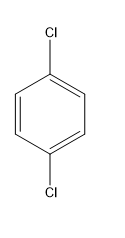
In this case, the dipole moments are in the opposite directions and they cancel out. Therefore, the net dipole moment is zero due to the symmetry of the molecule.
B.$1,2 - $dichlorobenzene
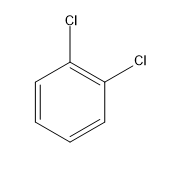
There is a resultant dipole moment for the molecule. The dipole moment is the vector sum of individual dipole moments of $C - Cl$ bonds. The angle between them is around ${60^ \circ }$ .
C.$1,3 - $dichlorobenzene

The two chlorine atoms are meta to each other and the molecule shows a resultant dipole moment. The individual dipole moments are at an angle of ${120^ \circ }$ to each other and their vector sum gives the net dipole moment of the compound.
D.trans $ - 2,3 - $ dichloro $ - 2 - $ butene
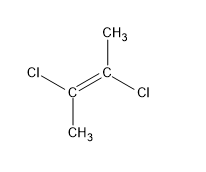
This is similar to (a). The dipole moment by identical chlorine atoms cancels out each other since they are in opposite directions. There is a center of symmetry at $C = C$ and thus the net dipole moment is zero.
Therefore, the compounds that show dipole moment are :
(b) $1,2 - $dichlorobenzene
(c) $1,3 - $dichlorobenzene
Note:
Dipole moment is a measure of polarity of a molecule. Non polar molecules have zero net dipole moment. Symmetric molecules will have net dipole moment zero as their individual dipole moments cancel out in opposite directions. Cis molecules will have more dipole moment than trans molecules.
Complete answer: Dipole moment is a vector quantity. It depends upon the difference in electronegativity between the atoms or molecules. Chlorine is an electronegative atom. Polarity arises mainly due to the difference in electronegativity of $C - Cl$ bond of the given molecules. Now, let us check which of the following compounds show dipole moment.
A.$1,4 - $dichlorobenzene
In this case, the dipole moments are in the opposite directions and they cancel out. Therefore, the net dipole moment is zero due to the symmetry of the molecule.
B.$1,2 - $dichlorobenzene
There is a resultant dipole moment for the molecule. The dipole moment is the vector sum of individual dipole moments of $C - Cl$ bonds. The angle between them is around ${60^ \circ }$ .
C.$1,3 - $dichlorobenzene
The two chlorine atoms are meta to each other and the molecule shows a resultant dipole moment. The individual dipole moments are at an angle of ${120^ \circ }$ to each other and their vector sum gives the net dipole moment of the compound.
D.trans $ - 2,3 - $ dichloro $ - 2 - $ butene
This is similar to (a). The dipole moment by identical chlorine atoms cancels out each other since they are in opposite directions. There is a center of symmetry at $C = C$ and thus the net dipole moment is zero.
Therefore, the compounds that show dipole moment are :
(b) $1,2 - $dichlorobenzene
(c) $1,3 - $dichlorobenzene
Note:
Dipole moment is a measure of polarity of a molecule. Non polar molecules have zero net dipole moment. Symmetric molecules will have net dipole moment zero as their individual dipole moments cancel out in opposite directions. Cis molecules will have more dipole moment than trans molecules.
Recently Updated Pages
Master Class 12 Economics: Engaging Questions & Answers for Success

Master Class 12 English: Engaging Questions & Answers for Success
Master Class 12 Social Science: Engaging Questions & Answers for Success
Master Class 12 Maths: Engaging Questions & Answers for Success
Master Class 12 Physics: Engaging Questions & Answers for Success
Master Class 9 General Knowledge: Engaging Questions & Answers for Success
Trending doubts
Which are the Top 10 Largest Countries of the World?
Draw a labelled sketch of the human eye class 12 physics CBSE
Differentiate between homogeneous and heterogeneous class 12 chemistry CBSE
Sulphuric acid is known as the king of acids State class 12 chemistry CBSE
Why is the cell called the structural and functional class 12 biology CBSE
Draw ray diagrams each showing i myopic eye and ii class 12 physics CBSE