




Which of the following compounds does not undergo Hell-Volhard-Zelinsky reaction?
${\text{A}}{\text{.}}$ Ethanoic acid
${\text{B}}{\text{.}}$ Propionic acid
${\text{C}}{\text{.}}$ Iso-butyric acid
${\text{D}}{\text{.}}$ Trichloroacetic acid
Answer
 Verified
685.5k+ views
Hint- Here, we will proceed by discussing the Vell Volhard Zelinsky reaction mechanism. Then, we will draw the structures of all the acids given in the options. Those which will be having alpha hydrogen will undergo the reaction.
Complete answer:
An aldehyde or ketone in possession of α hydrogen and its enol tautomer will be in equilibrium. This aldehyde and ketone component allows electrophilic addition to occur at the hydrogen α. However, carboxylic acids usually do not form stable enols, so adding alpha is easier to do with carboxylic acids than with aldehydes and ketones. The reaction from Hell Volhard Zelinsky reveals a process for incorporating alpha with a carboxylic acid. The purpose of the process is to transform the carboxylic acid into a derivative that is subjected to tautomerization and then to apply alpha to it. For this reaction to happen, the given carboxylic acid must have at least one alpha hydrogen present.
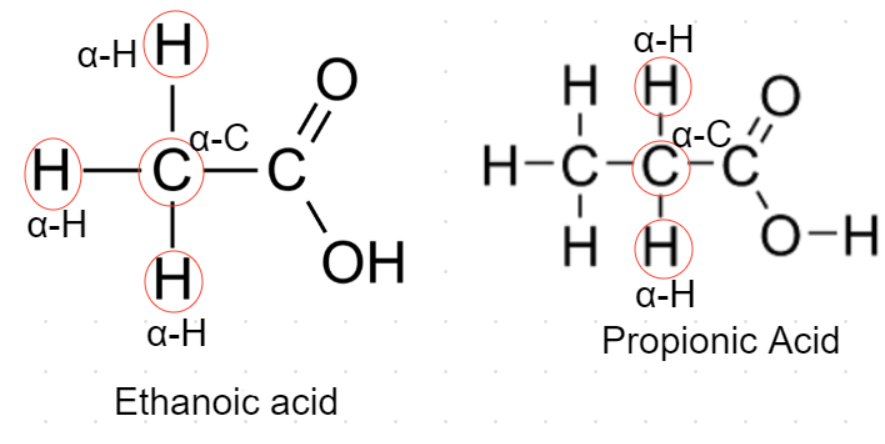
${\text{A}}{\text{.}}$ Ethanoic acid- This acid contains 3 alpha hydrogens as shown in the figure in which its structure is drawn.
So, ethanoic acid will undergo Hell-Volhard Zelinsky reaction.
${\text{B}}{\text{.}}$ Propionic acid- This acid contains 2 alpha hydrogens as shown in the figure in which its structure is drawn.
So, propionic acid will undergo Hell-Volhard Zelinsky reaction.
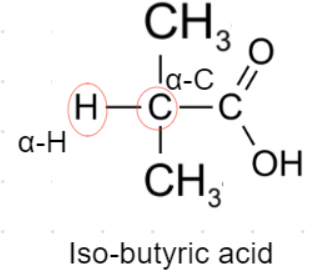
${\text{C}}{\text{.}}$ Iso-butyric acid- This acid contains 1 alpha hydrogens as shown in the figure in which its structure is drawn.
So, Iso-butyric acid will undergo Hell-Volhard Zelinsky reaction.
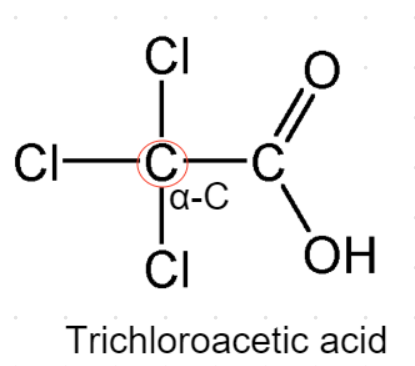
${\text{D}}{\text{.}}$ Trichloroacetic acid- This acid contains no alpha hydrogens as shown in the figure in which its structure is drawn.
So, Trichloroacetic acid will not undergo Hell-Volhard Zelinsky reaction due to the absence of any alpha hydrogen.
Therefore, option D is correct.
Note- For organic molecules, the alpha carbon refers to the first carbon atom that binds to a functional group, such as carbonyl. The atom of hydrogen bound to an alpha atom of carbon is considered an alpha-hydrogen molecule. The Hell Volhard Zelinsky reaction mechanism is somewhat distinct from other reactions to halogenation, because it occurs in the absence of a halogen carrier.
Complete answer:
An aldehyde or ketone in possession of α hydrogen and its enol tautomer will be in equilibrium. This aldehyde and ketone component allows electrophilic addition to occur at the hydrogen α. However, carboxylic acids usually do not form stable enols, so adding alpha is easier to do with carboxylic acids than with aldehydes and ketones. The reaction from Hell Volhard Zelinsky reveals a process for incorporating alpha with a carboxylic acid. The purpose of the process is to transform the carboxylic acid into a derivative that is subjected to tautomerization and then to apply alpha to it. For this reaction to happen, the given carboxylic acid must have at least one alpha hydrogen present.
${\text{A}}{\text{.}}$ Ethanoic acid- This acid contains 3 alpha hydrogens as shown in the figure in which its structure is drawn.
So, ethanoic acid will undergo Hell-Volhard Zelinsky reaction.
${\text{B}}{\text{.}}$ Propionic acid- This acid contains 2 alpha hydrogens as shown in the figure in which its structure is drawn.
So, propionic acid will undergo Hell-Volhard Zelinsky reaction.
${\text{C}}{\text{.}}$ Iso-butyric acid- This acid contains 1 alpha hydrogens as shown in the figure in which its structure is drawn.
So, Iso-butyric acid will undergo Hell-Volhard Zelinsky reaction.
${\text{D}}{\text{.}}$ Trichloroacetic acid- This acid contains no alpha hydrogens as shown in the figure in which its structure is drawn.
So, Trichloroacetic acid will not undergo Hell-Volhard Zelinsky reaction due to the absence of any alpha hydrogen.
Therefore, option D is correct.
Note- For organic molecules, the alpha carbon refers to the first carbon atom that binds to a functional group, such as carbonyl. The atom of hydrogen bound to an alpha atom of carbon is considered an alpha-hydrogen molecule. The Hell Volhard Zelinsky reaction mechanism is somewhat distinct from other reactions to halogenation, because it occurs in the absence of a halogen carrier.
Recently Updated Pages
Explain the structure of megasporangium class 12 biology CBSE

Why is chloroform kept in dark coloured bottles class 12 chemistry CBSE
Derive the balancing condition of a Wheatstone bri class 12 physics CBSE
Draw VI characteristics of a pn junction diode Explain class 12 physics CBSE
Is it possible to carry pride in ones language too class 12 english CBSE
In a population at Hardy Weinberg equilibrium the allele class 12 biology CBSE
Trending doubts
One megawatt is equal to how many units of electri class 12 physics CBSE
Which is the correct genotypic ratio of mendel dihybrid class 12 biology CBSE
What is the Full Form of PVC, PET, HDPE, LDPE, PP and PS ?
What is the structural formula of Aspirin A B C D class 12 chemistry CBSE
What is the Full Form of 1.DPT 2.DDT 3.BCG
Draw the diagram showing the germination of pollen class 12 biology CBSE