




Write the formula to find the shortest distance between two straight lines whose vector equations are $\vec{r}=\overrightarrow{{{a}_{1}}}+\lambda \overrightarrow{{{b}_{1}}}\text{ and }\vec{r}=\overrightarrow{{{a}_{2}}}+\pi \overrightarrow{{{b}_{2}}}$ where $\lambda \text{ and }\pi $ are scalars.
Answer
 Verified
604.8k+ views
Hint: In this question, we are given an equation of two lines in vector notation and we have to find the shortest distance between them. For that, we will first observe the lines and then determine if the lines are parallel or skew lines. After that, we will state the formula for finding the shortest distance between lines according to, if lines are parallel or skew.
Complete step-by-step solution:
Here, we are given pair of lines in vector form as $\vec{r}=\overrightarrow{{{a}_{1}}}+\lambda \overrightarrow{{{b}_{1}}}\text{ and }\vec{r}=\overrightarrow{{{a}_{2}}}+\pi \overrightarrow{{{b}_{2}}}$ where $\lambda \text{ and }\pi $ are scalars.
As we can see, one line has $\overrightarrow{{{b}_{1}}}$ and another line has $\overrightarrow{{{b}_{2}}}$ therefore, they are not parallel. So, these lines are skew lines.
Skew lines are the lines in three-dimensional geometry that do not intersect and not parallel.
We need to find the shortest distance between these two skew lines. The shortest distance between a pair of skew lines can be found by obtaining the length of the line segment that melts perpendicularly with both lines.
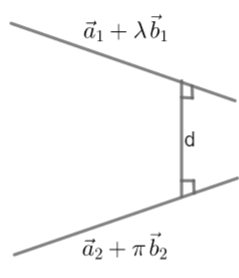
In this figure, length of d is the shortest distance. Formula for finding shortest distance between two skew lines $\vec{r}=\overrightarrow{{{a}_{1}}}+\lambda \overrightarrow{{{b}_{1}}}\text{ and }\vec{r}=\overrightarrow{{{a}_{2}}}+\pi \overrightarrow{{{b}_{2}}}$ where $\lambda \text{ and }\pi $ are scalars is given by
\[d=\left| \dfrac{\left( \overrightarrow{{{b}_{1}}}\times \overrightarrow{{{b}_{2}}} \right)\cdot \left( \overrightarrow{{{a}_{2}}}-\overrightarrow{{{a}_{1}}} \right)}{\left| \overrightarrow{{{b}_{1}}}\times \overrightarrow{{{b}_{2}}} \right|} \right|\]
Where $\overrightarrow{{{b}_{1}}}\times \overrightarrow{{{b}_{2}}}$ represents cross product between $\overrightarrow{{{b}_{1}}}\text{ and }\overrightarrow{{{b}_{2}}}$ and can be given by $\overrightarrow{{{b}_{1}}}\times \overrightarrow{{{b}_{2}}}=\left| \overrightarrow{{{b}_{1}}} \right|\left| \overrightarrow{{{b}_{2}}} \right|\sin \theta \hat{n}$ where $\left| \overrightarrow{{{b}_{1}}} \right|,\left| \overrightarrow{{{b}_{2}}} \right|$ represents magnitude of $\overrightarrow{{{b}_{1}}}\text{ and }\overrightarrow{{{b}_{2}}}$.
Hence, shortest distance between lines $\vec{r}=\overrightarrow{{{a}_{1}}}+\lambda \overrightarrow{{{b}_{1}}}\text{ and }\vec{r}=\overrightarrow{{{a}_{2}}}+\pi \overrightarrow{{{b}_{2}}}$ is equal to $\left| \dfrac{\left( \overrightarrow{{{b}_{1}}}\times \overrightarrow{{{b}_{2}}} \right)\cdot \left( \overrightarrow{{{a}_{2}}}-\overrightarrow{{{a}_{1}}} \right)}{\left| \overrightarrow{{{b}_{1}}}\times \overrightarrow{{{b}_{2}}} \right|} \right|$.
Note: Students should take care that, in the formula, if $\overrightarrow{{{b}_{1}}}\times \overrightarrow{{{b}_{2}}}$ is taken then we have to take $\overrightarrow{{{a}_{2}}}-\overrightarrow{{{a}_{1}}}$ and if we take $\overrightarrow{{{b}_{2}}}\times \overrightarrow{{{b}_{1}}}$ then we have to take $\overrightarrow{{{a}_{1}}}-\overrightarrow{{{a}_{2}}}$. Students should note that $\overrightarrow{{{b}_{1}}}\times \overrightarrow{{{b}_{2}}}\ne \overrightarrow{{{b}_{2}}}\times \overrightarrow{{{b}_{1}}}$. $\left| \overrightarrow{{{b}_{1}}}\times \overrightarrow{{{b}_{2}}} \right|$ represents magnitude of $\overrightarrow{{{b}_{1}}}\times \overrightarrow{{{b}_{2}}}$. Students should not get confused that if lines are not parallel then they should be intersecting. We are talking about three dimensional geometry here, so there exist lines which are neither parallel nor do they intersect.
Complete step-by-step solution:
Here, we are given pair of lines in vector form as $\vec{r}=\overrightarrow{{{a}_{1}}}+\lambda \overrightarrow{{{b}_{1}}}\text{ and }\vec{r}=\overrightarrow{{{a}_{2}}}+\pi \overrightarrow{{{b}_{2}}}$ where $\lambda \text{ and }\pi $ are scalars.
As we can see, one line has $\overrightarrow{{{b}_{1}}}$ and another line has $\overrightarrow{{{b}_{2}}}$ therefore, they are not parallel. So, these lines are skew lines.
Skew lines are the lines in three-dimensional geometry that do not intersect and not parallel.
We need to find the shortest distance between these two skew lines. The shortest distance between a pair of skew lines can be found by obtaining the length of the line segment that melts perpendicularly with both lines.
In this figure, length of d is the shortest distance. Formula for finding shortest distance between two skew lines $\vec{r}=\overrightarrow{{{a}_{1}}}+\lambda \overrightarrow{{{b}_{1}}}\text{ and }\vec{r}=\overrightarrow{{{a}_{2}}}+\pi \overrightarrow{{{b}_{2}}}$ where $\lambda \text{ and }\pi $ are scalars is given by
\[d=\left| \dfrac{\left( \overrightarrow{{{b}_{1}}}\times \overrightarrow{{{b}_{2}}} \right)\cdot \left( \overrightarrow{{{a}_{2}}}-\overrightarrow{{{a}_{1}}} \right)}{\left| \overrightarrow{{{b}_{1}}}\times \overrightarrow{{{b}_{2}}} \right|} \right|\]
Where $\overrightarrow{{{b}_{1}}}\times \overrightarrow{{{b}_{2}}}$ represents cross product between $\overrightarrow{{{b}_{1}}}\text{ and }\overrightarrow{{{b}_{2}}}$ and can be given by $\overrightarrow{{{b}_{1}}}\times \overrightarrow{{{b}_{2}}}=\left| \overrightarrow{{{b}_{1}}} \right|\left| \overrightarrow{{{b}_{2}}} \right|\sin \theta \hat{n}$ where $\left| \overrightarrow{{{b}_{1}}} \right|,\left| \overrightarrow{{{b}_{2}}} \right|$ represents magnitude of $\overrightarrow{{{b}_{1}}}\text{ and }\overrightarrow{{{b}_{2}}}$.
Hence, shortest distance between lines $\vec{r}=\overrightarrow{{{a}_{1}}}+\lambda \overrightarrow{{{b}_{1}}}\text{ and }\vec{r}=\overrightarrow{{{a}_{2}}}+\pi \overrightarrow{{{b}_{2}}}$ is equal to $\left| \dfrac{\left( \overrightarrow{{{b}_{1}}}\times \overrightarrow{{{b}_{2}}} \right)\cdot \left( \overrightarrow{{{a}_{2}}}-\overrightarrow{{{a}_{1}}} \right)}{\left| \overrightarrow{{{b}_{1}}}\times \overrightarrow{{{b}_{2}}} \right|} \right|$.
Note: Students should take care that, in the formula, if $\overrightarrow{{{b}_{1}}}\times \overrightarrow{{{b}_{2}}}$ is taken then we have to take $\overrightarrow{{{a}_{2}}}-\overrightarrow{{{a}_{1}}}$ and if we take $\overrightarrow{{{b}_{2}}}\times \overrightarrow{{{b}_{1}}}$ then we have to take $\overrightarrow{{{a}_{1}}}-\overrightarrow{{{a}_{2}}}$. Students should note that $\overrightarrow{{{b}_{1}}}\times \overrightarrow{{{b}_{2}}}\ne \overrightarrow{{{b}_{2}}}\times \overrightarrow{{{b}_{1}}}$. $\left| \overrightarrow{{{b}_{1}}}\times \overrightarrow{{{b}_{2}}} \right|$ represents magnitude of $\overrightarrow{{{b}_{1}}}\times \overrightarrow{{{b}_{2}}}$. Students should not get confused that if lines are not parallel then they should be intersecting. We are talking about three dimensional geometry here, so there exist lines which are neither parallel nor do they intersect.
Recently Updated Pages
Master Class 12 Business Studies: Engaging Questions & Answers for Success

Master Class 12 Chemistry: Engaging Questions & Answers for Success
Master Class 12 Biology: Engaging Questions & Answers for Success
Class 12 Question and Answer - Your Ultimate Solutions Guide
Master Class 11 Social Science: Engaging Questions & Answers for Success
Master Class 11 Chemistry: Engaging Questions & Answers for Success
Trending doubts
Which are the Top 10 Largest Countries of the World?
Draw a labelled sketch of the human eye class 12 physics CBSE
Name the crygenes that control cotton bollworm and class 12 biology CBSE
Differentiate between homogeneous and heterogeneous class 12 chemistry CBSE
Ribosomal RNA is actively synthesised in A Nucleoplasm class 12 biology CBSE
How many molecules of ATP and NADPH are required information class 12 biology CBSE