




Which functional group is introduced in phenol when it reacts with chloroform and dilute sodium hydroxide?
A. $ - CHC{l_2}$
B. $ - CHO$
C. $ - C{H_2}Cl$
D. $ - COOH$
Answer
 Verified
590.1k+ views
Hint:When phenol that is ${C_6}{H_6}O$ reacts with chloroform that is and sodium hydroxide that is $NaOH$, it is called Reimer–Tiemann reaction. This reaction introduces the aldehyde group in phenol $CHC{l_3}$ at ortho position. At ortho position, intramolecular $H$ bonding occurs.
Complete answer:
The Reimer–Tiemann reaction is a very famous reaction which is used to convert phenol ${C_6}{H_6}O$ into salicylaldehyde ${C_7}{H_6}{O_2}$ . It was discovered by Karl Reimer and Ferdinand Tiemann. This reaction has two steps .In first step phenol reacts with chloroform $CHC{l_3}$ and $NaOH$ to produce an intermediate .In the second step this intermediate undergoes hydrolysis to give $2$-hydroxy benzaldehyde.
It is important we understand the mechanism of the reaction . In the first step of the mechanism $O{H^ - }$ of $NaOH$ reacts with $H$of $CHC{l_3}$ to form water and trichloromethyl anion. It is called deprotonation. Similarly deprotonation of phenol occurs.
$CHC{l_3} + O{H^ - } \to {H_2}O + CC{l_3}^-$
Since chlorine is a group $17$ element and highly electronegative, it is a very good leaving group .So therefore chlorine leaves trichloromethyl anion and negative charge on trichloromethyl anion is neutralized. The product formed in the second step reacts with deprotonated phenol to form an intermediate product. This further undergoes hydrolysis to give salicylaldehyde. The product formed in the second step reacts with deprotonated phenol to form an intermediate product. This further undergoes hydrolysis to give salicylaldehyde.
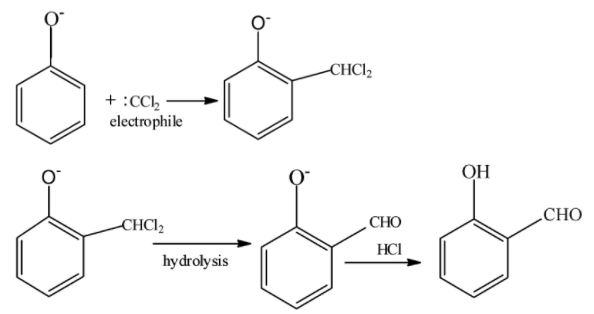
So the correct option is $B$
Note:
It is important to note that instead of $NaOH$ we can also use $KOH$. $NaOH$ or $KOH$ helps in deprotonation of chloroform and phenol. So it becomes necessary to use a strong base to begin the reaction.
Complete answer:
The Reimer–Tiemann reaction is a very famous reaction which is used to convert phenol ${C_6}{H_6}O$ into salicylaldehyde ${C_7}{H_6}{O_2}$ . It was discovered by Karl Reimer and Ferdinand Tiemann. This reaction has two steps .In first step phenol reacts with chloroform $CHC{l_3}$ and $NaOH$ to produce an intermediate .In the second step this intermediate undergoes hydrolysis to give $2$-hydroxy benzaldehyde.
It is important we understand the mechanism of the reaction . In the first step of the mechanism $O{H^ - }$ of $NaOH$ reacts with $H$of $CHC{l_3}$ to form water and trichloromethyl anion. It is called deprotonation. Similarly deprotonation of phenol occurs.
$CHC{l_3} + O{H^ - } \to {H_2}O + CC{l_3}^-$
Since chlorine is a group $17$ element and highly electronegative, it is a very good leaving group .So therefore chlorine leaves trichloromethyl anion and negative charge on trichloromethyl anion is neutralized. The product formed in the second step reacts with deprotonated phenol to form an intermediate product. This further undergoes hydrolysis to give salicylaldehyde. The product formed in the second step reacts with deprotonated phenol to form an intermediate product. This further undergoes hydrolysis to give salicylaldehyde.
So the correct option is $B$
Note:
It is important to note that instead of $NaOH$ we can also use $KOH$. $NaOH$ or $KOH$ helps in deprotonation of chloroform and phenol. So it becomes necessary to use a strong base to begin the reaction.
Recently Updated Pages
Three beakers labelled as A B and C each containing 25 mL of water were taken A small amount of NaOH anhydrous CuSO4 and NaCl were added to the beakers A B and C respectively It was observed that there was an increase in the temperature of the solutions contained in beakers A and B whereas in case of beaker C the temperature of the solution falls Which one of the following statements isarecorrect i In beakers A and B exothermic process has occurred ii In beakers A and B endothermic process has occurred iii In beaker C exothermic process has occurred iv In beaker C endothermic process has occurred

Master Class 12 Social Science: Engaging Questions & Answers for Success
Master Class 12 Physics: Engaging Questions & Answers for Success
Master Class 12 Maths: Engaging Questions & Answers for Success
Master Class 12 Economics: Engaging Questions & Answers for Success
Master Class 12 Chemistry: Engaging Questions & Answers for Success
Three beakers labelled as A B and C each containing 25 mL of water were taken A small amount of NaOH anhydrous CuSO4 and NaCl were added to the beakers A B and C respectively It was observed that there was an increase in the temperature of the solutions contained in beakers A and B whereas in case of beaker C the temperature of the solution falls Which one of the following statements isarecorrect i In beakers A and B exothermic process has occurred ii In beakers A and B endothermic process has occurred iii In beaker C exothermic process has occurred iv In beaker C endothermic process has occurred
Master Class 12 Social Science: Engaging Questions & Answers for Success
Master Class 12 Physics: Engaging Questions & Answers for Success
Trending doubts
Which are the Top 10 Largest Countries of the World?
Draw a labelled sketch of the human eye class 12 physics CBSE
Differentiate between homogeneous and heterogeneous class 12 chemistry CBSE
What are the major means of transport Explain each class 12 social science CBSE
Sulphuric acid is known as the king of acids State class 12 chemistry CBSE
Why should a magnesium ribbon be cleaned before burning class 12 chemistry CBSE