




Which flower has a line of symmetry?
Answer
 Verified
561.3k+ views
Hint: Floral symmetry refers to the ability of a flower, specifically its perianth, to be divided into two or more identical or mirror-image portions. Flowers, on the other hand, rarely have an axis of symmetry since their parts are spirally arranged.
Complete solution:-
Floral symmetry refers to the ability of a flower, specifically its perianth, to be divided into two or more identical or mirror-image portions. Flowers, on the other hand, rarely have an axis of symmetry since their parts are spirally arranged. Most flowers are actinomorphic ("star shaped," "radial"), which means they can be divided into three or more identical sectors that rotate around the flower's centre.
Each sector typically has one tepal, one petal, one sepal, and so on. The flower can be divided into symmetrical halves by the same number of longitudinal lines flowing through the axis, however this isn't always possible: There are two types of symmetry in flowers.
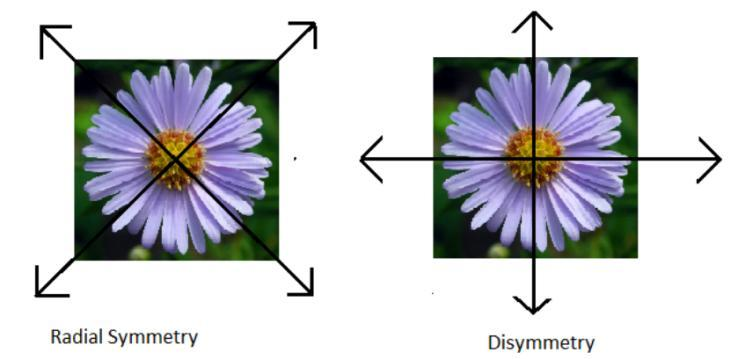
Symmetries are divided into two categories: radial and bilateral.
Actinomorphic flowers have radial symmetry, which means they may be divided into two equal halves on any radial plane passing through the centre. Flowers with bilateral symmetry are referred to as zygomorphic, meaning they can only be divided into two equal halves in one vertical plane. Mustard, datura, chilli flowers are actinomorphic, whereas, pea, Gulmohar, bean, Cassia are zygomorphic flowers.
Note:-
The body in radial symmetry takes the shape of a short or long cylinder or bowl, with a central axis from which the body parts radiate or are arranged in a regular pattern. The major axis is heteropolar, meaning it has opposite ends.
Complete solution:-
Floral symmetry refers to the ability of a flower, specifically its perianth, to be divided into two or more identical or mirror-image portions. Flowers, on the other hand, rarely have an axis of symmetry since their parts are spirally arranged. Most flowers are actinomorphic ("star shaped," "radial"), which means they can be divided into three or more identical sectors that rotate around the flower's centre.
Each sector typically has one tepal, one petal, one sepal, and so on. The flower can be divided into symmetrical halves by the same number of longitudinal lines flowing through the axis, however this isn't always possible: There are two types of symmetry in flowers.
Symmetries are divided into two categories: radial and bilateral.
Actinomorphic flowers have radial symmetry, which means they may be divided into two equal halves on any radial plane passing through the centre. Flowers with bilateral symmetry are referred to as zygomorphic, meaning they can only be divided into two equal halves in one vertical plane. Mustard, datura, chilli flowers are actinomorphic, whereas, pea, Gulmohar, bean, Cassia are zygomorphic flowers.
Note:-
The body in radial symmetry takes the shape of a short or long cylinder or bowl, with a central axis from which the body parts radiate or are arranged in a regular pattern. The major axis is heteropolar, meaning it has opposite ends.
Recently Updated Pages
If x a + bt + ct2 where x is in meters and t is in class 11 physics CBSE

A car covers the first half distance between two places class 11 physics CBSE
The resultant of two vectors overrightarrow P and overrightarrow class 11 physics CBSE
Find the value of cos 135 class 11 maths CBSE
A mass M is held in place by an applied force F and class 11 physics CBSE
A solution of glucose in water is labelled as 10 dfracwv class 11 chemistry CBSE
Trending doubts
One Metric ton is equal to kg A 10000 B 1000 C 100 class 11 physics CBSE
Find the value of the expression given below sin 30circ class 11 maths CBSE
What do you mean by retardation What is its SI uni class 11 physics CBSE
Draw a diagram of nephron and explain its structur class 11 biology CBSE
10 examples of friction in our daily life
Difference between physical and chemical change class 11 chemistry CBSE