




Which d-orbital has a different shape from the rest of all d- orbitals?
A.${{\text{d}}_{{{\text{x}}^{\text{2}}}{\text{ - }}{{\text{y}}^{\text{2}}}}}$
B.${{\text{d}}_{{{\text{z}}^{\text{2}}}}}$
C.${{\text{d}}_{{\text{xz}}}}$
D.${{\text{d}}_{{\text{xy}}}}$
E.${{\text{d}}_{{\text{yz}}}}$
Answer
 Verified
623.7k+ views
Hint:The s shell has only 1 orbital. Therefore, it can hold only 2 electrons. It is spherical. P shell has 3 orbitals and holds a maximum of 6 electrons. Each P orbital has a pair of lobes on either side.

The d shell has 5 orbitals in which except 1 orbital, all others have 4 lobes.
Complete step by step answer:
Let us look at all the orbitals of d.
We know that there are 5 lobes in the d orbital. They are ${{\text{d}}_{{\text{xy}}}}$, ${{\text{d}}_{{\text{xz}}}}$, ${{\text{d}}_{{\text{yz}}}}$, ${{\text{d}}_{{{\text{x}}^{\text{2}}}{\text{ - }}{{\text{y}}^{\text{2}}}}}$, ${{\text{d}}_{{{\text{z}}^{\text{2}}}}}$
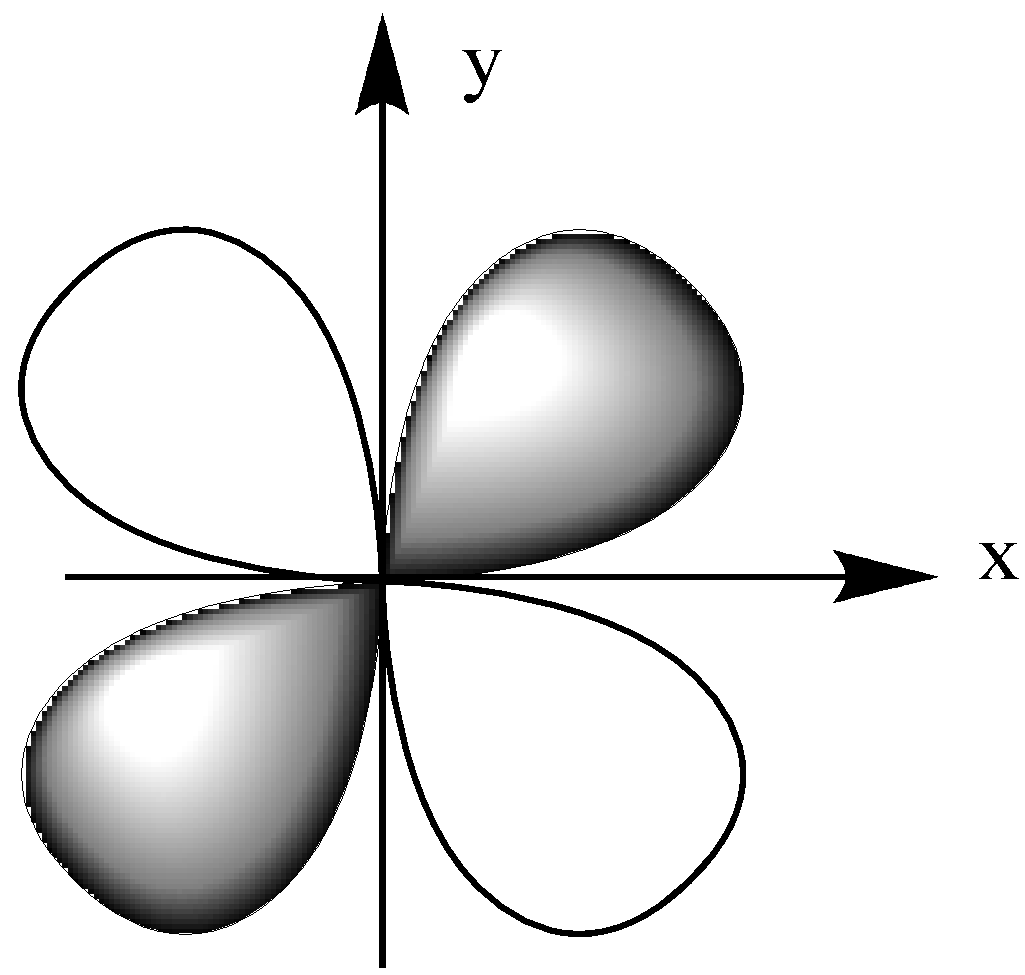
First, let us have a look at the orientation of the ${{\text{d}}_{{\text{xy}}}}$ orbital. It is in the x-y plane.
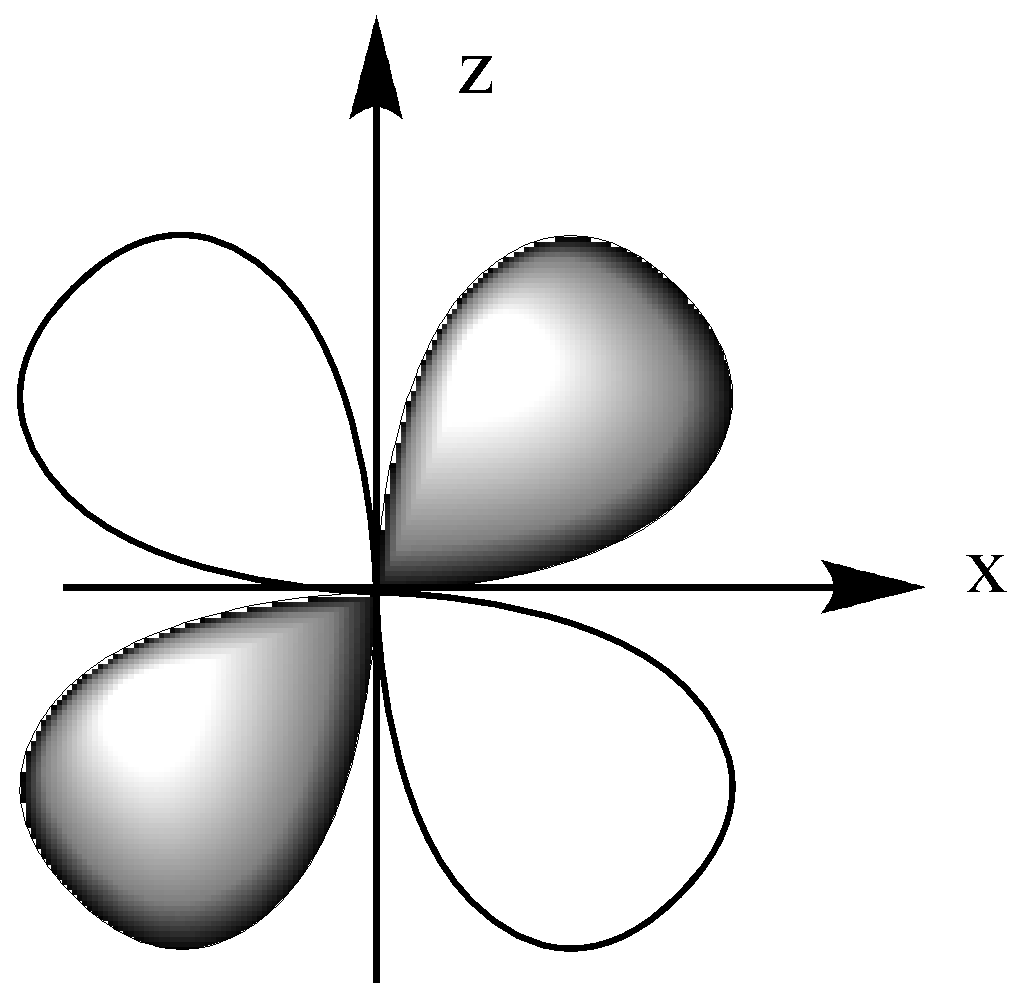
The ${{\text{d}}_{{\text{xz}}}}$ orbital is in the x-z plane, which means the lobe lies between the x and y-axis.
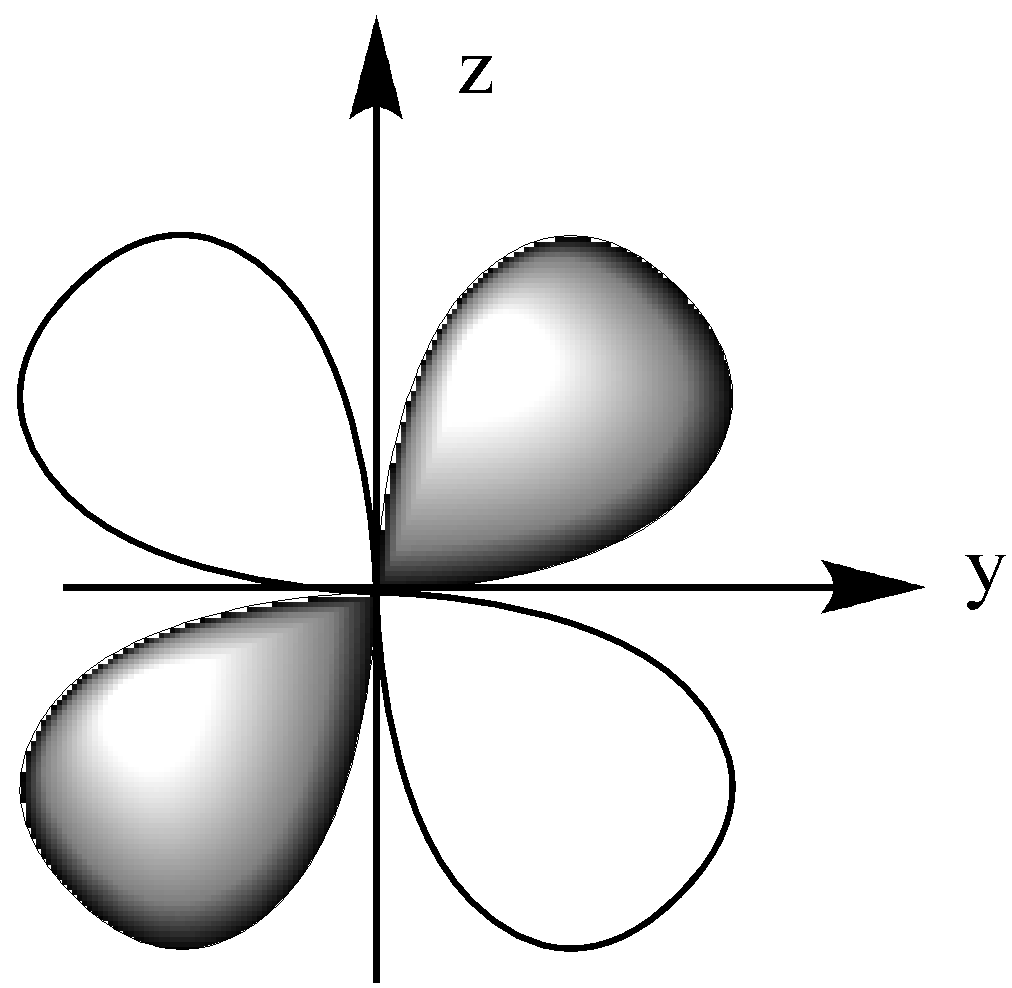
The ${{\text{d}}_{{\text{yz}}}}$ orbital lies in the y-z plane, which is between the z and y-axis.
The ${{\text{d}}_{{{\text{x}}^{\text{2}}}{\text{ - }}{{\text{y}}^{\text{2}}}}}$ orbital lies on the x and y-axis.
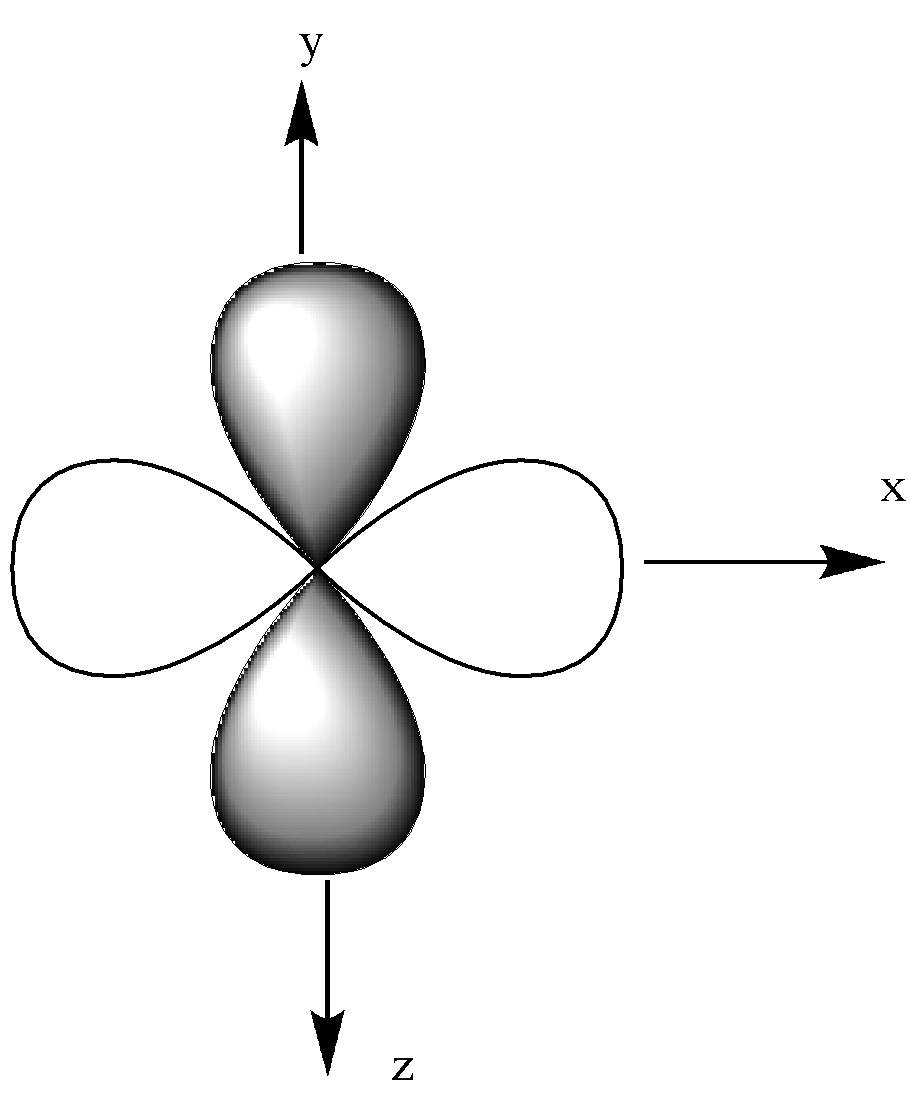
The ${{\text{d}}_{{{\text{z}}^{\text{2}}}}}$ orbital is like a single dumbbell along the z-axis and a ring around the nucleus on the XY plane. It has only 2 lobes and 1 ring.
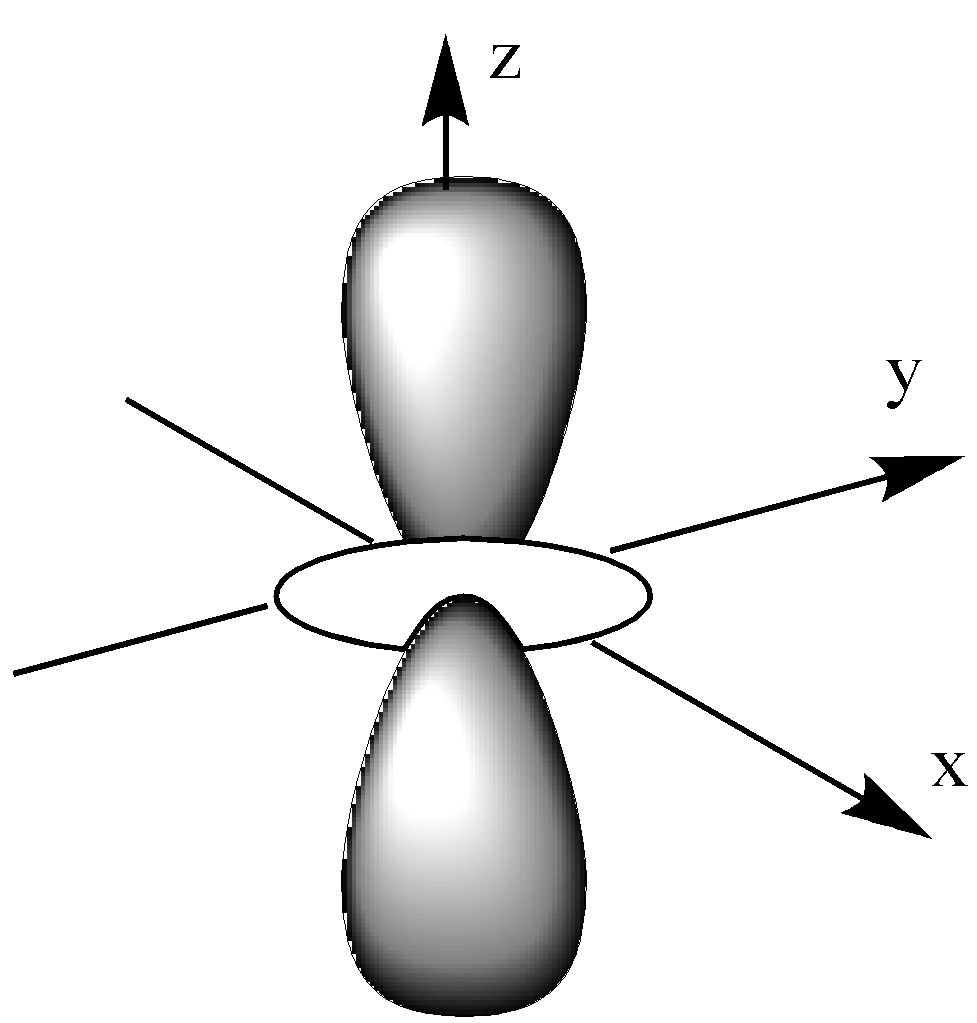
We could see that all other orbitals except the ${{\text{d}}_{{{\text{z}}^{\text{2}}}}}$ orbital have a double dumbbell shape, 4 lobes.
${{\text{d}}_{{{\text{z}}^{\text{2}}}}}$ have single dumbbell-shaped and 2 number lobes.
Thus the correct answer is ${{\text{d}}_{{{\text{z}}^{\text{2}}}}}$
Therefore, the correct option is (B) .
Note: The shapes of these orbitals help us to find the d orbital splitting on the approach of octahedral as well as tetrahedral ligands. The Crystal Field theory can be understood well with the knowledge of the structure of the orbitals and their orientation. Transition metals show special properties because of the d orbitals.
The d shell has 5 orbitals in which except 1 orbital, all others have 4 lobes.
Complete step by step answer:
Let us look at all the orbitals of d.
We know that there are 5 lobes in the d orbital. They are ${{\text{d}}_{{\text{xy}}}}$, ${{\text{d}}_{{\text{xz}}}}$, ${{\text{d}}_{{\text{yz}}}}$, ${{\text{d}}_{{{\text{x}}^{\text{2}}}{\text{ - }}{{\text{y}}^{\text{2}}}}}$, ${{\text{d}}_{{{\text{z}}^{\text{2}}}}}$
First, let us have a look at the orientation of the ${{\text{d}}_{{\text{xy}}}}$ orbital. It is in the x-y plane.
The ${{\text{d}}_{{\text{xz}}}}$ orbital is in the x-z plane, which means the lobe lies between the x and y-axis.
The ${{\text{d}}_{{\text{yz}}}}$ orbital lies in the y-z plane, which is between the z and y-axis.
The ${{\text{d}}_{{{\text{x}}^{\text{2}}}{\text{ - }}{{\text{y}}^{\text{2}}}}}$ orbital lies on the x and y-axis.
The ${{\text{d}}_{{{\text{z}}^{\text{2}}}}}$ orbital is like a single dumbbell along the z-axis and a ring around the nucleus on the XY plane. It has only 2 lobes and 1 ring.
We could see that all other orbitals except the ${{\text{d}}_{{{\text{z}}^{\text{2}}}}}$ orbital have a double dumbbell shape, 4 lobes.
${{\text{d}}_{{{\text{z}}^{\text{2}}}}}$ have single dumbbell-shaped and 2 number lobes.
Thus the correct answer is ${{\text{d}}_{{{\text{z}}^{\text{2}}}}}$
Therefore, the correct option is (B) .
Note: The shapes of these orbitals help us to find the d orbital splitting on the approach of octahedral as well as tetrahedral ligands. The Crystal Field theory can be understood well with the knowledge of the structure of the orbitals and their orientation. Transition metals show special properties because of the d orbitals.
Recently Updated Pages
Master Class 12 Business Studies: Engaging Questions & Answers for Success

Master Class 12 Chemistry: Engaging Questions & Answers for Success
Master Class 12 Biology: Engaging Questions & Answers for Success
Class 12 Question and Answer - Your Ultimate Solutions Guide
Master Class 11 English: Engaging Questions & Answers for Success
Master Class 11 Social Science: Engaging Questions & Answers for Success
Trending doubts
Which are the Top 10 Largest Countries of the World?
Draw a labelled sketch of the human eye class 12 physics CBSE
Differentiate between homogeneous and heterogeneous class 12 chemistry CBSE
Why is the cell called the structural and functional class 12 biology CBSE
When was the first election held in India a 194748 class 12 sst CBSE
Draw ray diagrams each showing i myopic eye and ii class 12 physics CBSE