




Which device works on the principle of Mutual induction?
Answer
 Verified
576k+ views
Hint: Mutual inductance occurs when one magnetic field interacts with another. The mutual inductance concept governs the operation of transformers, motors, generators, and other electrical equipment. Mutual induction occurs when a current flows through one coil or winding and induces a voltage in another coil.
Complete answer:
A transformer is a device that operates on the principle of mutual induction. A transformer is a device that converts alternating current (AC) from one voltage to another.
A transformer consists of two coils, known as the primary and secondary coils. The coils wrapped around a soft iron core. To reduce eddy currents, the iron core is laminated. The transformer's input is applied across the primary coil, and its output is acquired via the secondary coil.
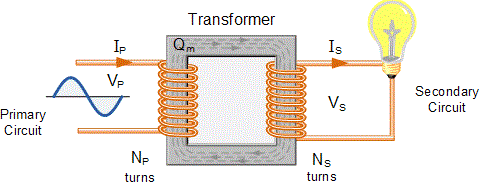
The transformer's principle working concept is based on mutual inductance between primary and secondary circuits that are linked by a shared magnetic flux. The two coils are electrically isolated yet magnetically coupled via a reluctance channel.
Additional information:
Transformer:
In its most basic form, a transformer is something that steps up or steps down voltage. However, when we investigate it further and concerning electric current, it is defined as a static device that changes the level of voltage between circuits. The transformer is essentially a voltage control device that is frequently utilized in alternating current power distribution and transmission.
Michael Faraday first proposed the concept of a transformer in 1831, and it has since been advanced by several other famous scientific thinkers. The general objective of utilizing transformers, however, was to maintain a balance between the electricity generated at very high voltages and the electricity used at very low voltages.
Note: Overall, a transformer performs the following functions:
Electric power transmission from one circuit to the other.
Electromagnetic induction is a method of transferring electrical electricity.
Transfer of electric power with no change in frequency
Mutual induction connects two circuits.
Complete answer:
A transformer is a device that operates on the principle of mutual induction. A transformer is a device that converts alternating current (AC) from one voltage to another.
A transformer consists of two coils, known as the primary and secondary coils. The coils wrapped around a soft iron core. To reduce eddy currents, the iron core is laminated. The transformer's input is applied across the primary coil, and its output is acquired via the secondary coil.
The transformer's principle working concept is based on mutual inductance between primary and secondary circuits that are linked by a shared magnetic flux. The two coils are electrically isolated yet magnetically coupled via a reluctance channel.
Additional information:
Transformer:
In its most basic form, a transformer is something that steps up or steps down voltage. However, when we investigate it further and concerning electric current, it is defined as a static device that changes the level of voltage between circuits. The transformer is essentially a voltage control device that is frequently utilized in alternating current power distribution and transmission.
Michael Faraday first proposed the concept of a transformer in 1831, and it has since been advanced by several other famous scientific thinkers. The general objective of utilizing transformers, however, was to maintain a balance between the electricity generated at very high voltages and the electricity used at very low voltages.
Note: Overall, a transformer performs the following functions:
Electric power transmission from one circuit to the other.
Electromagnetic induction is a method of transferring electrical electricity.
Transfer of electric power with no change in frequency
Mutual induction connects two circuits.
Recently Updated Pages
Which of the following graphs shows the variation of class 12 physics CBSE

Draw a labelled diagram of the human male reproductive class 12 biology CBSE
Describe the experiment to compare the emf of two cells class 12 physics CBSE
What is standard hydrogen electrode
What is conventional current and electric current class 12 physics CBSE
2Bromopentane is treated with an alcoholic KOH solution class 12 chemistry CBSE
Trending doubts
Draw a labelled sketch of the human eye class 12 physics CBSE
Which are the Top 10 Largest Countries of the World?
Differentiate between homogeneous and heterogeneous class 12 chemistry CBSE
Draw ray diagrams each showing i myopic eye and ii class 12 physics CBSE
Which is the correct genotypic ratio of mendel dihybrid class 12 biology CBSE
What is the Full Form of PVC, PET, HDPE, LDPE, PP and PS ?