




Which among the following compounds will give secondary alcohol in reacting with Grignard reagent followed by acid hydrolysis?
I.\[{\text{HCHO}}\]
II.\[{{\text{C}}_{\text{2}}}{{\text{H}}_{\text{5}}}{\text{CHO}}\]
III.\[{\text{C}}{{\text{H}}_{\text{3}}}{\text{COC}}{{\text{H}}_{\text{3}}}\]
IV.\[{\text{RCOO}}{{\text{C}}_{\text{2}}}{{\text{H}}_{\text{5}}}\]
The correct option is:
A) Only II
B) Only III
C) II and IV
D) III and IV
Answer
 Verified
594.9k+ views
Hint: All aldehydes except formaldehyde gives secondary alcohol on reaction with Grignard reagent followed by acid hydrolysis. Ketone and ester on reaction with Grignard reagent followed by acid hydrolysis give tertiary alcohol.
Complete step by step answer:
The given compounds to us are:
\[{\text{HCHO}}\] : Formaldehyde
\[{{\text{C}}_{\text{2}}}{{\text{H}}_{\text{5}}}{\text{CHO}}\] = Propionaldehyde
\[{\text{C}}{{\text{H}}_{\text{3}}}{\text{COC}}{{\text{H}}_{\text{3}}}\]= Acetone
\[{\text{RCOO}}{{\text{C}}_{\text{2}}}{{\text{H}}_{\text{5}}}\]= Ester
The reaction of formaldehyde (\[{\text{HCHO}}\]) with Grignard reagent followed by acid hydrolysis is as follows:
Formaldehyde on reaction with Grignard reagent followed by acid hydrolysis gives primary alcohol.

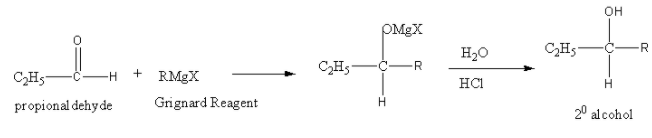
All other aldehydes on reaction with Grignard reagent followed by acid hydrolysis give secondary alcohol.
So, the reaction of propionaldehyde (\[{{\text{C}}_{\text{2}}}{{\text{H}}_{\text{5}}}{\text{CHO}}\]) is as follows:
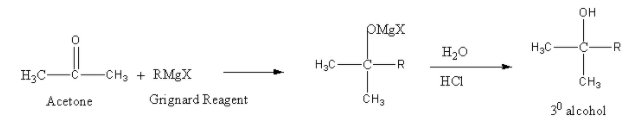
Ketone and ester give tertiary alcohol on reaction with Grignard reagent followed by acid hydrolysis.
So, the reaction of acetone (\[{\text{C}}{{\text{H}}_{\text{3}}}{\text{COC}}{{\text{H}}_{\text{3}}}\]) is as follows:
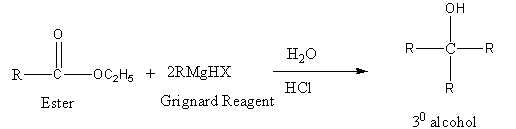
The reaction of ester (\[{\text{RCOO}}{{\text{C}}_{\text{2}}}{{\text{H}}_{\text{5}}}\]) with Grignard reagent followed by acid hydrolysis is as follows:
Thus, only Propionaldehyde (\[{{\text{C}}_{\text{2}}}{{\text{H}}_{\text{5}}}{\text{CHO}}\]) gives secondary alcohol on reaction with Grignard reagent followed by acid hydrolysis.
Hence, the correct option is (A) only II.
Note: Ketone reacts with 1 equivalent of Grignard reagent while ester reacts with 2 equivalents of a Grignard reagent to give tertiary alcohol. Since formaldehyde does not contain an alkyl group it is the only aldehyde that gives primary alcohol on reaction with the Grignard reagent. While other aldehydes give secondary alcohol.
Complete step by step answer:
The given compounds to us are:
\[{\text{HCHO}}\] : Formaldehyde
\[{{\text{C}}_{\text{2}}}{{\text{H}}_{\text{5}}}{\text{CHO}}\] = Propionaldehyde
\[{\text{C}}{{\text{H}}_{\text{3}}}{\text{COC}}{{\text{H}}_{\text{3}}}\]= Acetone
\[{\text{RCOO}}{{\text{C}}_{\text{2}}}{{\text{H}}_{\text{5}}}\]= Ester
The reaction of formaldehyde (\[{\text{HCHO}}\]) with Grignard reagent followed by acid hydrolysis is as follows:
Formaldehyde on reaction with Grignard reagent followed by acid hydrolysis gives primary alcohol.
All other aldehydes on reaction with Grignard reagent followed by acid hydrolysis give secondary alcohol.
So, the reaction of propionaldehyde (\[{{\text{C}}_{\text{2}}}{{\text{H}}_{\text{5}}}{\text{CHO}}\]) is as follows:
Ketone and ester give tertiary alcohol on reaction with Grignard reagent followed by acid hydrolysis.
So, the reaction of acetone (\[{\text{C}}{{\text{H}}_{\text{3}}}{\text{COC}}{{\text{H}}_{\text{3}}}\]) is as follows:
The reaction of ester (\[{\text{RCOO}}{{\text{C}}_{\text{2}}}{{\text{H}}_{\text{5}}}\]) with Grignard reagent followed by acid hydrolysis is as follows:
Thus, only Propionaldehyde (\[{{\text{C}}_{\text{2}}}{{\text{H}}_{\text{5}}}{\text{CHO}}\]) gives secondary alcohol on reaction with Grignard reagent followed by acid hydrolysis.
Hence, the correct option is (A) only II.
Note: Ketone reacts with 1 equivalent of Grignard reagent while ester reacts with 2 equivalents of a Grignard reagent to give tertiary alcohol. Since formaldehyde does not contain an alkyl group it is the only aldehyde that gives primary alcohol on reaction with the Grignard reagent. While other aldehydes give secondary alcohol.
Recently Updated Pages
Master Class 12 Social Science: Engaging Questions & Answers for Success

Master Class 12 Physics: Engaging Questions & Answers for Success
Master Class 12 Maths: Engaging Questions & Answers for Success
Master Class 12 Economics: Engaging Questions & Answers for Success
Master Class 12 Chemistry: Engaging Questions & Answers for Success
Master Class 12 Business Studies: Engaging Questions & Answers for Success
Trending doubts
Which are the Top 10 Largest Countries of the World?
Draw a labelled sketch of the human eye class 12 physics CBSE
Explain the structure of megasporangium class 12 biology CBSE
What are the major means of transport Explain each class 12 social science CBSE
How many chromosomes are found in human ovum a 46 b class 12 biology CBSE
The diagram of the section of a maize grain is given class 12 biology CBSE