




Why is Wheatstone's bridge more accurate?
Answer
 Verified
569.7k+ views
Hint:In 1833, Samuel Hunter Christie designed the Wheatstone bridge, which was popularized by Sir Charles Wheatstone in 1843. The Wheatstone Bridge Circuit having of a bridge formed by two known resistors, one unknown resistor, and one variable resistor. A Wheatstone bridge is an electrical circuit that balances two legs of a bridge circuit, one of which includes the unknown component, to measure an unknown electrical resistance. A Wheatstone bridge's main advantage is its ability to produce exceedingly exact measurements.
Complete step by step solution:
Reason:
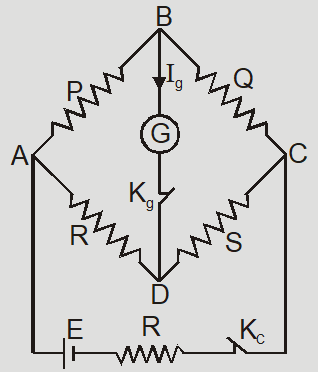
Wheatstone's bridge is a set of four resistances that can be used to calculate the value of one of them in terms of the other three. Because the resistance is derived using the null approach and is based on Kirchoff's law, a Wheatstone's bridge is more accurate than other methods of measuring resistance. The resistance of the galvanometer and the internal resistance of the cell does not affect the null point in the null technique. The current through the galvanometer becomes zero if one or more of the four resistances is altered. The null point is a term used to describe this place. The Wheatstone's bridge is claimed to be balanced in this condition.
Additional information:
Principle of Wheatstone bridge:
The null deflection principle is used in the Wheatstone bridge operation, which states that their resistance ratios are equivalent and that no current flows across the circuit. Under typical circumstances, the bridge is imbalanced, allowing current to flow through the galvanometer. When no current flows through the galvanometer, the bridge is considered to be balanced. By modifying the known and variable resistances, this condition can be attained.
Note: Application for the Wheatstone Bridge:
The Wheatstone bridge is used to detect low resistance precisely.
Physical characteristics like temperature, light, and strain are measured using a Wheatstone bridge and an operational amplifier.
Variations on the Wheatstone bridge can be used to test impedance, inductance, and capacitance, among other things.
Complete step by step solution:
Reason:
Wheatstone's bridge is a set of four resistances that can be used to calculate the value of one of them in terms of the other three. Because the resistance is derived using the null approach and is based on Kirchoff's law, a Wheatstone's bridge is more accurate than other methods of measuring resistance. The resistance of the galvanometer and the internal resistance of the cell does not affect the null point in the null technique. The current through the galvanometer becomes zero if one or more of the four resistances is altered. The null point is a term used to describe this place. The Wheatstone's bridge is claimed to be balanced in this condition.
Additional information:
Principle of Wheatstone bridge:
The null deflection principle is used in the Wheatstone bridge operation, which states that their resistance ratios are equivalent and that no current flows across the circuit. Under typical circumstances, the bridge is imbalanced, allowing current to flow through the galvanometer. When no current flows through the galvanometer, the bridge is considered to be balanced. By modifying the known and variable resistances, this condition can be attained.
Note: Application for the Wheatstone Bridge:
The Wheatstone bridge is used to detect low resistance precisely.
Physical characteristics like temperature, light, and strain are measured using a Wheatstone bridge and an operational amplifier.
Variations on the Wheatstone bridge can be used to test impedance, inductance, and capacitance, among other things.
Recently Updated Pages
Master Class 12 Physics: Engaging Questions & Answers for Success

Master Class 12 Social Science: Engaging Questions & Answers for Success
Master Class 12 English: Engaging Questions & Answers for Success
Master Class 12 Maths: Engaging Questions & Answers for Success
Master Class 12 Business Studies: Engaging Questions & Answers for Success
Master Class 12 Chemistry: Engaging Questions & Answers for Success
Trending doubts
Which is the strongest oxidising agent out of the following class 12 chemistry CBSE
Differentiate between homogeneous and heterogeneous class 12 chemistry CBSE
Draw a well labelled diagram of the human brain class 12 biology CBSE
Draw a well labelled diagram of LS of the human ki class 12 biology CBSE
Which of the following is the best conductor of electricity class 12 physics CBSE
The Somnath Temple which was destroyed by Mahmud of class 12 social sciences CBSE