



What is the square root of $146$ ?
Answer
 Verified
568.8k+ views
Hint: We first perform the prime factorisation of $146$ . Upon prime factorisation, we see that $146$ consists of only two prime numbers; $2,73$ , and that too only once. So, the square root of $146$ becomes $\sqrt{2}\times \sqrt{73}$ . We have to now use a calculator to find the respective root values, giving the answer as $12.083$ .
Complete step-by-step solution:
Indices are a representation of repetitive multiplication of the same kind. Repetitive multiplication if shown in the form $a\times a\times a\times a\times ....$ will become tedious and time taking. So, in order to avoid it, we have implemented the indices representation. Here, we represent the original number with the number of multiplications written as a superscript. For example, three times multiplication of two will be $2\times 2\times 2$ which can be written as ${{2}^{3}}$ . Indices can be called as an operation of numbers. The inverse operation of indices is called square rooting, cube rooting and so on. Square rooting means to break down a number into two other similar numbers such that their product gives the original number. For example, the square root of $4$ gives $2$ since $2\times 2$ implies $4$ .
In square rooting, we use prime factorisation to break down a number into its prime factors. Prime factorisation gives the product of prime factors. For example, the prime factorisation of $146$ gives,
\[\begin{align}
& 2\left| \!{\underline {\,
146 \,}} \right. \\
& \left| \!{\underline {\,
73 \,}} \right. \\
\end{align}\]
Which can be written as $2\times 73$ . After square rooting, clearly it gives $\sqrt{2}\times \sqrt{73}$ . But it can be written in decimals as $1.414\times 8.544=12.083$ .
Therefore, we can conclude that the square root of $146$ is $12.083$ .
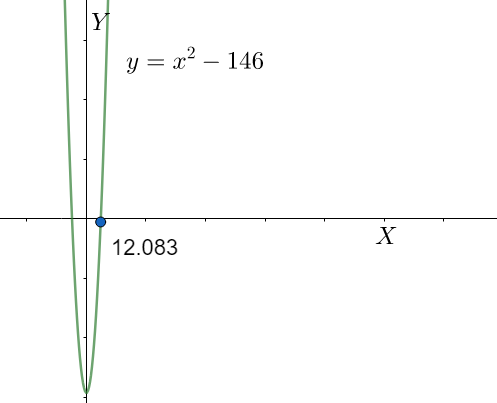
Note: The square root of $146$ can also be found out using the graphical method. We draw the graph of $y={{x}^{2}}-146$ and then find the values of x where the function becomes zero. We take only the positive root which is $12.083$ .
Complete step-by-step solution:
Indices are a representation of repetitive multiplication of the same kind. Repetitive multiplication if shown in the form $a\times a\times a\times a\times ....$ will become tedious and time taking. So, in order to avoid it, we have implemented the indices representation. Here, we represent the original number with the number of multiplications written as a superscript. For example, three times multiplication of two will be $2\times 2\times 2$ which can be written as ${{2}^{3}}$ . Indices can be called as an operation of numbers. The inverse operation of indices is called square rooting, cube rooting and so on. Square rooting means to break down a number into two other similar numbers such that their product gives the original number. For example, the square root of $4$ gives $2$ since $2\times 2$ implies $4$ .
In square rooting, we use prime factorisation to break down a number into its prime factors. Prime factorisation gives the product of prime factors. For example, the prime factorisation of $146$ gives,
\[\begin{align}
& 2\left| \!{\underline {\,
146 \,}} \right. \\
& \left| \!{\underline {\,
73 \,}} \right. \\
\end{align}\]
Which can be written as $2\times 73$ . After square rooting, clearly it gives $\sqrt{2}\times \sqrt{73}$ . But it can be written in decimals as $1.414\times 8.544=12.083$ .
Therefore, we can conclude that the square root of $146$ is $12.083$ .
Note: The square root of $146$ can also be found out using the graphical method. We draw the graph of $y={{x}^{2}}-146$ and then find the values of x where the function becomes zero. We take only the positive root which is $12.083$ .

Recently Updated Pages
Master Class 11 English: Engaging Questions & Answers for Success

Master Class 11 Social Science: Engaging Questions & Answers for Success
Master Class 11 Maths: Engaging Questions & Answers for Success
Master Class 11 Biology: Engaging Questions & Answers for Success
Master Class 11 Physics: Engaging Questions & Answers for Success
Master Class 11 Chemistry: Engaging Questions & Answers for Success
Trending doubts
In Indian rupees 1 trillion is equal to how many c class 8 maths CBSE
What is BLO What is the full form of BLO class 8 social science CBSE
What are the 12 elements of nature class 8 chemistry CBSE
Citizens of India can vote at the age of A 18 years class 8 social science CBSE
Which of the following leader has given the term insensate class 8 social science CBSE
Name the states through which the Tropic of Cancer class 8 social science CBSE