




What is the specialty of gymnosperms?
Answer
 Verified
602.7k+ views
Hint: The gymnosperm means ‘naked seed’ and they were described back in 300 BC by Theophrastus as unprotected seeds.
Complete step by step answer: Goebal stated gymnosperms as seeds without ovaries. It is believed that gymnosperms evolved from non-seed producing fern-like plants approximately 300 million years ago. Gymnosperms are also considered the predominant species on Earth’s surface during the Jurassic and Cretaceous periods of the Mesozoic era.
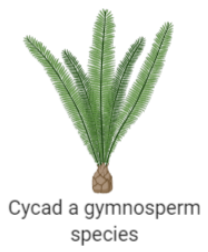
They are opposite to flower producing Angiosperms in their morphology. They are spread around almost all terrestrial types including temperate, tropical, and arctic regions of the world. The special property of gymnosperms is that the ovules are borne naked means the ovary wall is absent. Another characteristic feature of gymnosperms is the presence of leaf scars on their stem. The gymnosperms are vascular plants having their seed not enclosed by an ovary. Woody plants, shrubs, or some climbers are included in gymnosperms. Some of the species are deciduous while other species are evergreen. The largest living known gymnosperm is Sequoia sempervirens which is also called California or Coast redwood. It reaches a height of around 112 m. The smallest gymnosperm species known till now is Zamia pygmaea. It is about 25 cm tall. A gymnosperm named Taxodium mexicanum has a diameter of 17 meters. The Bristlecone pine species of a gymnosperm is regarded as the oldest living organism. It has a lifespan of around 5000 years. The gymnosperms are the most interesting plant species having a variety of uniquely characterized species.
Note: The gymnosperms are considered ancient species. They reproduce by vegetative as well as the sexual mode of reproduction. Some gymnosperms show symbiotic relations with algae and fungi.
Complete step by step answer: Goebal stated gymnosperms as seeds without ovaries. It is believed that gymnosperms evolved from non-seed producing fern-like plants approximately 300 million years ago. Gymnosperms are also considered the predominant species on Earth’s surface during the Jurassic and Cretaceous periods of the Mesozoic era.
They are opposite to flower producing Angiosperms in their morphology. They are spread around almost all terrestrial types including temperate, tropical, and arctic regions of the world. The special property of gymnosperms is that the ovules are borne naked means the ovary wall is absent. Another characteristic feature of gymnosperms is the presence of leaf scars on their stem. The gymnosperms are vascular plants having their seed not enclosed by an ovary. Woody plants, shrubs, or some climbers are included in gymnosperms. Some of the species are deciduous while other species are evergreen. The largest living known gymnosperm is Sequoia sempervirens which is also called California or Coast redwood. It reaches a height of around 112 m. The smallest gymnosperm species known till now is Zamia pygmaea. It is about 25 cm tall. A gymnosperm named Taxodium mexicanum has a diameter of 17 meters. The Bristlecone pine species of a gymnosperm is regarded as the oldest living organism. It has a lifespan of around 5000 years. The gymnosperms are the most interesting plant species having a variety of uniquely characterized species.
Note: The gymnosperms are considered ancient species. They reproduce by vegetative as well as the sexual mode of reproduction. Some gymnosperms show symbiotic relations with algae and fungi.
Recently Updated Pages
Master Class 11 Social Science: Engaging Questions & Answers for Success

Master Class 11 English: Engaging Questions & Answers for Success
Master Class 11 Maths: Engaging Questions & Answers for Success
Master Class 11 Chemistry: Engaging Questions & Answers for Success
Master Class 11 Biology: Engaging Questions & Answers for Success
Master Class 11 Physics: Engaging Questions & Answers for Success
Trending doubts
Differentiate between an exothermic and an endothermic class 11 chemistry CBSE
One Metric ton is equal to kg A 10000 B 1000 C 100 class 11 physics CBSE
Difference Between Prokaryotic Cells and Eukaryotic Cells
There are 720 permutations of the digits 1 2 3 4 5 class 11 maths CBSE
Draw a diagram of a plant cell and label at least eight class 11 biology CBSE
Two of the body parts which do not appear in MRI are class 11 biology CBSE