




What is the purpose of a splint?
Answer
 Verified
509.7k+ views
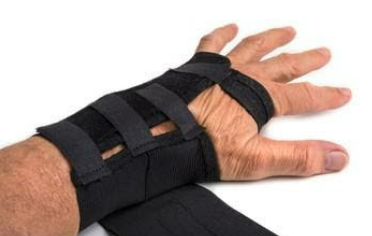
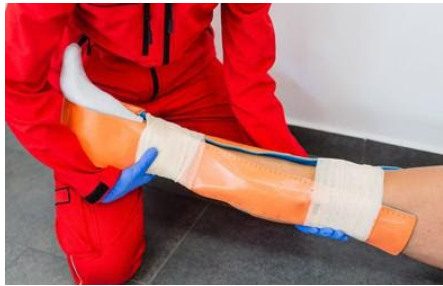
Hint: These are the medical aids that are used when someone suffers fractures. We all may have seen this and may have known it with various local and other names. Fractures are caused when the bones of our body break into two or more parts due to an accident or excess strength. The below diagram will help you to recall and clarify what is a splint.
Complete answer:
When a bone gets fractured in a limb, the easiest way to avoid displacement of the broken bone and promote healing is to splint the limb.
Splinting actually immobilizes the parts of the broken bone and thus allows them to join faster and speeds up healing. If no splint is used, then the broken parts may not join securely, and may be susceptible to break again when applied pressure due to daily activities.
Splinting also supports the muscles of the affected area, and reduces pain and swelling due to inflammation.
Splints are not always used in every fracture case. Sometimes plastering the fractured area is enough, especially for young age groups. But in middle and old-aged people, splints should be provided because their healing capacity is not so good and without splinting, the fractured part may get dislocated and result in improper joining of the bones.
Note:
Some learners may misunderstand splints with the diagram that is provided below:
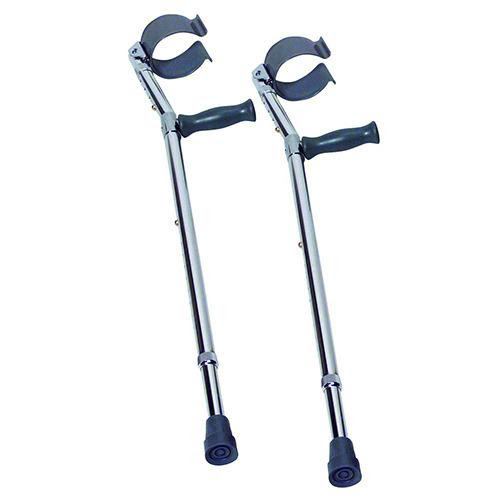
These are called crutches. These are supporting structures for a person who has broken his/her legs and helps them to walk. These do not help the fractured part of the leg to heal and are just supportive gears for walking. Splints are the aids that help in effective healing of the bone. This should be kept in mind.
Complete answer:
When a bone gets fractured in a limb, the easiest way to avoid displacement of the broken bone and promote healing is to splint the limb.
Splinting actually immobilizes the parts of the broken bone and thus allows them to join faster and speeds up healing. If no splint is used, then the broken parts may not join securely, and may be susceptible to break again when applied pressure due to daily activities.
Splinting also supports the muscles of the affected area, and reduces pain and swelling due to inflammation.
Splints are not always used in every fracture case. Sometimes plastering the fractured area is enough, especially for young age groups. But in middle and old-aged people, splints should be provided because their healing capacity is not so good and without splinting, the fractured part may get dislocated and result in improper joining of the bones.
Note:
Some learners may misunderstand splints with the diagram that is provided below:
These are called crutches. These are supporting structures for a person who has broken his/her legs and helps them to walk. These do not help the fractured part of the leg to heal and are just supportive gears for walking. Splints are the aids that help in effective healing of the bone. This should be kept in mind.
Recently Updated Pages
Master Class 11 English: Engaging Questions & Answers for Success

Master Class 11 Maths: Engaging Questions & Answers for Success
Class 11 Question and Answer - Your Ultimate Solutions Guide
Master Class 11 Biology: Engaging Questions & Answers for Success
Master Class 11 Physics: Engaging Questions & Answers for Success
Master Class 11 Accountancy: Engaging Questions & Answers for Success
Trending doubts
Differentiate between an exothermic and an endothermic class 11 chemistry CBSE
One Metric ton is equal to kg A 10000 B 1000 C 100 class 11 physics CBSE
Difference Between Prokaryotic Cells and Eukaryotic Cells
There are 720 permutations of the digits 1 2 3 4 5 class 11 maths CBSE
Draw a diagram of a plant cell and label at least eight class 11 biology CBSE
1 Quintal is equal to a 110 kg b 10 kg c 100kg d 1000 class 11 physics CBSE