




What is the Lewis structure of \[S{{O}_{2}}\]?
Answer
 Verified
560.4k+ views
Hint: Covalent bond is formed by the sharing of electrons between the two atoms. The octet rule illustrates that the two atoms combine to each other either by transfer of electrons or by sharing of electrons to have an octet (8 electrons) in their Valence shells. Both \[S\] and \[O\] have six electrons in their valence shell.
Complete answer:
In order to draw the Lewis structure of \[S{{O}_{2}}\], first we have to calculate the total number of valence electrons in \[S{{O}_{2}}\] molecule.
\[Total\;no.\;of\;valence\;electrons\\
=valence\;electrons\;of\;S+2\times (valence\;electrons\;of\;O)\]
\[Total\;no.\;of\;valence\;electrons=6+2\times (6)\]
\[Total\;no.\;of\;valence\;electrons=18\]
Herein \[S\] is a central atom and oxygen can make a maximum of two covalent bonds (because of the absence of d-orbitals). Therefore, the structure will be
$ O=S=O$
Now, in order to complete their respective octets, sulfur should have one nonbonding pair of electrons and each oxygen atom should have two nonbonding pairs of electrons. Therefore, the Lewis structure of \[S{{O}_{2}}\] molecule is
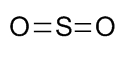
For calculating the formal charge on each atom i.e. \[S\] and \[O\], we have to use the following formula:
\[formal\;charge=valence\;electrons-non\;bonding\;electrons-\dfrac{bonding\;electrons}{2}\]
Therefore, \[formal\; charge\;on\;S=6-2-\dfrac{8}{2}=0\]
\[formal\;charge\;on\;O=6-4-\dfrac{4}{2}=0\]
Additional information: There are two types of bonds which include covalent and ionic bonds. An ionic bond is formed by the transfer of electrons i.e. one atom loses the electrons and another atom accepts the electron. For example: \[NaCl\]. On the other hand, covalent bonds are formed by sharing of electrons. Apart from these, there is one more type of bond which is called the coordinate bond in which sharing of electrons takes place between two atoms but both electrons are given by one atom.
Note:
It is important to note that the Lewis structure of \[S{{O}_{2}}\] contains four covalent bonds. In order to complete their octets, sulfur has one non-bonding pair of electrons while each oxygen has two nonbonding pairs of electrons. The formal charge on each atom i.e. sulfur and oxygen is zero.
Complete answer:
In order to draw the Lewis structure of \[S{{O}_{2}}\], first we have to calculate the total number of valence electrons in \[S{{O}_{2}}\] molecule.
\[Total\;no.\;of\;valence\;electrons\\
=valence\;electrons\;of\;S+2\times (valence\;electrons\;of\;O)\]
\[Total\;no.\;of\;valence\;electrons=6+2\times (6)\]
\[Total\;no.\;of\;valence\;electrons=18\]
Herein \[S\] is a central atom and oxygen can make a maximum of two covalent bonds (because of the absence of d-orbitals). Therefore, the structure will be
$ O=S=O$
Now, in order to complete their respective octets, sulfur should have one nonbonding pair of electrons and each oxygen atom should have two nonbonding pairs of electrons. Therefore, the Lewis structure of \[S{{O}_{2}}\] molecule is
For calculating the formal charge on each atom i.e. \[S\] and \[O\], we have to use the following formula:
\[formal\;charge=valence\;electrons-non\;bonding\;electrons-\dfrac{bonding\;electrons}{2}\]
Therefore, \[formal\; charge\;on\;S=6-2-\dfrac{8}{2}=0\]
\[formal\;charge\;on\;O=6-4-\dfrac{4}{2}=0\]
Additional information: There are two types of bonds which include covalent and ionic bonds. An ionic bond is formed by the transfer of electrons i.e. one atom loses the electrons and another atom accepts the electron. For example: \[NaCl\]. On the other hand, covalent bonds are formed by sharing of electrons. Apart from these, there is one more type of bond which is called the coordinate bond in which sharing of electrons takes place between two atoms but both electrons are given by one atom.
Note:
It is important to note that the Lewis structure of \[S{{O}_{2}}\] contains four covalent bonds. In order to complete their octets, sulfur has one non-bonding pair of electrons while each oxygen has two nonbonding pairs of electrons. The formal charge on each atom i.e. sulfur and oxygen is zero.
Recently Updated Pages
Which of the following graphs shows the variation of class 12 physics CBSE

Draw a labelled diagram of the human male reproductive class 12 biology CBSE
Describe the experiment to compare the emf of two cells class 12 physics CBSE
What is standard hydrogen electrode
What is conventional current and electric current class 12 physics CBSE
2Bromopentane is treated with an alcoholic KOH solution class 12 chemistry CBSE
Trending doubts
Draw a labelled sketch of the human eye class 12 physics CBSE
Which are the Top 10 Largest Countries of the World?
A member of Simon commission later became Prime Minister class 12 social science CBSE
Differentiate between homogeneous and heterogeneous class 12 chemistry CBSE
Draw ray diagrams each showing i myopic eye and ii class 12 physics CBSE
Which is the correct genotypic ratio of mendel dihybrid class 12 biology CBSE