




What is the domain of \[y=\sqrt{4-{{x}^{2}}}\]?
Answer
 Verified
541.8k+ views
Hint: In this problem, we have to find the domain of the given function \[y=\sqrt{4-{{x}^{2}}}\]. Here we can first find the x-intercept and the y-intercept, we can then plot them in the graph to find where the function is defined. We can then write the domain of the given function.
Complete step-by-step solution:
Here we have to find the domain of the given function \[y=\sqrt{4-{{x}^{2}}}\].
We can now find the x-intercept and the y-intercept for the given function.
We know that at x-intercept the value of y is 0 and at y-intercept the value of x is 0. By using this, we can find the intercepts value.
We can now find the point at x, where y is 0.
\[\begin{align}
& \Rightarrow 0=4-{{x}^{2}}=\left( 2+x \right)\left( 2-x \right) \\
& \Rightarrow x=\pm 2 \\
\end{align}\]
The x-intercept is at \[\left( 2,0 \right),\left( -2,0 \right)\].
We can now find the y-intercept, where x is 0.
\[\Rightarrow y=\sqrt{4-0}=2\]
The y-intercept is at \[\left( 0,2 \right)\].
We can now plot the points in the graph for the given semicircle equation.
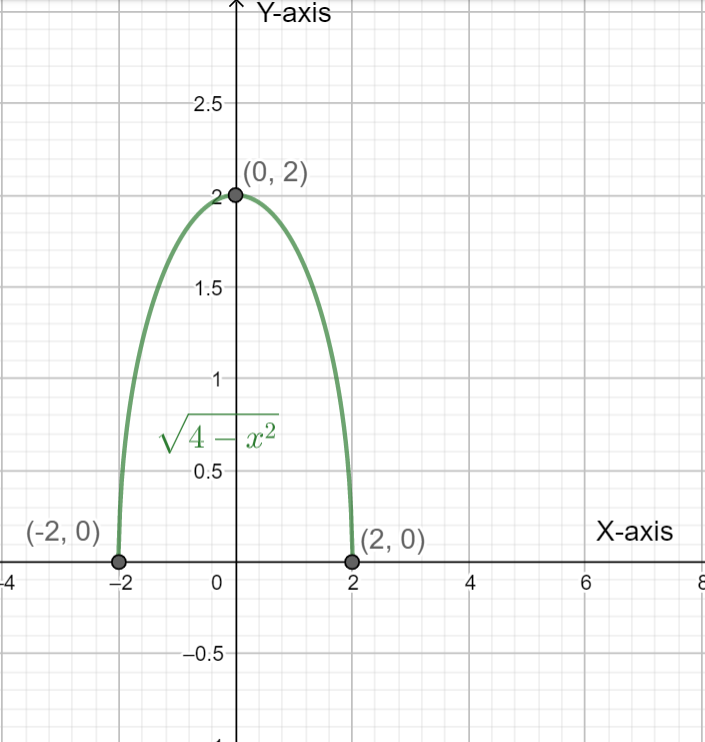
We can now see that the domain is \[-2\le x\le 2\].
Therefore, the required domain is \[\left[ -2,2 \right]\].
Note: We should always remember that at x-intercept the value of y is 0 and at y-intercept the value of x is 0. We should know that the domain of the function is the set of all possible values which qualify as input to a function or we can say it as the entire set of values possible for independent variables.
Complete step-by-step solution:
Here we have to find the domain of the given function \[y=\sqrt{4-{{x}^{2}}}\].
We can now find the x-intercept and the y-intercept for the given function.
We know that at x-intercept the value of y is 0 and at y-intercept the value of x is 0. By using this, we can find the intercepts value.
We can now find the point at x, where y is 0.
\[\begin{align}
& \Rightarrow 0=4-{{x}^{2}}=\left( 2+x \right)\left( 2-x \right) \\
& \Rightarrow x=\pm 2 \\
\end{align}\]
The x-intercept is at \[\left( 2,0 \right),\left( -2,0 \right)\].
We can now find the y-intercept, where x is 0.
\[\Rightarrow y=\sqrt{4-0}=2\]
The y-intercept is at \[\left( 0,2 \right)\].
We can now plot the points in the graph for the given semicircle equation.
We can now see that the domain is \[-2\le x\le 2\].
Therefore, the required domain is \[\left[ -2,2 \right]\].
Note: We should always remember that at x-intercept the value of y is 0 and at y-intercept the value of x is 0. We should know that the domain of the function is the set of all possible values which qualify as input to a function or we can say it as the entire set of values possible for independent variables.
Recently Updated Pages
Master Class 11 Social Science: Engaging Questions & Answers for Success

Master Class 11 Physics: Engaging Questions & Answers for Success
Master Class 11 Maths: Engaging Questions & Answers for Success
Master Class 11 Economics: Engaging Questions & Answers for Success
Master Class 11 Computer Science: Engaging Questions & Answers for Success
Master Class 11 Chemistry: Engaging Questions & Answers for Success
Trending doubts
One Metric ton is equal to kg A 10000 B 1000 C 100 class 11 physics CBSE
There are 720 permutations of the digits 1 2 3 4 5 class 11 maths CBSE
1 Quintal is equal to a 110 kg b 10 kg c 100kg d 1000 class 11 physics CBSE
State and prove Bernoullis theorem class 11 physics CBSE
Difference Between Prokaryotic Cells and Eukaryotic Cells
Which among the following are examples of coming together class 11 social science CBSE