




What is the derivative of \[XY\] ?
Answer
 Verified
539.1k+ views
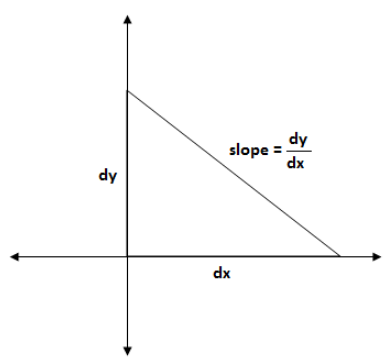
Hint:To find the derivative we can use the slope formula, that is \[slope=\dfrac{dy}{dx}\]. \[dy\] is the changes in \[Y\]and \[dx\] is the changes in \[X\].
To find the derivative of two variables in multiplication, this formula is used
\[\dfrac{d}{dx}(uv)=u\dfrac{d}{dx}(v)+v\dfrac{d}{dx}(u)\]
Mechanically, \[\dfrac{d}{dx}(f(x))\] measures the rate of change of \[f(x)\] with respect to \[x\].Differentiation of any constant is zero. Differentiation of constant and a function is equal to constant times the differentiation of the function.
Complete step by step answer:
Let us derivate \[XY\] with respect to \[X\]. Using the derivative formula,
\[\dfrac{d}{dx}(uv)=u\dfrac{d}{dx}(v)+v\dfrac{d}{dx}(u)\]
Substituting the terms
\[\dfrac{d}{dX}(XY)=X\dfrac{d}{dX}Y+Y\dfrac{d}{dX}X\]
The differentiation of \[X\] with respect to \[X\] is given by
\[\dfrac{d}{dX}X=1\]
As the derivation of the function is with respect to \[X\] , the variable \[Y\] cannot be differentiable. \[Y\] is not constant.
The derivative of \[XY\] with respect to \[X\] is
\[\dfrac{d}{dX}(XY)=X\dfrac{d}{dX}Y+Y\]
Let us derivate \[XY\] with respect to \[Y\].Using the derivative formula,
\[\dfrac{d}{dx}(uv)=u\dfrac{d}{dx}(v)+v\dfrac{d}{dx}(u)\]
Substituting the terms
\[\dfrac{d}{dY}(XY)=X\dfrac{d}{dY}Y+Y\dfrac{d}{dY}X\]
The differentiation of \[Y\] with respect to \[Y\] is given by
\[\dfrac{d}{dY}Y=1\]
As the derivation of the function is with respect to \[Y\], the variable \[X\] cannot be differentiable. \[X\] is not constant.
The derivative of \[XY\] with respect to \[Y\] is
\[\therefore \dfrac{d}{dY}(XY)=X+Y\dfrac{d}{dY}X\]
Note: \[\dfrac{d}{dx}(f(x))=\underset{h\to 0}{\mathop{\lim }}\,\dfrac{f(x+h)-f(x)}{h}\] is the formula for finding the derivative from the first principles. The slope is the rate of change of \[y\] with respect to \[x\] that means if \[x\] is increased by an additional unit the change in \[y\] is given by \[\dfrac{dy}{dx}\] . Let us understand with an example, the rate of change of displacement of an object is defined as the velocity \[Km/hr~\] that means when time is increased by one hour the displacement changes by \[Km\]. For solving derivative problems different techniques of differentiation must be known.
To find the derivative of two variables in multiplication, this formula is used
\[\dfrac{d}{dx}(uv)=u\dfrac{d}{dx}(v)+v\dfrac{d}{dx}(u)\]
Mechanically, \[\dfrac{d}{dx}(f(x))\] measures the rate of change of \[f(x)\] with respect to \[x\].Differentiation of any constant is zero. Differentiation of constant and a function is equal to constant times the differentiation of the function.
Complete step by step answer:
Let us derivate \[XY\] with respect to \[X\]. Using the derivative formula,
\[\dfrac{d}{dx}(uv)=u\dfrac{d}{dx}(v)+v\dfrac{d}{dx}(u)\]
Substituting the terms
\[\dfrac{d}{dX}(XY)=X\dfrac{d}{dX}Y+Y\dfrac{d}{dX}X\]
The differentiation of \[X\] with respect to \[X\] is given by
\[\dfrac{d}{dX}X=1\]
As the derivation of the function is with respect to \[X\] , the variable \[Y\] cannot be differentiable. \[Y\] is not constant.
The derivative of \[XY\] with respect to \[X\] is
\[\dfrac{d}{dX}(XY)=X\dfrac{d}{dX}Y+Y\]
Let us derivate \[XY\] with respect to \[Y\].Using the derivative formula,
\[\dfrac{d}{dx}(uv)=u\dfrac{d}{dx}(v)+v\dfrac{d}{dx}(u)\]
Substituting the terms
\[\dfrac{d}{dY}(XY)=X\dfrac{d}{dY}Y+Y\dfrac{d}{dY}X\]
The differentiation of \[Y\] with respect to \[Y\] is given by
\[\dfrac{d}{dY}Y=1\]
As the derivation of the function is with respect to \[Y\], the variable \[X\] cannot be differentiable. \[X\] is not constant.
The derivative of \[XY\] with respect to \[Y\] is
\[\therefore \dfrac{d}{dY}(XY)=X+Y\dfrac{d}{dY}X\]
Note: \[\dfrac{d}{dx}(f(x))=\underset{h\to 0}{\mathop{\lim }}\,\dfrac{f(x+h)-f(x)}{h}\] is the formula for finding the derivative from the first principles. The slope is the rate of change of \[y\] with respect to \[x\] that means if \[x\] is increased by an additional unit the change in \[y\] is given by \[\dfrac{dy}{dx}\] . Let us understand with an example, the rate of change of displacement of an object is defined as the velocity \[Km/hr~\] that means when time is increased by one hour the displacement changes by \[Km\]. For solving derivative problems different techniques of differentiation must be known.
Recently Updated Pages
Master Class 12 Business Studies: Engaging Questions & Answers for Success

Master Class 12 Chemistry: Engaging Questions & Answers for Success
Master Class 12 Biology: Engaging Questions & Answers for Success
Class 12 Question and Answer - Your Ultimate Solutions Guide
Master Class 11 Social Science: Engaging Questions & Answers for Success
Master Class 11 Chemistry: Engaging Questions & Answers for Success
Trending doubts
Which are the Top 10 Largest Countries of the World?
Draw a labelled sketch of the human eye class 12 physics CBSE
Name the crygenes that control cotton bollworm and class 12 biology CBSE
Differentiate between homogeneous and heterogeneous class 12 chemistry CBSE
Ribosomal RNA is actively synthesised in A Nucleoplasm class 12 biology CBSE
How many molecules of ATP and NADPH are required information class 12 biology CBSE