




What is SONAR? Explain its working.
Answer
 Verified
634.8k+ views
Hint: Try to understand what is SONAR and in what processes we use this instrument. Learn about the ultrasound and how we use this in a SONAR to determine the depth of sea or any underwater objects.
Complete step by step answer:
SONAR is a technique with the help of which we can determine the depth and direction of underwater objects. SONAR is the acronym for Sound Navigation and Ranging.
The working principle of SONAR is the detection of sound waves emitted or reflected from objects and then finding the distance. The SONAR uses the ultrasound to measure the distances to the objects.
An ultrasound is a high frequency sound with frequency above 20000 Hz. We use ultrasound because it has a very high frequency and hence very small wavelength and very high energy.
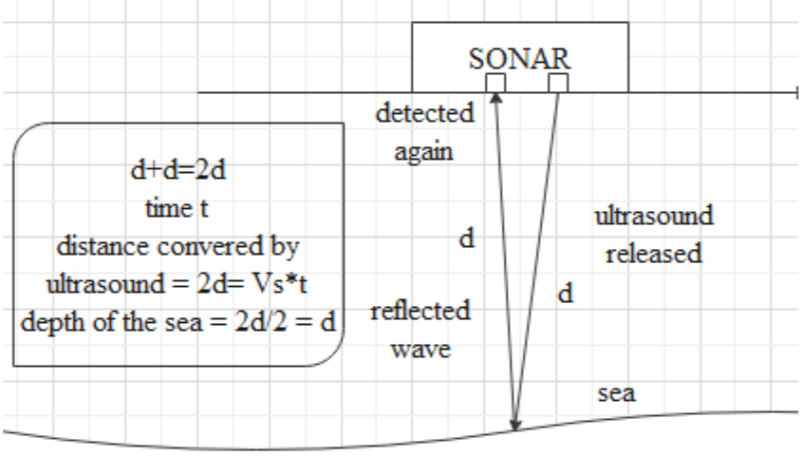
A SONAR releases the ultrasound in the surface of the sea and then the ultrasound is reflected back at the bottom of the sea or from objects underneath to the SONAR again. It will detect the reflected ultrasound and measure the time difference from release of the ultrasound to the detection of ultrasound. Since, sound has a definite velocity in water it will measure the distance travelled by the sound wave. This way we will get the distance the sound wave travelled.
But here the ultrasound travelled the same path twice – first when it is going down and second when it is reflected back to the SONAR. So, we will divide the distance obtained to get the original depth of the see or depth of any object.
Note: We use ultrasonic waves in sonar because ultrasonic waves have a very high frequency and hence a very high energy, because of which it can penetrate water to a very long distance. We don’t use infrasound or other sound waves because the energy of these waves is very low.
Complete step by step answer:
SONAR is a technique with the help of which we can determine the depth and direction of underwater objects. SONAR is the acronym for Sound Navigation and Ranging.
The working principle of SONAR is the detection of sound waves emitted or reflected from objects and then finding the distance. The SONAR uses the ultrasound to measure the distances to the objects.
An ultrasound is a high frequency sound with frequency above 20000 Hz. We use ultrasound because it has a very high frequency and hence very small wavelength and very high energy.
A SONAR releases the ultrasound in the surface of the sea and then the ultrasound is reflected back at the bottom of the sea or from objects underneath to the SONAR again. It will detect the reflected ultrasound and measure the time difference from release of the ultrasound to the detection of ultrasound. Since, sound has a definite velocity in water it will measure the distance travelled by the sound wave. This way we will get the distance the sound wave travelled.
But here the ultrasound travelled the same path twice – first when it is going down and second when it is reflected back to the SONAR. So, we will divide the distance obtained to get the original depth of the see or depth of any object.
Note: We use ultrasonic waves in sonar because ultrasonic waves have a very high frequency and hence a very high energy, because of which it can penetrate water to a very long distance. We don’t use infrasound or other sound waves because the energy of these waves is very low.
Recently Updated Pages
Master Class 12 Business Studies: Engaging Questions & Answers for Success

Master Class 12 Chemistry: Engaging Questions & Answers for Success
Master Class 12 Biology: Engaging Questions & Answers for Success
Class 12 Question and Answer - Your Ultimate Solutions Guide
Master Class 11 English: Engaging Questions & Answers for Success
Master Class 11 Social Science: Engaging Questions & Answers for Success
Trending doubts
Which are the Top 10 Largest Countries of the World?
Draw a labelled sketch of the human eye class 12 physics CBSE
The end of compass needle which points towards north class 12 physics CBSE
Differentiate between homogeneous and heterogeneous class 12 chemistry CBSE
In order to find out the different types of gametes class 12 biology NEET_UG
Why is the cell called the structural and functional class 12 biology CBSE