




What is S in 70S?
Answer
 Verified
617.4k+ views
Hint:-70S is a very common term used in cytology indicating ribosome sizes. Ribosomes are cellular organelles present in both plant cells and animal cells. It performs protein synthesis in the cells. Ribosomes are of different sizes in eukaryotes and prokaryotes.
Complete step-by-step solution:-
DNA contains a sequence of codes that ultimately results in the formation of a protein. However, first the codes are transcribed onto a messenger RNA or mRNA. Ribosomes bind to the mRNA and help in formation of the protein chain by linking the amino acids.
Ribosomes comprise two subunits bound to each other. The subunits act together and translate the mRNA to proteins. The ribosomal subunits are measured by a unit called Svedberg, abbreviated as S. It is a measure sedimentation of the particles during centrifugation. Prokaryotic ribosomes have 30S and 50S subunits, while Eukaryotes have 40S and 60S subunits. Svedberg units depend on the size, shape and density of particles. Since Svedberg is a non-additive component, subunit sizes of ribosomes do not add up. For example, in eukaryotes, the ribosomes size is 80S, but the sub units measure 40S and 60S.
The Svedberg unit is named after Theodor Svedberg, a chemist who won the Nobel Prize in acknowledgement of his work with colloids, and most importantly for the invention of the ultracentrifuge. Smaller particles tend to sediment slowly and have lower coefficients while bigger particles sediment faster and have coefficient values.
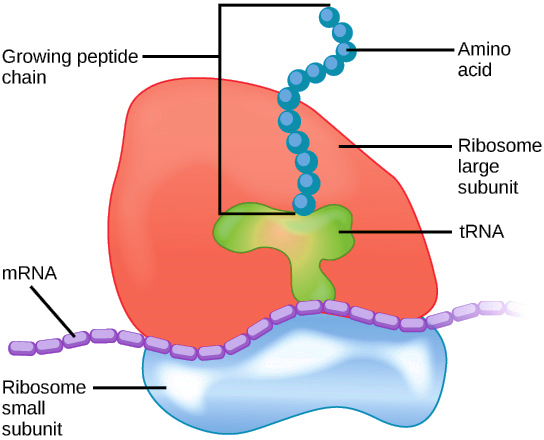
Fig: Schematic representation of a ribosome making a polypeptide chain
Additional Information:
Ribosomes are protein Synthesis machineries found in both plant and animal cells. ribosomes were discovered by cell biologist Palade, and named by scientist Richard Roberts. The ribosomes of prokaryotes and eukaryotes differ in their sizes and sequences, but have common origin and structure. The ribosomes function to form functional polypeptide chains of proteins. These chains are composed of amino acids in a particular sequence. Apart from ribosomes in the cytoplasm of a cell, mitochondria and plastids (only in plants) also contain ribosomes. These ribosomes are similar to cytoplasmic ribosomes.
Note:- in 70S stands for Svedberg. It is a non-metric unit used to determine sedimentation coefficient of particles. The measure of the particle is based on the rate at which the particle sediments in centrifugation. Ribosomes comprises a smaller subunit and a larger subunit – both measured in Svedberg units.
Complete step-by-step solution:-
DNA contains a sequence of codes that ultimately results in the formation of a protein. However, first the codes are transcribed onto a messenger RNA or mRNA. Ribosomes bind to the mRNA and help in formation of the protein chain by linking the amino acids.
Ribosomes comprise two subunits bound to each other. The subunits act together and translate the mRNA to proteins. The ribosomal subunits are measured by a unit called Svedberg, abbreviated as S. It is a measure sedimentation of the particles during centrifugation. Prokaryotic ribosomes have 30S and 50S subunits, while Eukaryotes have 40S and 60S subunits. Svedberg units depend on the size, shape and density of particles. Since Svedberg is a non-additive component, subunit sizes of ribosomes do not add up. For example, in eukaryotes, the ribosomes size is 80S, but the sub units measure 40S and 60S.
The Svedberg unit is named after Theodor Svedberg, a chemist who won the Nobel Prize in acknowledgement of his work with colloids, and most importantly for the invention of the ultracentrifuge. Smaller particles tend to sediment slowly and have lower coefficients while bigger particles sediment faster and have coefficient values.
Fig: Schematic representation of a ribosome making a polypeptide chain
Additional Information:
Ribosomes are protein Synthesis machineries found in both plant and animal cells. ribosomes were discovered by cell biologist Palade, and named by scientist Richard Roberts. The ribosomes of prokaryotes and eukaryotes differ in their sizes and sequences, but have common origin and structure. The ribosomes function to form functional polypeptide chains of proteins. These chains are composed of amino acids in a particular sequence. Apart from ribosomes in the cytoplasm of a cell, mitochondria and plastids (only in plants) also contain ribosomes. These ribosomes are similar to cytoplasmic ribosomes.
Note:- in 70S stands for Svedberg. It is a non-metric unit used to determine sedimentation coefficient of particles. The measure of the particle is based on the rate at which the particle sediments in centrifugation. Ribosomes comprises a smaller subunit and a larger subunit – both measured in Svedberg units.
Recently Updated Pages
Master Class 12 Business Studies: Engaging Questions & Answers for Success

Master Class 12 Biology: Engaging Questions & Answers for Success
Master Class 12 Chemistry: Engaging Questions & Answers for Success
Class 12 Question and Answer - Your Ultimate Solutions Guide
Master Class 11 English: Engaging Questions & Answers for Success
Master Class 11 Social Science: Engaging Questions & Answers for Success
Trending doubts
Which are the Top 10 Largest Countries of the World?
Draw a labelled sketch of the human eye class 12 physics CBSE
Differentiate between homogeneous and heterogeneous class 12 chemistry CBSE
Why is the cell called the structural and functional class 12 biology CBSE
Draw ray diagrams each showing i myopic eye and ii class 12 physics CBSE
Which is the correct genotypic ratio of mendel dihybrid class 12 biology CBSE