




What is Perfect Modulation?
Answer
 Verified
528.9k+ views
Hint:To avoid distortion in the modulated signal, the message signal's maximum amplitude must be smaller than (or equal to) the carrier signal's maximum amplitude. If the carrier signal has an amplitude of \[5\] volts, the message signal must have an amplitude of less than (or equal to) \[5\] volts. As a result, when \[Am{\text{ }} = {\text{ }}Ac\], the modulation index's maximum value will be less than or equal to one (\[Mi < = 1\]). The modulation index will have a minimum value of zero.
Based on this, there are \[3\] types of modulation:
Perfect-Modulation
Under-Modulation
Over-Modulation
Complete step-by-step solution:
Perfect modulation:
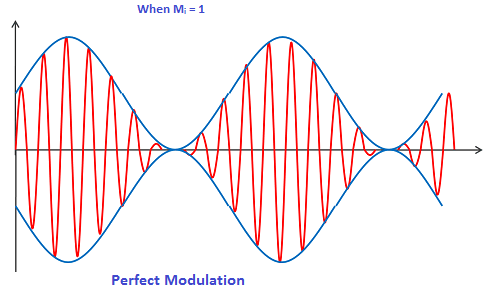
When the message signal or modulating signal, maximum amplitude is approximately equal to the carrier signal's maximum amplitude (\[Am{\text{ }} = {\text{ }}Ac\]), perfect-modulation occurs.
The modulation index is the ratio of the message signal's maximum amplitude to the carrier signal's maximum amplitude. For example, if the maximum amplitude of the message signal is \[4\] volts and the maximum amplitude of the carrier signal is also \[4\] volts, the modulating signal amplitude (\[4\] volts) to the carrier signal amplitude (\[4\] volts) ratio is\[1\]. As a result, with perfect-modulation, the modulation index is one (\[Mi{\text{ }} = {\text{ }}1\]).
The modulation depth is another name for the modulation index. The modulation depth of the perfect-modulation is\[100\% \]. The carrier level in perfect-modulation drops to $0$. There is no distortion with perfect modulation.
Note:Modulation benefits:
The size of the antenna was reduced.
There is no signal mixing.
The range of communication expands.
The transmissions multiplexed.
It is possible to change the bandwidth.
The quality of the reception improves.
Based on this, there are \[3\] types of modulation:
Perfect-Modulation
Under-Modulation
Over-Modulation
Complete step-by-step solution:
Perfect modulation:
When the message signal or modulating signal, maximum amplitude is approximately equal to the carrier signal's maximum amplitude (\[Am{\text{ }} = {\text{ }}Ac\]), perfect-modulation occurs.
The modulation index is the ratio of the message signal's maximum amplitude to the carrier signal's maximum amplitude. For example, if the maximum amplitude of the message signal is \[4\] volts and the maximum amplitude of the carrier signal is also \[4\] volts, the modulating signal amplitude (\[4\] volts) to the carrier signal amplitude (\[4\] volts) ratio is\[1\]. As a result, with perfect-modulation, the modulation index is one (\[Mi{\text{ }} = {\text{ }}1\]).
The modulation depth is another name for the modulation index. The modulation depth of the perfect-modulation is\[100\% \]. The carrier level in perfect-modulation drops to $0$. There is no distortion with perfect modulation.
Note:Modulation benefits:
The size of the antenna was reduced.
There is no signal mixing.
The range of communication expands.
The transmissions multiplexed.
It is possible to change the bandwidth.
The quality of the reception improves.
Recently Updated Pages
Master Class 12 Business Studies: Engaging Questions & Answers for Success

Master Class 12 Biology: Engaging Questions & Answers for Success
Master Class 12 Chemistry: Engaging Questions & Answers for Success
Class 12 Question and Answer - Your Ultimate Solutions Guide
Master Class 11 Social Science: Engaging Questions & Answers for Success
Master Class 11 English: Engaging Questions & Answers for Success
Trending doubts
Which is more stable and why class 12 chemistry CBSE
Which are the Top 10 Largest Countries of the World?
Draw a labelled sketch of the human eye class 12 physics CBSE
Differentiate between homogeneous and heterogeneous class 12 chemistry CBSE
What are the major means of transport Explain each class 12 social science CBSE
Sulphuric acid is known as the king of acids State class 12 chemistry CBSE