



What is occlusion?
Answer
 Verified
597k+ views
Hint: You should know that; occlusion is a type of adsorption and adsorption is a surface phenomenon. Adsorption is further characterized into two types i.e. chemisorption and physisorption
Complete answer:
Let us first understand about the adsorption phenomenon before proceeding to describe what is occlusion.
So, when there is attracting and retaining of the molecules of a particular substance on the surface of a liquid or a solid forming into a higher concentration of the molecules on the surface is called ‘adsorption’. The substance that is adsorbed on the surface is called the ‘adsorbate’ and the surface on which the substance is absorbed is called ‘adsorbent’. In short, we can say that the substance is called as “adsorbate” while the surface is called as “adsorbent”.
The reverse process of adsorption that is the removal of particles from the surface is known as ‘desorption’.
Occlusion is the term used to define the adsorption of gases on the surface of metals. So, we can say that it is a type of adsorption where the adsorbate is the gas and metal acts as the adsorbent where the gases are adsorbed. In chemistry, occlusion is the inclusion of one substance within another. This process can occur if precipitation or crystallization occurs rapidly. For example: Water molecules get packed into a pocket at the time of silver crystal formation due to rapid crystallization. The process is shown in the below diagram:
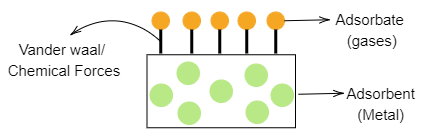
Note: There are two types of adsorption of gases on solids i.e. physisorption and chemisorption. In physisorption, weak Vander waals forces are present and this requires very small activation energy while chemisorption has chemical bond or ionic bond and requires high activation energy.
Complete answer:
Let us first understand about the adsorption phenomenon before proceeding to describe what is occlusion.
So, when there is attracting and retaining of the molecules of a particular substance on the surface of a liquid or a solid forming into a higher concentration of the molecules on the surface is called ‘adsorption’. The substance that is adsorbed on the surface is called the ‘adsorbate’ and the surface on which the substance is absorbed is called ‘adsorbent’. In short, we can say that the substance is called as “adsorbate” while the surface is called as “adsorbent”.
The reverse process of adsorption that is the removal of particles from the surface is known as ‘desorption’.
Occlusion is the term used to define the adsorption of gases on the surface of metals. So, we can say that it is a type of adsorption where the adsorbate is the gas and metal acts as the adsorbent where the gases are adsorbed. In chemistry, occlusion is the inclusion of one substance within another. This process can occur if precipitation or crystallization occurs rapidly. For example: Water molecules get packed into a pocket at the time of silver crystal formation due to rapid crystallization. The process is shown in the below diagram:
Note: There are two types of adsorption of gases on solids i.e. physisorption and chemisorption. In physisorption, weak Vander waals forces are present and this requires very small activation energy while chemisorption has chemical bond or ionic bond and requires high activation energy.
Recently Updated Pages
Master Class 12 Business Studies: Engaging Questions & Answers for Success

Master Class 12 Biology: Engaging Questions & Answers for Success
Master Class 12 Chemistry: Engaging Questions & Answers for Success
Class 12 Question and Answer - Your Ultimate Solutions Guide
Master Class 11 Social Science: Engaging Questions & Answers for Success
Master Class 11 English: Engaging Questions & Answers for Success
Trending doubts
Which is more stable and why class 12 chemistry CBSE
Which are the Top 10 Largest Countries of the World?
Draw a labelled sketch of the human eye class 12 physics CBSE
Differentiate between homogeneous and heterogeneous class 12 chemistry CBSE
What are the major means of transport Explain each class 12 social science CBSE
Sulphuric acid is known as the king of acids State class 12 chemistry CBSE