




What is mRNA?
Answer
 Verified
524.1k+ views
Hint: mRNA stands for messenger RNA. It is a single stranded RNA molecule, which is complementary to
one of the DNA strands of a gene. mRNA is the RNA version of the gene, which leaves the cell nucleus and progresses to the cytoplasm, where proteins are synthesized. During the process of protein synthesis, an organelle known as ribosome moves along with the mRNA.
Complete answer
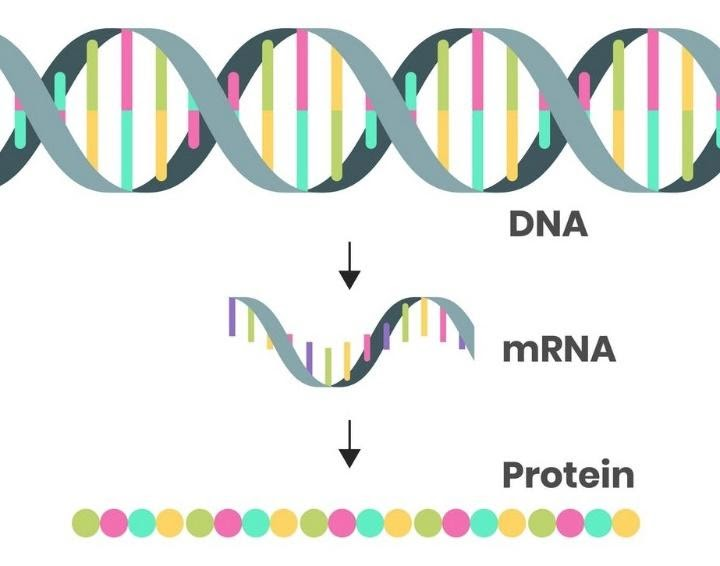
Fig: Synthesis of Protein via mRNA
Ribosome along with mRNA reads its base sequence, and utilizes the genetic code for translating each codon or three-base triplet into its respective amino acid. mRNA carries the genetic information, which are copied in the form of a series of three-base triplets or codons. Each codon is specific to a particular amino acid. Transfer RNA, also called tRNA, recognizes the codon present in the mRNA and calls for the specific amino acid involved in synthesizing the polypeptide chain. Thus, mRNA functions in providing specific binding sites for a series of specific tRNA molecules.
The principal function of mRNA is protein synthesis, which is a two-step process.
During the first step, an mRNA molecule is synthesized on a DNA molecule via the process of transcription. During the second step, the genetic information or message is translated into a linear chain of amino acids via the process of translation. Since, the mRNA is involved in carrying genetic information from nucleus to cytoplasm for the translation process, it is called messenger RNA.
During translation, along with mRNA, other forms of RNA like rRNA and tRNA also participate. rRNA is a component of ribosome and tRNA brings the amino acids for binding for complementary codon-anticodon pairing.
Note:
Generally, one gene, a DNA for a gene, is transcribed into mRNA molecule, which will end up synthesizing one specific protein. Its full form is messenger ribonucleic acid. It is also critical like DNA for the life, by playing a vital role in human biology. Currently, mRNA is used to develop a new category of medicines, by synthesizing and sequencing particular mRNA sequences for diseases.
one of the DNA strands of a gene. mRNA is the RNA version of the gene, which leaves the cell nucleus and progresses to the cytoplasm, where proteins are synthesized. During the process of protein synthesis, an organelle known as ribosome moves along with the mRNA.
Complete answer
Fig: Synthesis of Protein via mRNA
Ribosome along with mRNA reads its base sequence, and utilizes the genetic code for translating each codon or three-base triplet into its respective amino acid. mRNA carries the genetic information, which are copied in the form of a series of three-base triplets or codons. Each codon is specific to a particular amino acid. Transfer RNA, also called tRNA, recognizes the codon present in the mRNA and calls for the specific amino acid involved in synthesizing the polypeptide chain. Thus, mRNA functions in providing specific binding sites for a series of specific tRNA molecules.
The principal function of mRNA is protein synthesis, which is a two-step process.
During the first step, an mRNA molecule is synthesized on a DNA molecule via the process of transcription. During the second step, the genetic information or message is translated into a linear chain of amino acids via the process of translation. Since, the mRNA is involved in carrying genetic information from nucleus to cytoplasm for the translation process, it is called messenger RNA.
During translation, along with mRNA, other forms of RNA like rRNA and tRNA also participate. rRNA is a component of ribosome and tRNA brings the amino acids for binding for complementary codon-anticodon pairing.
Note:
Generally, one gene, a DNA for a gene, is transcribed into mRNA molecule, which will end up synthesizing one specific protein. Its full form is messenger ribonucleic acid. It is also critical like DNA for the life, by playing a vital role in human biology. Currently, mRNA is used to develop a new category of medicines, by synthesizing and sequencing particular mRNA sequences for diseases.
Recently Updated Pages
Master Class 12 Business Studies: Engaging Questions & Answers for Success

Master Class 12 Biology: Engaging Questions & Answers for Success
Master Class 12 Chemistry: Engaging Questions & Answers for Success
Class 12 Question and Answer - Your Ultimate Solutions Guide
Master Class 11 Social Science: Engaging Questions & Answers for Success
Master Class 11 English: Engaging Questions & Answers for Success
Trending doubts
Which are the Top 10 Largest Countries of the World?
Draw a labelled sketch of the human eye class 12 physics CBSE
Differentiate between homogeneous and heterogeneous class 12 chemistry CBSE
Why is the cell called the structural and functional class 12 biology CBSE
Draw ray diagrams each showing i myopic eye and ii class 12 physics CBSE
Which is the correct genotypic ratio of mendel dihybrid class 12 biology CBSE