




What is Curie temperature?
Answer
 Verified
624.6k+ views
Hint: Before understanding Curie temperature, we must know that, as temperature increases, the randomization of magnetic moments increases. This results in changes in properties of magnetic materials. Curie temperature is such a point.
Complete solution:
Now we will discuss more about Curie temperature and temperature dependence on susceptibility of materials.
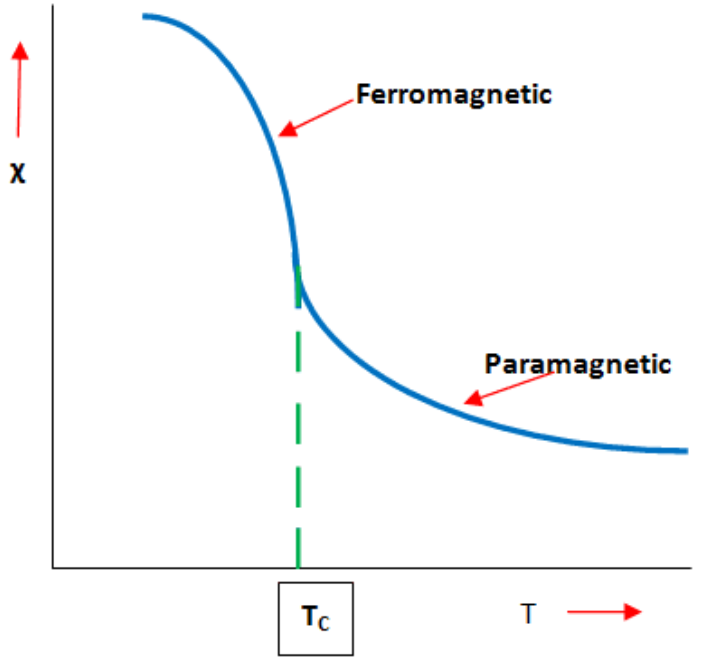
Curie temperature: it is the temperature at which a ferromagnetic material becomes paramagnetic in nature. That is, the temperature at which a magnetic material completely loses its magnetic property.
When temperature increases, randomization of magnetic moments increases which leads to decrease in magnetization \[I\]. So, the resulting magnetic field \[B\] decreases.
That means \[\chi \](susceptibility) decreases as \[T\] increases.
Curie's law states that “susceptibility of a paramagnetic substance is inversely proportional to temperature.”
i.e., \[\chi =\dfrac{c}{T}\]
In this equation, \[c\] is called Curies constant.
Now, let’s take the case of a ferromagnetic material. A ferromagnetic material has magnetic properties as its magnetic moments are aligned in a certain direction. As temperature increases, this alignment randomizes and it loses magnetic property and turns into a paramagnetic material at a certain temperature. This temperature is known as Curie temperature.
After Curie temperature, we can see the susceptibility varies as, \[\chi =\dfrac{c}{T-{{T}_{C}}}\]
Where \[{{T}_{C}}\] is a Curie temperature.
Note: We must be aware that every material has different construction of intrinsic magnetic moments that depend on temperature. So Curie temperature varies according to materials as temperature required for different materials differs.
Complete solution:
Now we will discuss more about Curie temperature and temperature dependence on susceptibility of materials.
Curie temperature: it is the temperature at which a ferromagnetic material becomes paramagnetic in nature. That is, the temperature at which a magnetic material completely loses its magnetic property.
When temperature increases, randomization of magnetic moments increases which leads to decrease in magnetization \[I\]. So, the resulting magnetic field \[B\] decreases.
That means \[\chi \](susceptibility) decreases as \[T\] increases.
Curie's law states that “susceptibility of a paramagnetic substance is inversely proportional to temperature.”
i.e., \[\chi =\dfrac{c}{T}\]
In this equation, \[c\] is called Curies constant.
Now, let’s take the case of a ferromagnetic material. A ferromagnetic material has magnetic properties as its magnetic moments are aligned in a certain direction. As temperature increases, this alignment randomizes and it loses magnetic property and turns into a paramagnetic material at a certain temperature. This temperature is known as Curie temperature.
After Curie temperature, we can see the susceptibility varies as, \[\chi =\dfrac{c}{T-{{T}_{C}}}\]
Where \[{{T}_{C}}\] is a Curie temperature.
Note: We must be aware that every material has different construction of intrinsic magnetic moments that depend on temperature. So Curie temperature varies according to materials as temperature required for different materials differs.
Recently Updated Pages
Master Class 12 Business Studies: Engaging Questions & Answers for Success

Master Class 12 Chemistry: Engaging Questions & Answers for Success
Master Class 12 Biology: Engaging Questions & Answers for Success
Class 12 Question and Answer - Your Ultimate Solutions Guide
Master Class 9 General Knowledge: Engaging Questions & Answers for Success
Master Class 9 Maths: Engaging Questions & Answers for Success
Trending doubts
Which are the Top 10 Largest Countries of the World?
Draw a labelled sketch of the human eye class 12 physics CBSE
Name the crygenes that control cotton bollworm and class 12 biology CBSE
Differentiate between homogeneous and heterogeneous class 12 chemistry CBSE
In a transcription unit the promoter is said to be class 12 biology CBSE
Sulphuric acid is known as the king of acids State class 12 chemistry CBSE