




What is blastocyst?
Answer
 Verified
591.6k+ views
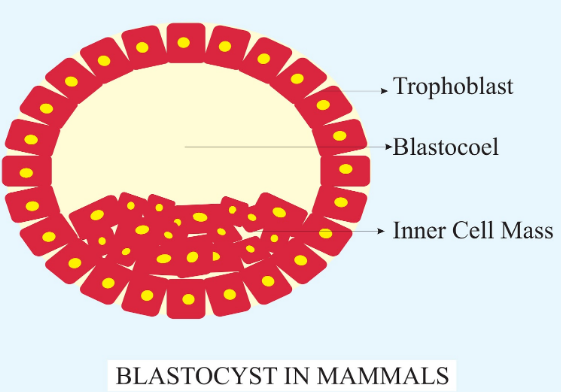
Hint: A blastocyst is formed in the early developmental stage of mammals which is a structure that possesses an inner cell mass and forms the embryo. It is surrounded by an outermost layer which is known as the trophoblast.
Complete answer:
A blastocyst is a structure that is present in mammals and is known as blastula in other animals. After the process of fertilization blastocyst forms within 5 days and it is a fluid-filled cavity that opens up in the morula which is an early embryonic stage of a ball of 16 cells. The blastocyst is composed of 200 to 300 cells and has a diameter of about 0.1-0.2 nanometres. It performs rapid cleavage cell division and undergoes implantation after 7 days of fertilization and gets embedded into the endometrium layer of the uterine wall. Gastrulation takes place followed by implantation and the blastocyst gets embedded in the endometrium which requires it to hatch from the zona pellucida which helps to resist the adherence towards the fallopian tube and make its way towards the uterus as a pre-embryo.
The blastocyst develops as a morula and keeps on dividing by entering the uterus and begins to absorb the fluids in the intracellular vacuoles which later accumulate between the blastomeres. The blastomeres present in the outer cell mass develop tight junctions and the morula continues to observe the fluid which collects between blastomeres of the inner cell mass. This gives rise to the formation of a tiny fluid-filled cavity and a hole through the blastocyst which emerges from the zona pellucida.
Note:
The blastocyst secretes the human chorionic gonadotropin during the process of implantation which is the factor for measuring a pregnancy test and can be measured in both blood and urine for determining the pregnancy of the women.
Complete answer:
A blastocyst is a structure that is present in mammals and is known as blastula in other animals. After the process of fertilization blastocyst forms within 5 days and it is a fluid-filled cavity that opens up in the morula which is an early embryonic stage of a ball of 16 cells. The blastocyst is composed of 200 to 300 cells and has a diameter of about 0.1-0.2 nanometres. It performs rapid cleavage cell division and undergoes implantation after 7 days of fertilization and gets embedded into the endometrium layer of the uterine wall. Gastrulation takes place followed by implantation and the blastocyst gets embedded in the endometrium which requires it to hatch from the zona pellucida which helps to resist the adherence towards the fallopian tube and make its way towards the uterus as a pre-embryo.
The blastocyst develops as a morula and keeps on dividing by entering the uterus and begins to absorb the fluids in the intracellular vacuoles which later accumulate between the blastomeres. The blastomeres present in the outer cell mass develop tight junctions and the morula continues to observe the fluid which collects between blastomeres of the inner cell mass. This gives rise to the formation of a tiny fluid-filled cavity and a hole through the blastocyst which emerges from the zona pellucida.
Note:
The blastocyst secretes the human chorionic gonadotropin during the process of implantation which is the factor for measuring a pregnancy test and can be measured in both blood and urine for determining the pregnancy of the women.
Recently Updated Pages
Basicity of sulphurous acid and sulphuric acid are

Onehalf of a convex lens is covered with a black paper class 12 physics CBSE
Differentiate between lanthanoids and actinoids class 12 chemistry CBSE
An object 5 cm in length is held 25 cm away from a class 12 physics CBSE
Name the following halides according to the IUPAC system class 12 chemistry CBSE
What is the Full Form of PVC, PET, HDPE, LDPE, PP and PS ?
Trending doubts
Draw a labelled sketch of the human eye class 12 physics CBSE
Which are the Top 10 Largest Countries of the World?
Draw ray diagrams each showing i myopic eye and ii class 12 physics CBSE
Which is the correct genotypic ratio of mendel dihybrid class 12 biology CBSE
Differentiate between homogeneous and heterogeneous class 12 chemistry CBSE
Give 10 examples of unisexual and bisexual flowers