




Derive the mirror equation for a convex mirror. Using it, shows that a convex mirror always produces a virtual image, independent of the location of the object.
Answer
 Verified
594.6k+ views
Hint: As a first step, you could make a neat ray diagram of the image formation of an object kept in front of a convex mirror. Then you could use basic geometry of similar triangles to derive the mirror equation. Then you could see how the image distance will be for a convex mirror and hence the proof for the second part.
Complete Step by step solution:
In the question, we are asked to derive the mirror equation for the case of a convex mirror. We are also asked to prove that the convex mirror produces a virtual image independent of the location of the object using the above derived relation.
As a first step, we could make a neat ray diagram of the image formation of a convex mirror.
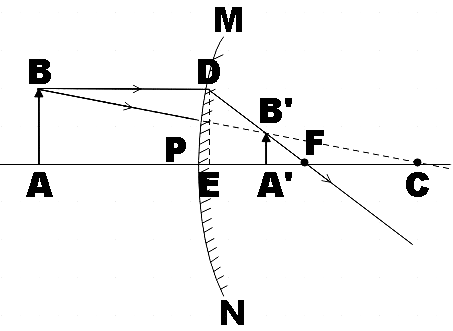
Now consider $\Delta ABC$ and $A'B'C$,
$\angle BAC=\angle B'A'C=90{}^\circ $
$\angle ACB=\angle A'CB'$
$\angle CBA=\angle CB'A'$ (common angle)
Therefore, we could say that they are similar triangles.
$\Rightarrow \dfrac{AB}{A'B'}=\dfrac{AC}{A'C}$ …………………………………….. (1)
Similarly, $\Delta DEF\sim \Delta A'B'F$
$\Rightarrow \dfrac{DE}{A'B'}=\dfrac{EF}{A'F}$ ………………………………………. (2)
When the aperture of the convex mirror is very small, $DE=AB$
Equation (2) will now become,
$\dfrac{AB}{A'B'}=\dfrac{PF}{A'F}$ …………………………………………….. (3)
From equations (1) and (3),
$\dfrac{PF}{A'F}=\dfrac{AC}{A'C}$
$\Rightarrow \dfrac{PF}{PF-PA'}=\dfrac{PA+PC}{PC-PA'}$
But we know that PF is the focal length (f), PA is the object distance (u), PA’ is the image distance (v) and PC is the radius of curvature (R=2f).
$\Rightarrow \dfrac{f}{f-v}=\dfrac{-u+2f}{2f-v}$
$\Rightarrow 2{{f}^{2}}-vf=2{{f}^{2}}-uf-2fv+uv$
$\Rightarrow fv+uf-vu=0$
Dividing each term by uvf we get,
$\dfrac{1}{u}+\dfrac{1}{v}-\dfrac{1}{f}=0$
Therefore, we derived the mirror formula for a convex lens as,
$\dfrac{1}{v}+\dfrac{1}{u}=\dfrac{1}{f}$
Now for the second part of the question, let us rearrange the formula,
$\dfrac{1}{v}=\dfrac{1}{f}-\dfrac{1}{v}$
Clearly, from the above figure, we see that the focal length of a convex mirror is always positive and object distance is always negative and thus from the above relation we see that the image distance will always be positive. This directly implies that the image will always be formed behind the mirror for an object placed anywhere in front of the convex mirror.
Note:
By convention, we take measurements from the pole of a mirror. Any measurements taken to the left of the pole are taken negative and those to the right are taken positive. Also, we have formed the image using two points:
(1) Ray parallel to principle axis passes through focal point.
(2) Ray directed towards the centre of curvature, retraces its path.
Complete Step by step solution:
In the question, we are asked to derive the mirror equation for the case of a convex mirror. We are also asked to prove that the convex mirror produces a virtual image independent of the location of the object using the above derived relation.
As a first step, we could make a neat ray diagram of the image formation of a convex mirror.
Now consider $\Delta ABC$ and $A'B'C$,
$\angle BAC=\angle B'A'C=90{}^\circ $
$\angle ACB=\angle A'CB'$
$\angle CBA=\angle CB'A'$ (common angle)
Therefore, we could say that they are similar triangles.
$\Rightarrow \dfrac{AB}{A'B'}=\dfrac{AC}{A'C}$ …………………………………….. (1)
Similarly, $\Delta DEF\sim \Delta A'B'F$
$\Rightarrow \dfrac{DE}{A'B'}=\dfrac{EF}{A'F}$ ………………………………………. (2)
When the aperture of the convex mirror is very small, $DE=AB$
Equation (2) will now become,
$\dfrac{AB}{A'B'}=\dfrac{PF}{A'F}$ …………………………………………….. (3)
From equations (1) and (3),
$\dfrac{PF}{A'F}=\dfrac{AC}{A'C}$
$\Rightarrow \dfrac{PF}{PF-PA'}=\dfrac{PA+PC}{PC-PA'}$
But we know that PF is the focal length (f), PA is the object distance (u), PA’ is the image distance (v) and PC is the radius of curvature (R=2f).
$\Rightarrow \dfrac{f}{f-v}=\dfrac{-u+2f}{2f-v}$
$\Rightarrow 2{{f}^{2}}-vf=2{{f}^{2}}-uf-2fv+uv$
$\Rightarrow fv+uf-vu=0$
Dividing each term by uvf we get,
$\dfrac{1}{u}+\dfrac{1}{v}-\dfrac{1}{f}=0$
Therefore, we derived the mirror formula for a convex lens as,
$\dfrac{1}{v}+\dfrac{1}{u}=\dfrac{1}{f}$
Now for the second part of the question, let us rearrange the formula,
$\dfrac{1}{v}=\dfrac{1}{f}-\dfrac{1}{v}$
Clearly, from the above figure, we see that the focal length of a convex mirror is always positive and object distance is always negative and thus from the above relation we see that the image distance will always be positive. This directly implies that the image will always be formed behind the mirror for an object placed anywhere in front of the convex mirror.
Note:
By convention, we take measurements from the pole of a mirror. Any measurements taken to the left of the pole are taken negative and those to the right are taken positive. Also, we have formed the image using two points:
(1) Ray parallel to principle axis passes through focal point.
(2) Ray directed towards the centre of curvature, retraces its path.
Recently Updated Pages
Master Class 12 Business Studies: Engaging Questions & Answers for Success

Master Class 12 Chemistry: Engaging Questions & Answers for Success
Master Class 12 Biology: Engaging Questions & Answers for Success
Class 12 Question and Answer - Your Ultimate Solutions Guide
Master Class 11 English: Engaging Questions & Answers for Success
Master Class 11 Social Science: Engaging Questions & Answers for Success
Trending doubts
Which are the Top 10 Largest Countries of the World?
Draw a labelled sketch of the human eye class 12 physics CBSE
Differentiate between homogeneous and heterogeneous class 12 chemistry CBSE
Why is the cell called the structural and functional class 12 biology CBSE
Draw ray diagrams each showing i myopic eye and ii class 12 physics CBSE
Which is the correct genotypic ratio of mendel dihybrid class 12 biology CBSE