




What is an RC Series circuit?
Answer
 Verified
526.2k+ views
Hint: In order to answer this question we need to understand that all electric or electronic circuits or structures are afflicted by a few forms of “time-put off” between it enter and output when a signal or voltage, both non-stop, (DC) or alternating (AC) is first applied to it. The resistor is a linear component whereas the inductor and capacitor have storage capacity.
Complete step by step answer:
A circuit that contains pure resistance R ohms connected in series with a pure capacitor of capacitance C farads is known as RC Series Circuit. A sinusoidal voltage is applied and current I flow through the resistance (R) and the capacitance (C) of the circuit.
The RC Series circuit is shown in the figure below:
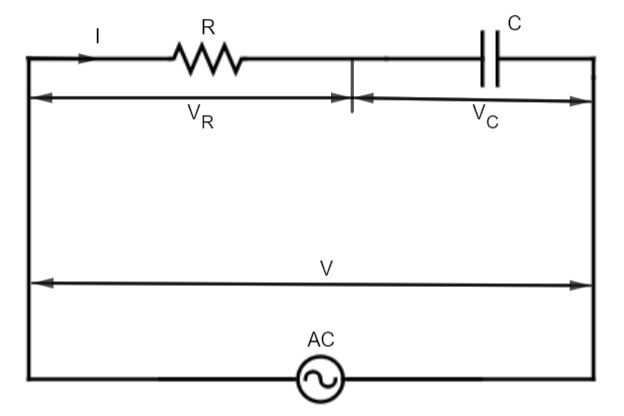
\[{V_R} = {\text{ voltage across the resistance R}}{\text{.}}\]
\[{{\text{V}}_C} = {\text{ voltage across the capacitor C}}{\text{.}}\]
\[{\text{V = total voltage across the RC series circuit}}{\text{.}}\]
When components R and C are in series, the current must be the same (magnitude and phase) in
all parts of the circuit. The current through the resistor R is in phase with the voltage across R.
But the capacitive current is out of phase with the capacitor voltage. \[{{\text{I}}_C}\] leads \[{V_C}\] by \[{90^ \circ }\]. Therefore, the voltages across R and C are out of phase.
Note:
It should be remembered that an RC circuit is a circuit with both a resistor (R) and a capacitor (C). A capacitor is an electrical component used to store energy by separating electric charge on two opposing plates. And a capacitor can accumulate the energy and a resistor positioned in the series will switch the rate at which it charges or discharges. And the characteristic time dependence will be exponential.
Complete step by step answer:
A circuit that contains pure resistance R ohms connected in series with a pure capacitor of capacitance C farads is known as RC Series Circuit. A sinusoidal voltage is applied and current I flow through the resistance (R) and the capacitance (C) of the circuit.
The RC Series circuit is shown in the figure below:
\[{V_R} = {\text{ voltage across the resistance R}}{\text{.}}\]
\[{{\text{V}}_C} = {\text{ voltage across the capacitor C}}{\text{.}}\]
\[{\text{V = total voltage across the RC series circuit}}{\text{.}}\]
When components R and C are in series, the current must be the same (magnitude and phase) in
all parts of the circuit. The current through the resistor R is in phase with the voltage across R.
But the capacitive current is out of phase with the capacitor voltage. \[{{\text{I}}_C}\] leads \[{V_C}\] by \[{90^ \circ }\]. Therefore, the voltages across R and C are out of phase.
Note:
It should be remembered that an RC circuit is a circuit with both a resistor (R) and a capacitor (C). A capacitor is an electrical component used to store energy by separating electric charge on two opposing plates. And a capacitor can accumulate the energy and a resistor positioned in the series will switch the rate at which it charges or discharges. And the characteristic time dependence will be exponential.
Recently Updated Pages
Master Class 10 Computer Science: Engaging Questions & Answers for Success

Master Class 10 Social Science: Engaging Questions & Answers for Success
Master Class 10 Science: Engaging Questions & Answers for Success
Class 10 Question and Answer - Your Ultimate Solutions Guide
Master Class 10 Maths: Engaging Questions & Answers for Success
Master Class 10 English: Engaging Questions & Answers for Success
Trending doubts
Which are the Top 10 Largest Countries of the World?
Draw a labelled sketch of the human eye class 12 physics CBSE
Why is the cell called the structural and functional class 12 biology CBSE
Draw ray diagrams each showing i myopic eye and ii class 12 physics CBSE
Differentiate between homogeneous and heterogeneous class 12 chemistry CBSE
Which is the correct genotypic ratio of mendel dihybrid class 12 biology CBSE