




What causes plant growth?
Answer
 Verified
603.9k+ views
Hint: The process of the division of the parent cell to produce two or more daughter cells is called a cell division. It is a part of the cell cycle that keeps the cell division in check. It helps in the growth and development of an organism resulting in an increase in its mass and number.
Complete answer:
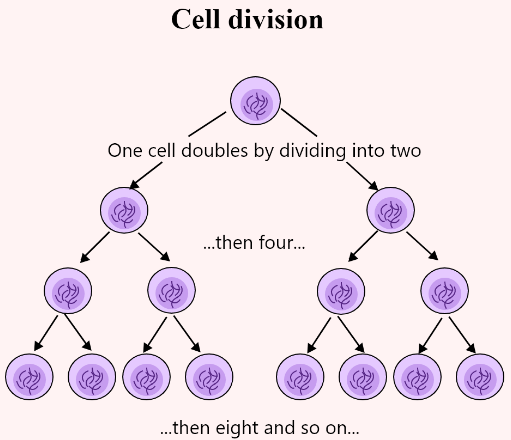
Growth, reproduction, ability to sense the environment, and suitable response against something all are counted as unique features of living organisms. Some features like metabolism, ability to self-replicate, self-organize, interact and emergence can also be added to the list. The growth of plants occurs by cell division and cell enlargement. The cell enlarges its size before it undergoes division. Plants increase in mass and number is the characteristic of growth. Multicellular organisms grow by cell division. By the process of cell division, the plants tend to grow throughout their life.
All the events that occur in a cell and prepare it for the cell division come under the cell cycle. It is a four-stage process. In gap 1 or G1 stage - cell increase in size, in S stage- copies its DNA that is a synthesis of DNA takes place, in gap 2 or G2 stage - it prepares the cells to divide and in mitosis phase or M stage - cell divides. The process of cell division and cell growth is controlled by certain genes. Cells replicate themselves in an organized manner and step-by-step fashion during the cell cycle and ensure that the dividing cells i.e DNA are copied properly or not, any errors found, pr replication occurs correctly or not.
-The cell division is very important because of the following reasons-
1) For the survival and growth of organisms.
2) Maintaining chromosome numbers.
3) Damaged cells renewable
Note:
In 1835, a German botanist Hugo von Mohl first discovered the cell division. He discovered it in alga Cladophora under the microscope. Cell division consists of various stages: Prophase – the first stage of division. Then chromatin tends to condense to form chromosomes. The second stage is Metaphase – chromosomes arranged at the equatorial plate, then Anaphase – chromosomes arranged at the poles, and lastly Telophase – forms a cell plate in between the cells dividing into two daughter cells.
Complete answer:
Growth, reproduction, ability to sense the environment, and suitable response against something all are counted as unique features of living organisms. Some features like metabolism, ability to self-replicate, self-organize, interact and emergence can also be added to the list. The growth of plants occurs by cell division and cell enlargement. The cell enlarges its size before it undergoes division. Plants increase in mass and number is the characteristic of growth. Multicellular organisms grow by cell division. By the process of cell division, the plants tend to grow throughout their life.
All the events that occur in a cell and prepare it for the cell division come under the cell cycle. It is a four-stage process. In gap 1 or G1 stage - cell increase in size, in S stage- copies its DNA that is a synthesis of DNA takes place, in gap 2 or G2 stage - it prepares the cells to divide and in mitosis phase or M stage - cell divides. The process of cell division and cell growth is controlled by certain genes. Cells replicate themselves in an organized manner and step-by-step fashion during the cell cycle and ensure that the dividing cells i.e DNA are copied properly or not, any errors found, pr replication occurs correctly or not.
-The cell division is very important because of the following reasons-
1) For the survival and growth of organisms.
2) Maintaining chromosome numbers.
3) Damaged cells renewable
Note:
In 1835, a German botanist Hugo von Mohl first discovered the cell division. He discovered it in alga Cladophora under the microscope. Cell division consists of various stages: Prophase – the first stage of division. Then chromatin tends to condense to form chromosomes. The second stage is Metaphase – chromosomes arranged at the equatorial plate, then Anaphase – chromosomes arranged at the poles, and lastly Telophase – forms a cell plate in between the cells dividing into two daughter cells.
Recently Updated Pages
If x a + bt + ct2 where x is in meters and t is in class 11 physics CBSE

A car covers the first half distance between two places class 11 physics CBSE
The resultant of two vectors overrightarrow P and overrightarrow class 11 physics CBSE
Find the value of cos 135 class 11 maths CBSE
A mass M is held in place by an applied force F and class 11 physics CBSE
A solution of glucose in water is labelled as 10 dfracwv class 11 chemistry CBSE
Trending doubts
One Metric ton is equal to kg A 10000 B 1000 C 100 class 11 physics CBSE
Find the value of the expression given below sin 30circ class 11 maths CBSE
What do you mean by retardation What is its SI uni class 11 physics CBSE
Draw a diagram of nephron and explain its structur class 11 biology CBSE
10 examples of friction in our daily life
Difference between physical and chemical change class 11 chemistry CBSE