




What are Rotifers?
Answer
 Verified
553.8k+ views
Hint: Rotifers belong to phylum Rotifera and are also called wheel animals. The smallest phylum in all is Rotifera which include minute aquatic animals which are multicellular in nature which have wheel-like ciliated organ use for swimming and feeding. They were first described by Rev. John Harris in 1696. Later Antonie Van Leeuwenhoek described other forms of rotifers in 1703.
Complete answer:
Rotifers are generally found in freshwater called pseudocoelomates and sometimes found in saltwater too. The word rotifer comes from the Neo-latin word which means “Wheel bearer”. The labelled diagram of Rotifer is shown below:
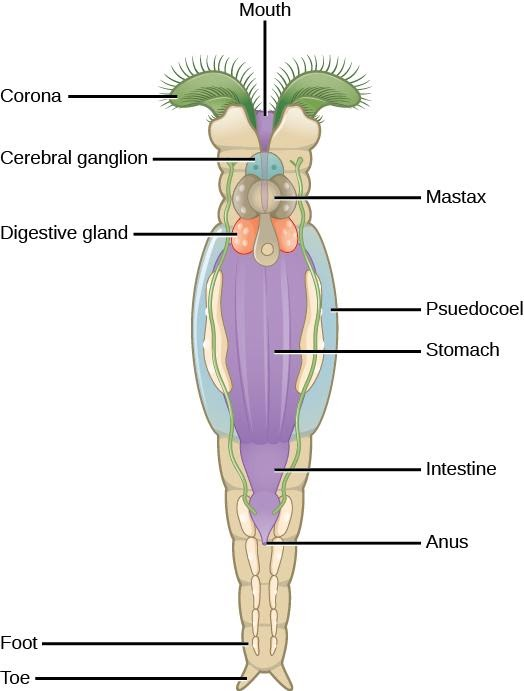
The corona is present around the mouth whose motion is similar to a wheel. That's why rotifers' names are wheel animals. The length of rotifers lies between 0.1 mm to 0.5 mm but some rotifers range from 50µm to 2 mm. Around 2200 rotifers species have been discovered and having a three subclasses –
1. Seisonidea: They have very little in common. They consist of only 2 known genera with 3 species of each. The mode of reproduction is sexual.
2. Bdelloidea: 350 species of this group are to be known. It can be reproduced by the process of parthenogenesis.
3. Monogononta: This is the largest group in three with about 1500 species to be known and existence. The mode of reproduction is asexual.
They are bilaterally symmetrical animals and have different types of shapes. Their body is divided in three parts – head, trunk and foot. They have a coronal cilia which helps to sweep the food in the mouth of these species.
Note:
Rotifers do not have a circulatory system, the exchange of gases takes place by the help of the body surface. Male rotifers have a non-functional digestive system; by this they have a short life span.
Due to the nature of rotifers that are nutrient recycling they are used to clean the water in the fish tanks and prevent the clouds formation of waste matter.
Complete answer:
Rotifers are generally found in freshwater called pseudocoelomates and sometimes found in saltwater too. The word rotifer comes from the Neo-latin word which means “Wheel bearer”. The labelled diagram of Rotifer is shown below:
The corona is present around the mouth whose motion is similar to a wheel. That's why rotifers' names are wheel animals. The length of rotifers lies between 0.1 mm to 0.5 mm but some rotifers range from 50µm to 2 mm. Around 2200 rotifers species have been discovered and having a three subclasses –
1. Seisonidea: They have very little in common. They consist of only 2 known genera with 3 species of each. The mode of reproduction is sexual.
2. Bdelloidea: 350 species of this group are to be known. It can be reproduced by the process of parthenogenesis.
3. Monogononta: This is the largest group in three with about 1500 species to be known and existence. The mode of reproduction is asexual.
They are bilaterally symmetrical animals and have different types of shapes. Their body is divided in three parts – head, trunk and foot. They have a coronal cilia which helps to sweep the food in the mouth of these species.
Note:
Rotifers do not have a circulatory system, the exchange of gases takes place by the help of the body surface. Male rotifers have a non-functional digestive system; by this they have a short life span.
Due to the nature of rotifers that are nutrient recycling they are used to clean the water in the fish tanks and prevent the clouds formation of waste matter.
Recently Updated Pages
If x a + bt + ct2 where x is in meters and t is in class 11 physics CBSE

A car covers the first half distance between two places class 11 physics CBSE
The resultant of two vectors overrightarrow P and overrightarrow class 11 physics CBSE
Find the value of cos 135 class 11 maths CBSE
A mass M is held in place by an applied force F and class 11 physics CBSE
A solution of glucose in water is labelled as 10 dfracwv class 11 chemistry CBSE
Trending doubts
One Metric ton is equal to kg A 10000 B 1000 C 100 class 11 physics CBSE
Find the value of the expression given below sin 30circ class 11 maths CBSE
What do you mean by retardation What is its SI uni class 11 physics CBSE
Draw a diagram of nephron and explain its structur class 11 biology CBSE
10 examples of friction in our daily life
Difference between physical and chemical change class 11 chemistry CBSE