




What are embryoids?
Answer
 Verified
635.1k+ views
Hint:Embryoids are a cluster of three dimensional pluripotent cells. The types of pluripotent stem cells that include the embryoid bodies are the embryonic stem cells and these are extracted from the blastocyst stage of an embryo. It can be done in mice, primates and even human beings.
Complete answer:
Embryoids are non zygotic clusters of embryo like structures and are formed in vitro. They have the potential to develop into a fully grown plant. They are from the category of somatic embryos. These embryos develop from vegetative cells. These will further develop into a classic plant. It's estimated that a huge amount of embryoids can be formed from a single embryo or explants.
Cells have the ability to self assemble and self organize into functional as well as complex tissues and organs. Due to this quality, embryoids have been generated in vitro. This provides a great opportunity to study the very intricate embryological events in a highly quantitative manner.
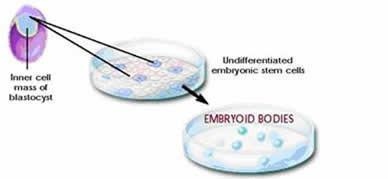
They are mostly made from embryonic stem cells by placing them in gel matrices, there are alternative ways as well. They can be made from induced pluripotent stem cells as well. The stem cells will be put in a compact area and will be allowed to grow which will eventually form an embryo-like ball. It is important to arrange embryos spatially constrained otherwise they do not form embryoids.
Additional Information:
Scientists have previously created synthetic embryos, which are also known as embryoids. These entities are made by coaxing human stem cells to form structures found in very early human embryos.
Note:
Embryoids may not have all the necessary capacities to convert into a fully functional human fetus but are sufficient enough to be studied as a research model.
Complete answer:
Embryoids are non zygotic clusters of embryo like structures and are formed in vitro. They have the potential to develop into a fully grown plant. They are from the category of somatic embryos. These embryos develop from vegetative cells. These will further develop into a classic plant. It's estimated that a huge amount of embryoids can be formed from a single embryo or explants.
Cells have the ability to self assemble and self organize into functional as well as complex tissues and organs. Due to this quality, embryoids have been generated in vitro. This provides a great opportunity to study the very intricate embryological events in a highly quantitative manner.
They are mostly made from embryonic stem cells by placing them in gel matrices, there are alternative ways as well. They can be made from induced pluripotent stem cells as well. The stem cells will be put in a compact area and will be allowed to grow which will eventually form an embryo-like ball. It is important to arrange embryos spatially constrained otherwise they do not form embryoids.
Additional Information:
Scientists have previously created synthetic embryos, which are also known as embryoids. These entities are made by coaxing human stem cells to form structures found in very early human embryos.
Note:
Embryoids may not have all the necessary capacities to convert into a fully functional human fetus but are sufficient enough to be studied as a research model.
Recently Updated Pages
Onehalf of a convex lens is covered with a black paper class 12 physics CBSE

Differentiate between lanthanoids and actinoids class 12 chemistry CBSE
An object 5 cm in length is held 25 cm away from a class 12 physics CBSE
Name the following halides according to the IUPAC system class 12 chemistry CBSE
What is the Full Form of PVC, PET, HDPE, LDPE, PP and PS ?
An infinite ladder network of resistances is constructed class 12 physics CBSE
Trending doubts
Draw a labelled sketch of the human eye class 12 physics CBSE
Which are the Top 10 Largest Countries of the World?
Draw ray diagrams each showing i myopic eye and ii class 12 physics CBSE
Which is the correct genotypic ratio of mendel dihybrid class 12 biology CBSE
Differentiate between homogeneous and heterogeneous class 12 chemistry CBSE
Give 10 examples of unisexual and bisexual flowers