




What are coralloid roots?
Answer
 Verified
590.1k+ views
Hint: Roots are the significant underground part of every single vascular plant. This part of the plant is responsible for mooring the plant down into the ground and absorbing the fundamental mineral components, supplements, and water from the dirt to be able to provide the plant. It is likewise used to store food.
Complete answer:
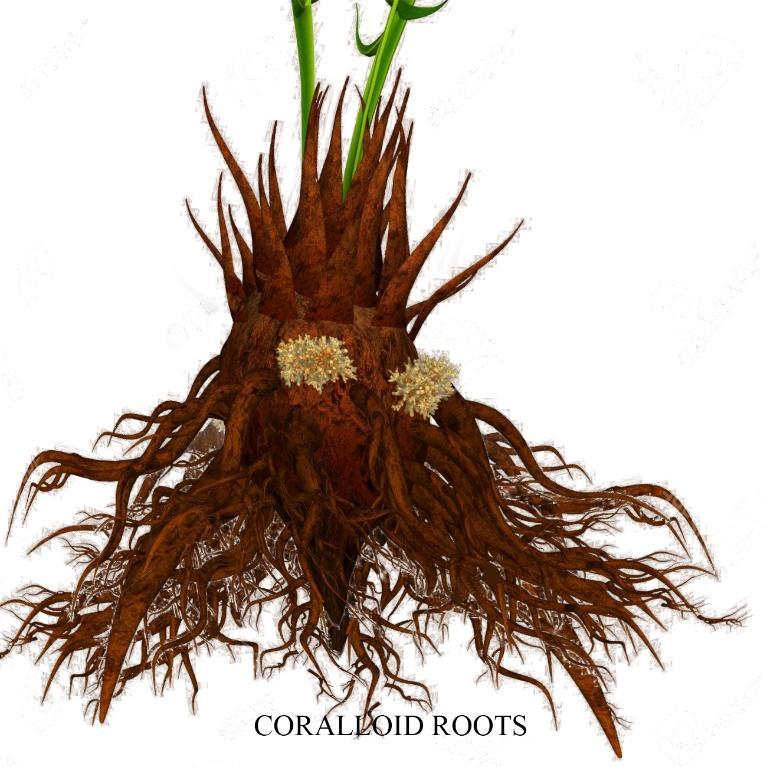
Coralloid roots are specific roots found in Cycas which are related to nitrogen-fixing cyanobacteria. Inside the coralloid root is the cyanobacterial zone, which is the locale possessed by cyanobacteria. The coralloid roots contain Cyanobacteria, which has a blue-green growth that fixes nitrogen and, in relationship with root tissues, produces advantageous amino acids such as asparagine and citrulline. Coralloid roots of cycads were found to start endogenously from the pericycle of apogeotropic optional roots or extrinsic roots that have been to the surface of the soil. All of the developed coralloid attachments are defenseless to diseases caused by algal endophytes, which appear to enter from the soil through a break in the dermal layers. In the coralloid roots, the green growth possesses intercellular spaces in a zone that emerges from the protoderm, and in which the cells prolong radially following algal disease. The zone is encircled by a determined root cap. The secondary cortex is derived from the root cap.
Note:
The coralloid roots develop blue-green algae that help in nitrogen fixation. Nitrogen fixation is a process by which molecular nitrogen is converted into ammonia that is further used by the plants and microorganisms in their metabolic processes.
Complete answer:
Coralloid roots are specific roots found in Cycas which are related to nitrogen-fixing cyanobacteria. Inside the coralloid root is the cyanobacterial zone, which is the locale possessed by cyanobacteria. The coralloid roots contain Cyanobacteria, which has a blue-green growth that fixes nitrogen and, in relationship with root tissues, produces advantageous amino acids such as asparagine and citrulline. Coralloid roots of cycads were found to start endogenously from the pericycle of apogeotropic optional roots or extrinsic roots that have been to the surface of the soil. All of the developed coralloid attachments are defenseless to diseases caused by algal endophytes, which appear to enter from the soil through a break in the dermal layers. In the coralloid roots, the green growth possesses intercellular spaces in a zone that emerges from the protoderm, and in which the cells prolong radially following algal disease. The zone is encircled by a determined root cap. The secondary cortex is derived from the root cap.
Note:
The coralloid roots develop blue-green algae that help in nitrogen fixation. Nitrogen fixation is a process by which molecular nitrogen is converted into ammonia that is further used by the plants and microorganisms in their metabolic processes.
Recently Updated Pages
Lysosomes are known as suicidal bags of cell why class 11 biology CBSE

Father s age is three times the sum of the ages of-class-11-maths-CBSE
Give a comparative account of the classes of kingdom class 11 biology CBSE
The ceiling of a long hall is 25m high What is the class 11 physics CBSE
Name the Largest and the Smallest Cell in the Human Body ?
Draw a welllabelled diagram of a plant cell class 11 biology CBSE
Trending doubts
Find the value of the expression given below sin 30circ class 11 maths CBSE
One Metric ton is equal to kg A 10000 B 1000 C 100 class 11 physics CBSE
Two of the body parts which do not appear in MRI are class 11 biology CBSE
10 examples of friction in our daily life
Proton was discovered by A Thomson B Rutherford C Chadwick class 11 chemistry CBSE
10 examples of diffusion in everyday life