




We wish to obtain a capacitance of \[5\mu F\], by using some capacitors, each of \[2\,\mu F\] . Then the minimum number of capacitors required is?
A. 3
B. 4
C. 5
D. not possible
Answer
 Verified
536.4k+ views
Hint: We know that capacitors work in an opposite way as compared to resistors when connected in either series or parallel combination. So, we will start by checking the equivalent capacitance of capacitors connected in series and in parallel. We see both conditions do not give equivalent capacitance of \[5\mu F\]. Hence we will combine capacitors in parallel and series and look at the minimum number of capacitors required.
Complete step by step answer:
As mentioned in the hint above the capacitors in series connection is given by :
\[C_{(eq)} = C_1 + C_2 + ...... + C_n\].............(in parallel)
And ; \[\dfrac{1}{{C(eq)}} = \dfrac{1}{{C_1}} + \dfrac{1}{{C_2}} + ...... + \dfrac{1}{{C_3}}\]......(in series)
The case of series combination we see that: \[\dfrac{1}{{C(eq)}} = \dfrac{1}{2} + \dfrac{1}{2}\]
\[\dfrac{1}{{C(eq)}} = \dfrac{1}{1} = 1\mu F\]
And in case or parallel: \[C_{(eq)} = 2 + 2 = 4\mu F\]
But we need \[5\mu F\], hence we will try making different combinations. This can be achieved by adding 2 capacitors in series, it will give effective capacitance of \[1\mu F\].Now if we add 2 capacitors in parallel to the earlier circuit we get effective capacitance as \[5\mu F\].
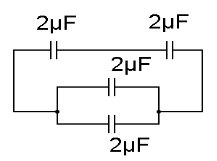
C(eq) because the series is 1microfarad and because of the parallel connection is 4 microfarad. Hence the effective capacitance of circuit \[ = 1\mu F + 4\mu F\].
\[C_{(eq)} = 5\mu F\]
Hence looking at all the observations above we see that to make capacitance of \[5\mu F\] using capacitors of \[2\mu F\], minimum 4 capacitors will be required.
Hence the correct option is B.
Note: We should remember that capacitors in series is given by \[\dfrac{1}{{C(eq)}} = \dfrac{1}{{C_1}} + \dfrac{1}{{C_2}} + ...... + \dfrac{1}{{C_3}}\] and the capacitor in parallel is given by \[C(eq) = C_1 + C_2 + ...... + C_n\]. It should not be confused with a combination of resistors.Here C(eq) is equivalent capacitance. There can be many other combinations but keep in mind we need a minimum number of capacitors.
Complete step by step answer:
As mentioned in the hint above the capacitors in series connection is given by :
\[C_{(eq)} = C_1 + C_2 + ...... + C_n\].............(in parallel)
And ; \[\dfrac{1}{{C(eq)}} = \dfrac{1}{{C_1}} + \dfrac{1}{{C_2}} + ...... + \dfrac{1}{{C_3}}\]......(in series)
The case of series combination we see that: \[\dfrac{1}{{C(eq)}} = \dfrac{1}{2} + \dfrac{1}{2}\]
\[\dfrac{1}{{C(eq)}} = \dfrac{1}{1} = 1\mu F\]
And in case or parallel: \[C_{(eq)} = 2 + 2 = 4\mu F\]
But we need \[5\mu F\], hence we will try making different combinations. This can be achieved by adding 2 capacitors in series, it will give effective capacitance of \[1\mu F\].Now if we add 2 capacitors in parallel to the earlier circuit we get effective capacitance as \[5\mu F\].
C(eq) because the series is 1microfarad and because of the parallel connection is 4 microfarad. Hence the effective capacitance of circuit \[ = 1\mu F + 4\mu F\].
\[C_{(eq)} = 5\mu F\]
Hence looking at all the observations above we see that to make capacitance of \[5\mu F\] using capacitors of \[2\mu F\], minimum 4 capacitors will be required.
Hence the correct option is B.
Note: We should remember that capacitors in series is given by \[\dfrac{1}{{C(eq)}} = \dfrac{1}{{C_1}} + \dfrac{1}{{C_2}} + ...... + \dfrac{1}{{C_3}}\] and the capacitor in parallel is given by \[C(eq) = C_1 + C_2 + ...... + C_n\]. It should not be confused with a combination of resistors.Here C(eq) is equivalent capacitance. There can be many other combinations but keep in mind we need a minimum number of capacitors.
Recently Updated Pages
Master Class 12 Business Studies: Engaging Questions & Answers for Success

Master Class 12 Chemistry: Engaging Questions & Answers for Success
Master Class 12 Biology: Engaging Questions & Answers for Success
Class 12 Question and Answer - Your Ultimate Solutions Guide
Master Class 11 Social Science: Engaging Questions & Answers for Success
Master Class 11 Chemistry: Engaging Questions & Answers for Success
Trending doubts
Which are the Top 10 Largest Countries of the World?
Draw a labelled sketch of the human eye class 12 physics CBSE
Name the crygenes that control cotton bollworm and class 12 biology CBSE
Differentiate between homogeneous and heterogeneous class 12 chemistry CBSE
Ribosomal RNA is actively synthesised in A Nucleoplasm class 12 biology CBSE
How many molecules of ATP and NADPH are required information class 12 biology CBSE