




How much water is in an adult human body?
Answer
 Verified
597.3k+ views
Hint: Water forms the major fluid component in our body. It is the major constituent of the internal environment and plays a major role in various places -
-Homeostasis
-Transport mechanism
-Metabolic reactions
-Maintaining the texture of tissues
-Maintain body temperature
Complete answer:
The human body is made of solids and liquids. The liquid or fluid part forms two-thirds of a component of the body. In females, the water content is less because of more subcutaneous adipose tissue. Also, a thin person has more water content than an obese person. Therefore body characteristics are a major determinant of the water content. The total water content in an ideal human being weighing 70Kgs is almost equal to 40 liters.
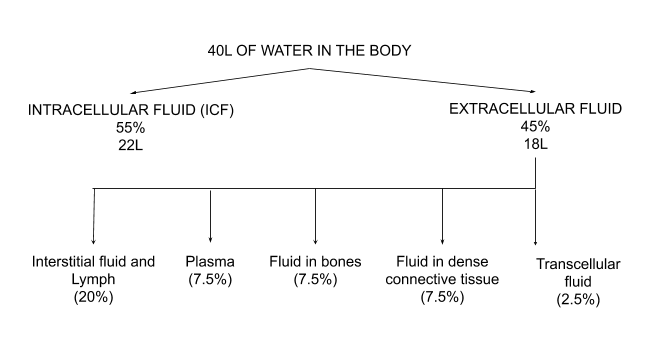
Let’s take 40 liters as total water content and divide its values depending upon the two major compartments.
-Intracellular fluid (ICF)- Its volume is 22 L and it forms 55 percent of the total body water.
-Extracellular fluid (ECF)- Its volume is 18 L and it forms 45 percent of the total body water.
ECF is divided into 5 subunits:
-Interstitial fluid and lymph (20%)
-Plasma (7.5%)
-Fluid in bones (7.5%)
-Fluid in dense connective tissues like cartilage (7.5%)
-Transcellular fluid (2.5%) that includes: Cerebrospinal fluid, Intraocular fluid, Digestive juices, Serous fluid – peritoneal fluid, pericardial and intrapleural fluid, Synovial fluid in joints and Fluid in the urinary tract.
Note: Total body water and the volume of different compartments of the body fluid are measured by the indicator dilution method or dye dilution method.
The body has various mechanisms through which maintains the water balance and kidneys play a major role in it.
-Homeostasis
-Transport mechanism
-Metabolic reactions
-Maintaining the texture of tissues
-Maintain body temperature
Complete answer:
The human body is made of solids and liquids. The liquid or fluid part forms two-thirds of a component of the body. In females, the water content is less because of more subcutaneous adipose tissue. Also, a thin person has more water content than an obese person. Therefore body characteristics are a major determinant of the water content. The total water content in an ideal human being weighing 70Kgs is almost equal to 40 liters.
Let’s take 40 liters as total water content and divide its values depending upon the two major compartments.
-Intracellular fluid (ICF)- Its volume is 22 L and it forms 55 percent of the total body water.
-Extracellular fluid (ECF)- Its volume is 18 L and it forms 45 percent of the total body water.
ECF is divided into 5 subunits:
-Interstitial fluid and lymph (20%)
-Plasma (7.5%)
-Fluid in bones (7.5%)
-Fluid in dense connective tissues like cartilage (7.5%)
-Transcellular fluid (2.5%) that includes: Cerebrospinal fluid, Intraocular fluid, Digestive juices, Serous fluid – peritoneal fluid, pericardial and intrapleural fluid, Synovial fluid in joints and Fluid in the urinary tract.
Note: Total body water and the volume of different compartments of the body fluid are measured by the indicator dilution method or dye dilution method.
The body has various mechanisms through which maintains the water balance and kidneys play a major role in it.

Recently Updated Pages
Master Class 11 English: Engaging Questions & Answers for Success

Master Class 11 Social Science: Engaging Questions & Answers for Success
Master Class 11 Maths: Engaging Questions & Answers for Success
Master Class 11 Chemistry: Engaging Questions & Answers for Success
Master Class 11 Biology: Engaging Questions & Answers for Success
Master Class 11 Physics: Engaging Questions & Answers for Success
Trending doubts
What is BLO What is the full form of BLO class 8 social science CBSE
Which Indian state shares the longest international class 8 social science CBSE
Citizens of India can vote at the age of A 18 years class 8 social science CBSE
In Indian rupees 1 trillion is equal to how many c class 8 maths CBSE
Full form of STD, ISD and PCO
Give me the opposite gender of Duck class 8 english CBSE