




What is the voltage gain in the common emitter amplifier where input resistance is $3\,\Omega $ and load resistance is $24\,\Omega $ and current gain is $\beta = 6$ ?
Answer
 Verified
537.3k+ views
Hint: An amplifier is a device that increases the amplitude of the voltage or current inputs. The common emitter configuration is represented as
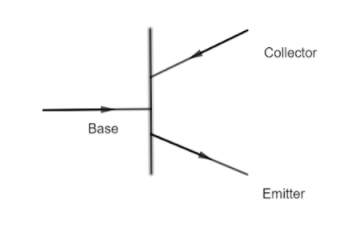
A common emitter configuration has the emitter common to both input and output circuits. The input signal is collected at the base and output received from the collector. It has both current and voltage gain. This configuration is more commonly used as a voltage amplifier.
Formula used: The voltage gain in a common emitter amplifier is given as $v = \beta \dfrac{{{R_L}}}{{{R_i}}}$ .
Here $v$ is the voltage gain, $\beta $ is the current gain, ${R_L}$ is the load resistance and ${R_i}$ is the input resistance.
Complete step by step solution:
We are given that the configuration is the common emitter so we shall apply the formula $v = \beta \dfrac{{{R_L}}}{{{R_i}}}$ where $v$ is the voltage gain, $\beta $ is the current gain, ${R_L}$ is the load resistance and ${R_i}$ is the input resistance.
Given that the current gain, $\beta = 6$ .
Also, the ${R_L} = 24\,\Omega $ is the load resistance and ${R_i} = 3\,\Omega $ is the input resistance.
Substituting these values in the formula,
$v = 6 \times \dfrac{{24}}{3}$
Further solving this we get,
$v = 48$
So, the voltage gain in this situation is 48.
Note: In a common emitter configuration, it is both PNP and NPN transistor arrangements that are available but more frequently designed and widely used is the NPN transistor arrangement. Capacitors can also be a part of amplifier arrangements. At low and very high frequencies, the voltage gain drops. But when the frequencies are mid-level ranging, it is a constant value for the given circuit parameters.
A common emitter configuration has the emitter common to both input and output circuits. The input signal is collected at the base and output received from the collector. It has both current and voltage gain. This configuration is more commonly used as a voltage amplifier.
Formula used: The voltage gain in a common emitter amplifier is given as $v = \beta \dfrac{{{R_L}}}{{{R_i}}}$ .
Here $v$ is the voltage gain, $\beta $ is the current gain, ${R_L}$ is the load resistance and ${R_i}$ is the input resistance.
Complete step by step solution:
We are given that the configuration is the common emitter so we shall apply the formula $v = \beta \dfrac{{{R_L}}}{{{R_i}}}$ where $v$ is the voltage gain, $\beta $ is the current gain, ${R_L}$ is the load resistance and ${R_i}$ is the input resistance.
Given that the current gain, $\beta = 6$ .
Also, the ${R_L} = 24\,\Omega $ is the load resistance and ${R_i} = 3\,\Omega $ is the input resistance.
Substituting these values in the formula,
$v = 6 \times \dfrac{{24}}{3}$
Further solving this we get,
$v = 48$
So, the voltage gain in this situation is 48.
Note: In a common emitter configuration, it is both PNP and NPN transistor arrangements that are available but more frequently designed and widely used is the NPN transistor arrangement. Capacitors can also be a part of amplifier arrangements. At low and very high frequencies, the voltage gain drops. But when the frequencies are mid-level ranging, it is a constant value for the given circuit parameters.
Recently Updated Pages
Master Class 12 Business Studies: Engaging Questions & Answers for Success

Master Class 12 Chemistry: Engaging Questions & Answers for Success
Master Class 12 Biology: Engaging Questions & Answers for Success
Class 12 Question and Answer - Your Ultimate Solutions Guide
Master Class 11 English: Engaging Questions & Answers for Success
Master Class 11 Social Science: Engaging Questions & Answers for Success
Trending doubts
Which are the Top 10 Largest Countries of the World?
Draw a labelled sketch of the human eye class 12 physics CBSE
The end of compass needle which points towards north class 12 physics CBSE
Differentiate between homogeneous and heterogeneous class 12 chemistry CBSE
In order to find out the different types of gametes class 12 biology NEET_UG
Why is the cell called the structural and functional class 12 biology CBSE