




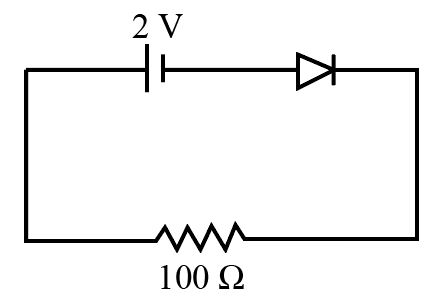
What is the voltage across an ideal p-n junction diode for the shown circuit?
A) 0.7 V
B) 1 V
C) 2 V
D) 0 V
Answer
 Verified
604.8k+ views
Hint :The semiconductors are of two types. The first type is p-type semiconductor, and the second is the n-type semiconductor. The p-type semiconductor has a deficiency of electrons or a greater number of holes, and the n-type semiconductor contains the electrons in excess. The combination of both types of semiconductor forms a p-n junction diode. The p side is the positive terminal, and the n side is the negative terminal.
Complete Step By Step Answer:
The electrons in the circuit move from the negative terminal to the positive terminal. The negative terminal of the battery in the circuit is connected to the p side of the p-n junction, so the diode is reverse biased. The p-n junction diode cannot pass the current from the junction in reverse bias due to high resistance. The p-n junction in the circuit behaves like an open circuit, so the voltage drop across the ideal p-n junction diode remains equal to the voltage of the battery.
Therefore, the voltage across an ideal p-n junction diode for the shown circuit is $2\;{\text{V}}$ and the option (C) is correct.
Note :
The flow of the current happens due to the electrons and holes. The electrons are called the majority charge carrier of n-type semiconductors, and holes become the majority charge carrier in a p-type semiconductor. The p-n junction diode is called in forward bias if the p side of the p-n junction diode is connected with the positive terminal of the battery. The resistance of the p-n junction diode for forward bias becomes low and current passes from the diode. Be careful in observing the connections between the terminals of the battery, and p and n sides of the p-n junction diode because current can only pass in the forward bias.
Complete Step By Step Answer:
The electrons in the circuit move from the negative terminal to the positive terminal. The negative terminal of the battery in the circuit is connected to the p side of the p-n junction, so the diode is reverse biased. The p-n junction diode cannot pass the current from the junction in reverse bias due to high resistance. The p-n junction in the circuit behaves like an open circuit, so the voltage drop across the ideal p-n junction diode remains equal to the voltage of the battery.
Therefore, the voltage across an ideal p-n junction diode for the shown circuit is $2\;{\text{V}}$ and the option (C) is correct.
Note :
The flow of the current happens due to the electrons and holes. The electrons are called the majority charge carrier of n-type semiconductors, and holes become the majority charge carrier in a p-type semiconductor. The p-n junction diode is called in forward bias if the p side of the p-n junction diode is connected with the positive terminal of the battery. The resistance of the p-n junction diode for forward bias becomes low and current passes from the diode. Be careful in observing the connections between the terminals of the battery, and p and n sides of the p-n junction diode because current can only pass in the forward bias.
Recently Updated Pages
Master Class 12 Economics: Engaging Questions & Answers for Success

Master Class 12 Social Science: Engaging Questions & Answers for Success
Master Class 12 English: Engaging Questions & Answers for Success
Master Class 12 Maths: Engaging Questions & Answers for Success
Master Class 12 Physics: Engaging Questions & Answers for Success
Master Class 12 Biology: Engaging Questions & Answers for Success
Trending doubts
Draw a labelled sketch of the human eye class 12 physics CBSE
Which are the Top 10 Largest Countries of the World?
Draw ray diagrams each showing i myopic eye and ii class 12 physics CBSE
Which is the correct genotypic ratio of mendel dihybrid class 12 biology CBSE
Differentiate between homogeneous and heterogeneous class 12 chemistry CBSE
Which animal never drinks water in its entire life class 12 biology CBSE