




Verify LMVT for the function $f\left( x \right) = x + \dfrac{1}{x},x \in \left[ {1,3} \right]$
Answer
 Verified
611.4k+ views
Hint – In order to verify LMVT for the given function, we will take help of the graph and LMVT to solve the given equation and after getting the result from LMVT we will check if it lies between the mentioned domain.
Complete step by step answer:
It is given that $f\left( x \right) = x + \dfrac{1}{x},x \in \left[ {1,3} \right]$
$ \Rightarrow \dfrac{{{x^2} + 1}}{x}$
Now, we know the graph of above equation
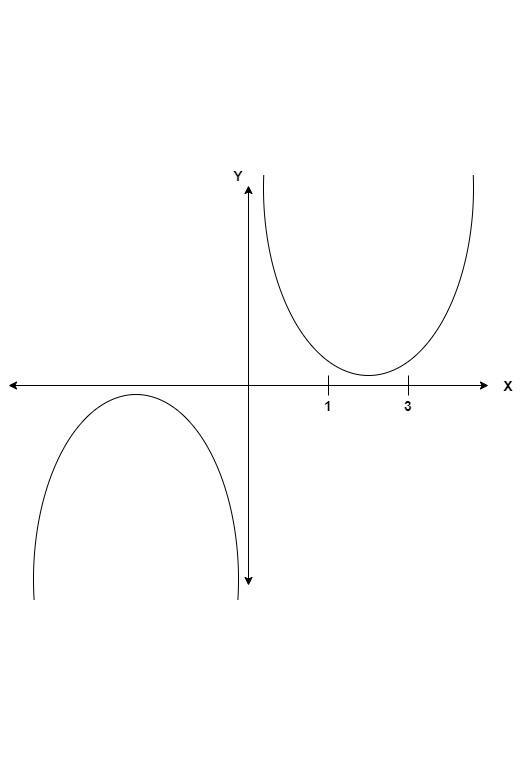
Hence, from graph we can see that
$\dfrac{{{x^2} + 1}}{x}$, $x + \dfrac{1}{x}$ are differentiable too.
So, we will differentiate it by using Lagrange’s Mean Value Theorem i.e.
Let $f:\left[ {a,b} \right] \to R$ be a continuous function, differentiable on the open interval $\left( {a,b} \right)$. Then there exists some $c \in \left( {a,b} \right)$ such that $f'\left( c \right) = \dfrac{{f\left( b \right) - f\left( a \right)}}{{b - a}}$, where $f\left( c \right) = f\left( x \right) = x + \dfrac{1}{x}$ and $\left( {a,b} \right) = \left( {1,3} \right)$ which implies that $a = 1,b = 3$.
$\therefore f'\left( x \right) = 1 - \dfrac{1}{{{x^2}}}$ and $f\left( a \right) = f\left( 1 \right) = 1 + \dfrac{1}{1} = 1 + 1 = 2$, $f\left( b \right) = f\left( 3 \right) = 3 + \dfrac{1}{3} = \dfrac{{10}}{3}$
Now, we will put these values in above formula, to get
$ \Rightarrow 1 - \dfrac{1}{{{x^2}}} = \dfrac{{\dfrac{{10}}{3} - 2}}{{3 - 1}}$
We will solve it further,
$ \Rightarrow 1 - \dfrac{1}{{{x^2}}} = \dfrac{{\dfrac{{10 - 6}}{3}}}{2} = \dfrac{4}{{3 \times 2}} = \dfrac{4}{6} = \dfrac{2}{3}$
Simplifying it further, we will get
$
\Rightarrow 1 - \dfrac{2}{3} = \dfrac{1}{{{x^2}}} \\
\Rightarrow \dfrac{1}{3} = \dfrac{1}{{{x^2}}} \\
$
By cross multiplying, we get
${x^2} = 3$
Taking square both the sides,
$\therefore x = \pm \sqrt 3 $
Hence, $x = \sqrt 3 $ which lies between $\left[ {1,3} \right]$
Therefore, it satisfies LMVT.
Note – LMVT is also known as MVT “Mean Value Theorem” which states that for a given planar arc between two endpoints, there is at least one point at which the tangent to the arc is parallel to the secant through its endpoints. So, to avoid mistakes one must retain that there is only one formula for LMVT and you have to use it properly. A student should differentiate and put values carefully too
Complete step by step answer:
It is given that $f\left( x \right) = x + \dfrac{1}{x},x \in \left[ {1,3} \right]$
$ \Rightarrow \dfrac{{{x^2} + 1}}{x}$
Now, we know the graph of above equation
Hence, from graph we can see that
$\dfrac{{{x^2} + 1}}{x}$, $x + \dfrac{1}{x}$ are differentiable too.
So, we will differentiate it by using Lagrange’s Mean Value Theorem i.e.
Let $f:\left[ {a,b} \right] \to R$ be a continuous function, differentiable on the open interval $\left( {a,b} \right)$. Then there exists some $c \in \left( {a,b} \right)$ such that $f'\left( c \right) = \dfrac{{f\left( b \right) - f\left( a \right)}}{{b - a}}$, where $f\left( c \right) = f\left( x \right) = x + \dfrac{1}{x}$ and $\left( {a,b} \right) = \left( {1,3} \right)$ which implies that $a = 1,b = 3$.
$\therefore f'\left( x \right) = 1 - \dfrac{1}{{{x^2}}}$ and $f\left( a \right) = f\left( 1 \right) = 1 + \dfrac{1}{1} = 1 + 1 = 2$, $f\left( b \right) = f\left( 3 \right) = 3 + \dfrac{1}{3} = \dfrac{{10}}{3}$
Now, we will put these values in above formula, to get
$ \Rightarrow 1 - \dfrac{1}{{{x^2}}} = \dfrac{{\dfrac{{10}}{3} - 2}}{{3 - 1}}$
We will solve it further,
$ \Rightarrow 1 - \dfrac{1}{{{x^2}}} = \dfrac{{\dfrac{{10 - 6}}{3}}}{2} = \dfrac{4}{{3 \times 2}} = \dfrac{4}{6} = \dfrac{2}{3}$
Simplifying it further, we will get
$
\Rightarrow 1 - \dfrac{2}{3} = \dfrac{1}{{{x^2}}} \\
\Rightarrow \dfrac{1}{3} = \dfrac{1}{{{x^2}}} \\
$
By cross multiplying, we get
${x^2} = 3$
Taking square both the sides,
$\therefore x = \pm \sqrt 3 $
Hence, $x = \sqrt 3 $ which lies between $\left[ {1,3} \right]$
Therefore, it satisfies LMVT.
Note – LMVT is also known as MVT “Mean Value Theorem” which states that for a given planar arc between two endpoints, there is at least one point at which the tangent to the arc is parallel to the secant through its endpoints. So, to avoid mistakes one must retain that there is only one formula for LMVT and you have to use it properly. A student should differentiate and put values carefully too
Recently Updated Pages
Complete reduction of benzene diazonium chloride with class 12 chemistry CBSE

How can you identify optical isomers class 12 chemistry CBSE
The coating formed on the metals such as iron silver class 12 chemistry CBSE
Metals are refined by using different methods Which class 12 chemistry CBSE
What do you understand by denaturation of proteins class 12 chemistry CBSE
Assertion Nitrobenzene is used as a solvent in FriedelCrafts class 12 chemistry CBSE
Trending doubts
What are the major means of transport Explain each class 12 social science CBSE
RNA and DNA are chiral molecules their chirality is class 12 chemistry CBSE
RNA and DNA are chiral molecules their chirality is class 12 chemistry CBSE
India is a sovereign socialist secular democratic republic class 12 social science CBSE
The correct structure of ethylenediaminetetraacetic class 12 chemistry CBSE
How many states of matter are there in total class 12 chemistry CBSE