




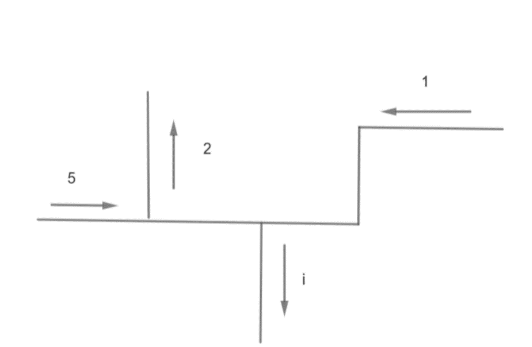
What is the value of current i in the given figure?
A. $- 4\,mA$
B. $+ 2\,mA$
C. $+ 4\,mA$
D. $+ 8\,mA$
Answer
 Verified
533.7k+ views
Hint:By applying KCL law we can solve the above problem.Kirchhoff’s Current Law often shortens as KCL, which states that the algebraic sum of all the currents entering and exiting a node must be equal to zero. In other words we can also say that the sum of current entering a node is equal to the sum of current exiting a node.
Formula Used:
$\boxed{\sum\limits_{k = 1}^n {{i_k} = 0} }$
Where, $i = \,Current$ and k varies from $k = 1,2,3, \ldots \ldots n$.
Complete step by step answer:
According to Kirchhoff’s current law, the algebraic sum of all the currents entering and exiting a node must be equal to zero. In other words we can also say that the sum of current entering a node is equal to the sum of current exiting a node.As per the question we need to calculate the value of i that is exiting from the node. For this we have to apply Kirchhoff’s current law.As given in the diagram,
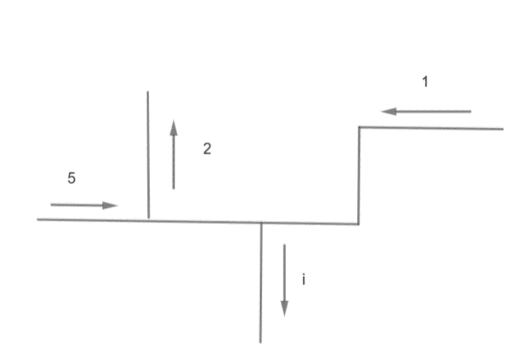
As we can see from the diagram current $5mA\,\,and\,\,1mA$ are entering current while current $2mA\,\,and\,\,i$ are exciting currents.Applying Kirchhoff Current law we can write
Method I:
$\sum\limits_{k = 1}^n {{i_k} = 0} $
Here k varies from $k = 1,2,3,4$
Now we can write,
$\sum\limits_{k = 1}^4 {{i_{1,2,3,4}}} = 0$
$ \Rightarrow {i_1} + {i_2} + {i_3} + {i_4} = 0$
With the help of above diagram
${i_1} = 5mA,{i_2} = 1mA,{i_3} = 2mA,{i_4} = i$
Now putting the above value in the equation we get,
$5mA + 1mA - 2mA - i = 0$
(As ${i_3}\,\,and\,\,{i_4}$ are exiting current which flows in opposite direction)
Now,
$4mA - i = 0$
$ \therefore \boxed{i = + 4mA}$
Method 2:
Entering Current=Exiting Current
$ \Rightarrow 5mA + 1mA = 2mA + i$
$ \Rightarrow 6mA = 2mA + i$
$ \Rightarrow 6mA - 2mA = i$
$ \therefore \boxed{i = + 4mA}$
Hence, the correct option is $\left( C \right)$.
Note:Always take proper sign convention when you are using method 1 to solve this kind of problem or else you will make a mistake. If in place of $ - 2mA$ I will take $ + 2mA$ then my answer will be incorrect. So be careful while solving this kind of problem. It will be better for you to solve this kind of problem using method 2.
Formula Used:
$\boxed{\sum\limits_{k = 1}^n {{i_k} = 0} }$
Where, $i = \,Current$ and k varies from $k = 1,2,3, \ldots \ldots n$.
Complete step by step answer:
According to Kirchhoff’s current law, the algebraic sum of all the currents entering and exiting a node must be equal to zero. In other words we can also say that the sum of current entering a node is equal to the sum of current exiting a node.As per the question we need to calculate the value of i that is exiting from the node. For this we have to apply Kirchhoff’s current law.As given in the diagram,
As we can see from the diagram current $5mA\,\,and\,\,1mA$ are entering current while current $2mA\,\,and\,\,i$ are exciting currents.Applying Kirchhoff Current law we can write
Method I:
$\sum\limits_{k = 1}^n {{i_k} = 0} $
Here k varies from $k = 1,2,3,4$
Now we can write,
$\sum\limits_{k = 1}^4 {{i_{1,2,3,4}}} = 0$
$ \Rightarrow {i_1} + {i_2} + {i_3} + {i_4} = 0$
With the help of above diagram
${i_1} = 5mA,{i_2} = 1mA,{i_3} = 2mA,{i_4} = i$
Now putting the above value in the equation we get,
$5mA + 1mA - 2mA - i = 0$
(As ${i_3}\,\,and\,\,{i_4}$ are exiting current which flows in opposite direction)
Now,
$4mA - i = 0$
$ \therefore \boxed{i = + 4mA}$
Method 2:
Entering Current=Exiting Current
$ \Rightarrow 5mA + 1mA = 2mA + i$
$ \Rightarrow 6mA = 2mA + i$
$ \Rightarrow 6mA - 2mA = i$
$ \therefore \boxed{i = + 4mA}$
Hence, the correct option is $\left( C \right)$.
Note:Always take proper sign convention when you are using method 1 to solve this kind of problem or else you will make a mistake. If in place of $ - 2mA$ I will take $ + 2mA$ then my answer will be incorrect. So be careful while solving this kind of problem. It will be better for you to solve this kind of problem using method 2.
Recently Updated Pages
Master Class 12 Economics: Engaging Questions & Answers for Success

Master Class 12 English: Engaging Questions & Answers for Success
Master Class 12 Social Science: Engaging Questions & Answers for Success
Master Class 12 Maths: Engaging Questions & Answers for Success
Master Class 12 Physics: Engaging Questions & Answers for Success
Master Class 9 General Knowledge: Engaging Questions & Answers for Success
Trending doubts
Which are the Top 10 Largest Countries of the World?
Draw a labelled sketch of the human eye class 12 physics CBSE
Differentiate between homogeneous and heterogeneous class 12 chemistry CBSE
Why is the cell called the structural and functional class 12 biology CBSE
Draw ray diagrams each showing i myopic eye and ii class 12 physics CBSE
Which is the correct genotypic ratio of mendel dihybrid class 12 biology CBSE