




Using disk or ring method, how do you find the volume of \[y = {x^2} - x,y = 3 - {x^2}\] about \[y = 4\] ?
Answer
 Verified
567.9k+ views
Hint: Here, we find the volume of the given function using the disk methods. The disk method, also known as the method of disks or rings, is a way to calculate the volume of a solid of revolution by taking the sum of cross-sectional areas of infinitesimal thickness of the solid. The volume V of a solid of revolution, \[V = \pi \int\limits_a^b {{{\left( {{{\left( {f(x)} \right)}^2} - {{\left( {g(x)} \right)}^2}} \right)}^{}}dx} \] .
Complete step by step solution:
The given equation of parabola, we have
\[
y = {x^2} - x \to \left( 1 \right) \\
y = 3 - {x^2} \to \left( 2 \right) \\
y = 4 \to \left( 3 \right) \\
\]
The region enclosed by the three curve in the below graph,
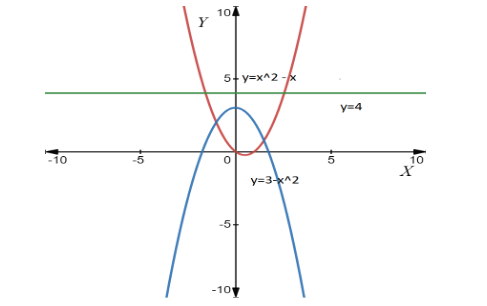
The volume V of a solid of revolution, \[V = \pi \int\limits_a^b {{{\left( {{{\left( {f(x)} \right)}^2} - {{\left( {g(x)} \right)}^2}} \right)}^{}}dx} \] .
Where, \[V - \] Volume of solid
\[a - \] Least value of \[x\] of \[f(x)\]
\[b - \] Highest value of \[x\] of \[f(x)\]
\[f(x) - \] The value of radius of the disc
\[dx - \] The value of height of the disc
To find the point of intersection, where the two parabola meets,
\[
{x^2} - x = 3 - {x^2} \\
{x^2} - x - 3 + {x^2} = 0 \;
\]
By simplifying the equation to find the point of intersection
\[
2{x^2} - x - 3 = 0 \\
x(2x - 1) = 3 \;
\]
To simplify, we get
\[x = 3\] ,
Then, another factor is
\[
2x - 1 = 3 \\
2x = 3 + 1 \\
x = \dfrac{4}{2} = 2 \;
\]
The point of intersection, \[(a,b) = (2,3)\]
Let the given parabola equation,
\[
f(x) = {x^2} - x \\
g(x) = 3 - {x^2} \;
\]
To find the volume,
\[V = \pi \int\limits_a^b {{{\left( {{{\left( {f(x)} \right)}^2} - {{\left( {g(x)} \right)}^2}} \right)}^{}}dx} \]
By substituting values in the formula
\[
\\
V = \pi \int\limits_2^3 {\left( {\left( {{{({x^2})}^2} - 2{x^2} \cdot x + {x^2}} \right) - \left( {{3^2} - 2 \times 3 \cdot {x^2} + {{\left( {{x^2}} \right)}^2}} \right)} \right)dx} \\
V = \pi \int\limits_2^3 {\left( {\left( {{x^4} - 2{x^3} + {x^2}} \right) - \left( {9 - 6{x^2} + {x^4}} \right)} \right)dx} \;
\]
To simply it by apply the algebraic formula, \[{(a - b)^2} = {a^2} - 2ab + {b^2}\]
\[V = \pi \int\limits_2^3 {\left( {\left( {{{({x^2})}^2} - 2{x^2} \cdot x + {x^2}} \right) - \left( {{3^2} - 2 \times 3 \cdot {x^2} + {{\left( {{x^2}} \right)}^2}} \right)} \right)dx} \]
\[V = \pi \int\limits_2^3 {\left( {\left( {{x^4} - 2{x^3} + {x^2}} \right) - \left( {9 - 6{x^2} + {x^4}} \right)} \right)dx} \]
To evaluate it by using integral, we get
\[V = \pi \left[ {\left( {\dfrac{{{x^5}}}{5} - \dfrac{{2{x^4}}}{4} + \dfrac{{{x^3}}}{3}} \right) - \left( {9x - \dfrac{{6{x^3}}}{3} + \dfrac{{{x^5}}}{5}} \right)} \right] _2^3\]
By simplify the above equation, we get
\[V = \pi \left[ {\dfrac{{{x^5}}}{5} - \dfrac{{2{x^4}}}{4} + \dfrac{{{x^3}}}{3} - 9x + \dfrac{{6{x^3}}}{3} - \dfrac{{{x^5}}}{5}} \right] _2^3\]
Performing addition and subtraction to simplify, we get
\[V = \pi \left[ { - \dfrac{{2{x^4}}}{4} + \dfrac{{7{x^3}}}{3} - 9x} \right] _2^3\]
Solving the equation by substitute upper and lower limit, we get
\[V = \pi \left[ {\left( { - \dfrac{{2 \times {3^4}}}{4} + \dfrac{{7 \times {3^3}}}{3} - 9 \times 3} \right) - \left( { - \dfrac{{2 \times {2^4}}}{4} + \dfrac{{7 \times {2^3}}}{3} - 9 \times 2} \right)} \right] \]
By simplify the power of the value,
\[V = \pi \left( { - \dfrac{{2 \times 81}}{4} + \dfrac{{7 \times 27}}{3} - 9 \times 3 + \dfrac{{2 \times 16}}{4} - \dfrac{{7 \times 8}}{3} + 9 \times 2} \right)\]
By performing operation for the same denominator value, we get
\[V = \pi \left( {\dfrac{{ - (2 \times 81) + (2 \times 16)}}{4} + \dfrac{{(7 \times 27) - (7 \times 8)}}{3} + 9( - 3 + 2)} \right)\]
\[V = \pi \left( {\dfrac{{2( - 81 + 16)}}{4} + \dfrac{{7(27 - 8)}}{3} + 9( - 1)} \right)\]
Now, we get
\[V = \pi \left( {\dfrac{{2( - 65)}}{4} + \dfrac{{7(19)}}{3} - 9} \right)\]
Take LCM on above equation, we get
\[V = \pi \left( {\dfrac{{2( - 65)(3) + 7(19)(4) - 9(12)}}{{12}}} \right) = \pi \left( {\dfrac{{ - 390 + 532 - 108}}{{12}}} \right)\]
\[V = \pi \dfrac{{(532 - 498)}}{{12}} = \pi \dfrac{{34}}{{12}} = \pi \dfrac{{17}}{6}\]
\[V = \dfrac{{17}}{6}\pi \]
Therefore, the volume bounded by the region, \[V = \dfrac{{17}}{6}\pi \]
So, the correct answer is “ \[V = \dfrac{{17}}{6}\pi \] ”.
Note: A solid of revolution is formed by rotating a two-dimensional function around an axis to produce a three-dimensional shape (either a full solid or a ring).Here we use integration to solve the volume bounded by the region with the point of intersection. We remember the formula for volume met by the two parabola functions.
Complete step by step solution:
The given equation of parabola, we have
\[
y = {x^2} - x \to \left( 1 \right) \\
y = 3 - {x^2} \to \left( 2 \right) \\
y = 4 \to \left( 3 \right) \\
\]
The region enclosed by the three curve in the below graph,
The volume V of a solid of revolution, \[V = \pi \int\limits_a^b {{{\left( {{{\left( {f(x)} \right)}^2} - {{\left( {g(x)} \right)}^2}} \right)}^{}}dx} \] .
Where, \[V - \] Volume of solid
\[a - \] Least value of \[x\] of \[f(x)\]
\[b - \] Highest value of \[x\] of \[f(x)\]
\[f(x) - \] The value of radius of the disc
\[dx - \] The value of height of the disc
To find the point of intersection, where the two parabola meets,
\[
{x^2} - x = 3 - {x^2} \\
{x^2} - x - 3 + {x^2} = 0 \;
\]
By simplifying the equation to find the point of intersection
\[
2{x^2} - x - 3 = 0 \\
x(2x - 1) = 3 \;
\]
To simplify, we get
\[x = 3\] ,
Then, another factor is
\[
2x - 1 = 3 \\
2x = 3 + 1 \\
x = \dfrac{4}{2} = 2 \;
\]
The point of intersection, \[(a,b) = (2,3)\]
Let the given parabola equation,
\[
f(x) = {x^2} - x \\
g(x) = 3 - {x^2} \;
\]
To find the volume,
\[V = \pi \int\limits_a^b {{{\left( {{{\left( {f(x)} \right)}^2} - {{\left( {g(x)} \right)}^2}} \right)}^{}}dx} \]
By substituting values in the formula
\[
\\
V = \pi \int\limits_2^3 {\left( {\left( {{{({x^2})}^2} - 2{x^2} \cdot x + {x^2}} \right) - \left( {{3^2} - 2 \times 3 \cdot {x^2} + {{\left( {{x^2}} \right)}^2}} \right)} \right)dx} \\
V = \pi \int\limits_2^3 {\left( {\left( {{x^4} - 2{x^3} + {x^2}} \right) - \left( {9 - 6{x^2} + {x^4}} \right)} \right)dx} \;
\]
To simply it by apply the algebraic formula, \[{(a - b)^2} = {a^2} - 2ab + {b^2}\]
\[V = \pi \int\limits_2^3 {\left( {\left( {{{({x^2})}^2} - 2{x^2} \cdot x + {x^2}} \right) - \left( {{3^2} - 2 \times 3 \cdot {x^2} + {{\left( {{x^2}} \right)}^2}} \right)} \right)dx} \]
\[V = \pi \int\limits_2^3 {\left( {\left( {{x^4} - 2{x^3} + {x^2}} \right) - \left( {9 - 6{x^2} + {x^4}} \right)} \right)dx} \]
To evaluate it by using integral, we get
\[V = \pi \left[ {\left( {\dfrac{{{x^5}}}{5} - \dfrac{{2{x^4}}}{4} + \dfrac{{{x^3}}}{3}} \right) - \left( {9x - \dfrac{{6{x^3}}}{3} + \dfrac{{{x^5}}}{5}} \right)} \right] _2^3\]
By simplify the above equation, we get
\[V = \pi \left[ {\dfrac{{{x^5}}}{5} - \dfrac{{2{x^4}}}{4} + \dfrac{{{x^3}}}{3} - 9x + \dfrac{{6{x^3}}}{3} - \dfrac{{{x^5}}}{5}} \right] _2^3\]
Performing addition and subtraction to simplify, we get
\[V = \pi \left[ { - \dfrac{{2{x^4}}}{4} + \dfrac{{7{x^3}}}{3} - 9x} \right] _2^3\]
Solving the equation by substitute upper and lower limit, we get
\[V = \pi \left[ {\left( { - \dfrac{{2 \times {3^4}}}{4} + \dfrac{{7 \times {3^3}}}{3} - 9 \times 3} \right) - \left( { - \dfrac{{2 \times {2^4}}}{4} + \dfrac{{7 \times {2^3}}}{3} - 9 \times 2} \right)} \right] \]
By simplify the power of the value,
\[V = \pi \left( { - \dfrac{{2 \times 81}}{4} + \dfrac{{7 \times 27}}{3} - 9 \times 3 + \dfrac{{2 \times 16}}{4} - \dfrac{{7 \times 8}}{3} + 9 \times 2} \right)\]
By performing operation for the same denominator value, we get
\[V = \pi \left( {\dfrac{{ - (2 \times 81) + (2 \times 16)}}{4} + \dfrac{{(7 \times 27) - (7 \times 8)}}{3} + 9( - 3 + 2)} \right)\]
\[V = \pi \left( {\dfrac{{2( - 81 + 16)}}{4} + \dfrac{{7(27 - 8)}}{3} + 9( - 1)} \right)\]
Now, we get
\[V = \pi \left( {\dfrac{{2( - 65)}}{4} + \dfrac{{7(19)}}{3} - 9} \right)\]
Take LCM on above equation, we get
\[V = \pi \left( {\dfrac{{2( - 65)(3) + 7(19)(4) - 9(12)}}{{12}}} \right) = \pi \left( {\dfrac{{ - 390 + 532 - 108}}{{12}}} \right)\]
\[V = \pi \dfrac{{(532 - 498)}}{{12}} = \pi \dfrac{{34}}{{12}} = \pi \dfrac{{17}}{6}\]
\[V = \dfrac{{17}}{6}\pi \]
Therefore, the volume bounded by the region, \[V = \dfrac{{17}}{6}\pi \]
So, the correct answer is “ \[V = \dfrac{{17}}{6}\pi \] ”.
Note: A solid of revolution is formed by rotating a two-dimensional function around an axis to produce a three-dimensional shape (either a full solid or a ring).Here we use integration to solve the volume bounded by the region with the point of intersection. We remember the formula for volume met by the two parabola functions.
Recently Updated Pages
Master Class 12 Economics: Engaging Questions & Answers for Success

Master Class 12 English: Engaging Questions & Answers for Success
Master Class 12 Social Science: Engaging Questions & Answers for Success
Master Class 12 Maths: Engaging Questions & Answers for Success
Master Class 12 Physics: Engaging Questions & Answers for Success
Master Class 12 Business Studies: Engaging Questions & Answers for Success
Trending doubts
Which are the Top 10 Largest Countries of the World?
Draw a labelled sketch of the human eye class 12 physics CBSE
Differentiate between homogeneous and heterogeneous class 12 chemistry CBSE
Why is the cell called the structural and functional class 12 biology CBSE
Draw ray diagrams each showing i myopic eye and ii class 12 physics CBSE
Which is the correct genotypic ratio of mendel dihybrid class 12 biology CBSE