




Using definite integral, compute the area of the region bounded by the sides of the triangle whose vertices are (2, 0), (4, 5) and (6, 3).
(a) 6 square units
(b) 7 square units
(c) 8 square units
(d) 9 square units
Answer
 Verified
550.8k+ views
Hint: To get the area of the triangle with the vertices given we will start with finding the equations of the line of the triangles. We then try to transform the equations in forms of y to use the limits in form of x. Finding the integration of the form of the definite integral gives us our desired result.
Complete step by step solution:
Let us consider A (2, 0), B (4, 5) and C (6, 3) be the vertices of the given triangle.
So, the equation of AB is:
\[y - 0 = \dfrac{{5 - 0}}{{4 - 2}}(x - 2)\]
\[\Rightarrow y = \dfrac{5}{2}(x - 2)\]…….. (1)
And, again, the equation of BC is:
\[y - 5 = \dfrac{{3 - 5}}{{6 - 4}}(x - 4)\]
\[\Rightarrow y - 5 = \dfrac{{ - 2}}{2}(x - 4)\]
\[\Rightarrow y - 5 = - 1(x - 4)\]
\[\Rightarrow y - 5 = - x + 4\]
\[\Rightarrow y = 9 - x\]……….. (2)
And, the equation of CA is:
\[y - 3 = \dfrac{{0 - 3}}{{2 - 6}}(x - 6)\]
\[\Rightarrow y - 3 = \dfrac{{ - 3}}{{ - 4}}(x - 6)\]
\[\Rightarrow y - 3 = \dfrac{3}{4}(x - 6)\]
Now, by more simplification,
\[\Rightarrow 4y - 12 = 3x - 18\]
\[\Rightarrow y = \dfrac{1}{4}(3x - 6)\]
\[{ \Rightarrow 4y = 3x - 6}\]
\[\Rightarrow y = \dfrac{3}{4}(x - 2)\]………. (3)
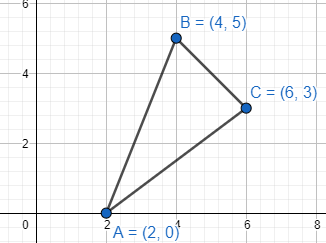
To find the area of the triangle, we are to use the definite integral in this question. Now, we have considered the lines as the forms of “y”. So, we are to integrate the equations with the limits of x. And, if we get the integration with respect to two lines, the third line will be a common part. We have to subtract the integration of the third line with the sum of the other two to find the area.
Now, Area would be,
\[\dfrac{5}{2}\int\limits_2^4 {(x - 2)} + \int\limits_4^6 {(9 - x)} - \dfrac{3}{4}\int\limits_4^6 {(x - 2)}\]
\[= \dfrac{5}{2}\left. {\left( {\dfrac{{{x^2}}}{2} - 2x} \right)} \right|_2^4 + \left. {\left( {9x - \dfrac{{{x^2}}}{2}} \right)} \right|_4^6 - \dfrac{3}{4}\left. {\left( {\dfrac{{{x^2}}}{2} - 2x} \right)} \right|_2^6\]
\[= \dfrac{5}{2}[6 - 4] + [18 - 10] - \dfrac{3}{4}[16 - 8]\]
\[= \dfrac{5}{2}.2 + 8 - \dfrac{3}{4}.8\]
\[= 5 + 8 - 6\]
= 7 square units
Hence, the correct option is (b) 7 square units.
Note: We can also solve the problem in a different way. The equations of the lines can be transformed into forms of x to use the limits of y. Using the definite integral with the limits of y gives us our desired result.
Complete step by step solution:
Let us consider A (2, 0), B (4, 5) and C (6, 3) be the vertices of the given triangle.
So, the equation of AB is:
\[y - 0 = \dfrac{{5 - 0}}{{4 - 2}}(x - 2)\]
\[\Rightarrow y = \dfrac{5}{2}(x - 2)\]…….. (1)
And, again, the equation of BC is:
\[y - 5 = \dfrac{{3 - 5}}{{6 - 4}}(x - 4)\]
\[\Rightarrow y - 5 = \dfrac{{ - 2}}{2}(x - 4)\]
\[\Rightarrow y - 5 = - 1(x - 4)\]
\[\Rightarrow y - 5 = - x + 4\]
\[\Rightarrow y = 9 - x\]……….. (2)
And, the equation of CA is:
\[y - 3 = \dfrac{{0 - 3}}{{2 - 6}}(x - 6)\]
\[\Rightarrow y - 3 = \dfrac{{ - 3}}{{ - 4}}(x - 6)\]
\[\Rightarrow y - 3 = \dfrac{3}{4}(x - 6)\]
Now, by more simplification,
\[\Rightarrow 4y - 12 = 3x - 18\]
\[\Rightarrow y = \dfrac{1}{4}(3x - 6)\]
\[{ \Rightarrow 4y = 3x - 6}\]
\[\Rightarrow y = \dfrac{3}{4}(x - 2)\]………. (3)
To find the area of the triangle, we are to use the definite integral in this question. Now, we have considered the lines as the forms of “y”. So, we are to integrate the equations with the limits of x. And, if we get the integration with respect to two lines, the third line will be a common part. We have to subtract the integration of the third line with the sum of the other two to find the area.
Now, Area would be,
\[\dfrac{5}{2}\int\limits_2^4 {(x - 2)} + \int\limits_4^6 {(9 - x)} - \dfrac{3}{4}\int\limits_4^6 {(x - 2)}\]
\[= \dfrac{5}{2}\left. {\left( {\dfrac{{{x^2}}}{2} - 2x} \right)} \right|_2^4 + \left. {\left( {9x - \dfrac{{{x^2}}}{2}} \right)} \right|_4^6 - \dfrac{3}{4}\left. {\left( {\dfrac{{{x^2}}}{2} - 2x} \right)} \right|_2^6\]
\[= \dfrac{5}{2}[6 - 4] + [18 - 10] - \dfrac{3}{4}[16 - 8]\]
\[= \dfrac{5}{2}.2 + 8 - \dfrac{3}{4}.8\]
\[= 5 + 8 - 6\]
= 7 square units
Hence, the correct option is (b) 7 square units.
Note: We can also solve the problem in a different way. The equations of the lines can be transformed into forms of x to use the limits of y. Using the definite integral with the limits of y gives us our desired result.
Recently Updated Pages
Master Class 12 Economics: Engaging Questions & Answers for Success

Master Class 12 Physics: Engaging Questions & Answers for Success
Master Class 12 English: Engaging Questions & Answers for Success
Master Class 12 Social Science: Engaging Questions & Answers for Success
Master Class 12 Maths: Engaging Questions & Answers for Success
Master Class 12 Business Studies: Engaging Questions & Answers for Success
Trending doubts
Why cannot DNA pass through cell membranes class 12 biology CBSE
Draw a neat and well labeled diagram of TS of ovary class 12 biology CBSE
In a human foetus the limbs and digits develop after class 12 biology CBSE
AABbCc genotype forms how many types of gametes a 4 class 12 biology CBSE
Differentiate between homogeneous and heterogeneous class 12 chemistry CBSE
The correct structure of ethylenediaminetetraacetic class 12 chemistry CBSE