




Use the spherical \[(r,\theta ,\phi )\], polar and cylindrical coordinates to answer the following:
a) Calculate the i) volume ii) Surface area of a sphere of radius R.
b) Calculate the volume and surface area of a cylinder of radius R and length L using integration method. (Use dA and dV elements in their respective coordinate systems).
Answer
 Verified
622.8k+ views
Hint: We can use the different coordinate systems to calculate the area and volume of a given shape by using proper methods and substitutions. The integration method is much easier than the manual adding of elements to get a total sum. We can use it for all the coordinate systems.
Complete answer:
Let us calculate the volume and surface area of the sphere and cylinder using the appropriate coordinate systems.
a)Volume and Surface area of a sphere of radius R.2
Consider a sphere of radius R as given below:
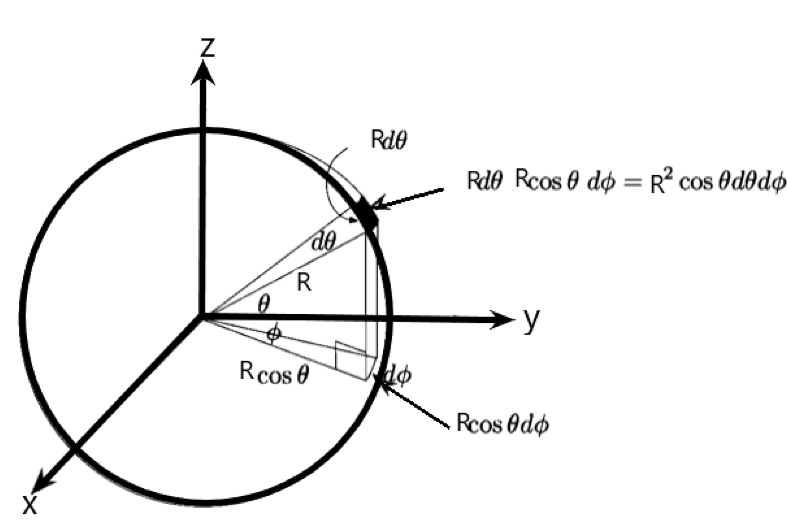
i) We can calculate the volume of it using the spherical coordinate system as –
We should know the conversion from rectangular to spherical coordinates as –
\[{{r}^{2}}={{x}^{2}}+{{y}^{2}}+{{z}^{2}}\]
Now the volume element dV is given by as
\[dV={{r}^{2}}\sin \phi drd\theta d\phi \]
We can do the triple integration of the above element with proper limits as –
\[\begin{align}
& {{r}^{2}}={{x}^{2}}+{{y}^{2}}+{{z}^{2}} \\
& \Rightarrow dV={{r}^{2}}\sin \phi drd\theta d\phi \\
& Volume,V=\int{\int{\int{{{r}^{2}}}}}dV \\
& \text{By substituting for dV,} \\
& \Rightarrow \text{Volume,}V=\int_{0}^{R}{dr\int_{0}^{\pi }{{{r}^{2}}\sin \theta d\theta }\int_{0}^{2\pi }{d\phi }} \\
& \Rightarrow \text{Volume,}V=\int_{0}^{R}{{{r}^{2}}}dr\int_{0}^{\pi }{\sin \theta d\theta }\int_{0}^{2\pi }{d\phi } \\
& \Rightarrow \text{Volume,}V=-\dfrac{{{R}^{3}}}{3}(-1-1)(2\pi ) \\
& \therefore V=\dfrac{4}{3}\pi {{R}^{3}} \\
\end{align}\]
The volume of the sphere is \[\dfrac{4}{3}\pi {{R}^{3}}\].
ii) We can find the surface area by integrating over the area element dA which is given as \[{{r}^{2}}\cos \theta d\theta d\phi \]. The surface will be given as –
\[\begin{align}
& \int{dA=}{{R}^{2}}\int_{-\dfrac{\pi }{2}}^{+\dfrac{\pi }{2}}{\cos \theta d\theta }\int_{0}^{2\pi }{d\phi } \\
& \Rightarrow \text{Surface area, }A={{R}^{2}}(\sin \dfrac{\pi }{2}-\sin (-\dfrac{\pi }{2}))(2\pi -0) \\
& \Rightarrow A={{R}^{2}}(1-1)(2\pi ) \\
& \therefore A=4\pi {{R}^{2}} \\
\end{align}\]
The surface area of the sphere is \[4\pi {{R}^{2}}\].
b) Now, let us use the cylindrical coordinates to find the surface area and volume of the cylinder of length L and radius R.
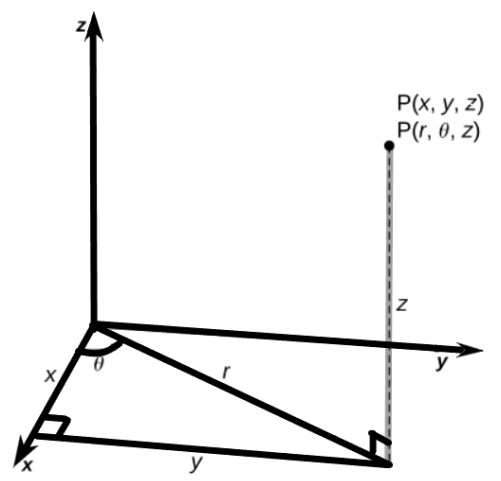
The cylindrical coordinate equivalent for the corner point P \[(r,\theta ,z)\] of the cylinder is as shown in the above figure.
We can find the Surface area of the cylinder with
\[\begin{align}
& r=R \\
& z=L \\
\end{align}\]
Where,
\[\begin{align}
& x=r\cos \theta \\
& y=r\sin \theta \\
& z=z \\
& \text{as,} \\
& \text{Surface area, }A=\int_{0}^{R}{dr\int_{0}^{2\pi }{d\theta }}\int_{0}^{L}{dz} \\
& \Rightarrow A=R(2\pi )L \\
& \therefore A=2\pi RL \\
\end{align}\]
Similarly, we can find the volume of the cylinder by using the given the method –
\[\begin{align}
& \text{Volume, }V=\int_{0}^{R}{r}\int_{0}^{2\pi }{d\theta \int_{0}^{L}{dz}} \\
& \Rightarrow V=\dfrac{{{R}^{2}}}{2}(2\pi )L \\
& \therefore V=\pi {{R}^{2}}L \\
\end{align}\]
Thus, we have found the surface areas and volumes of the sphere and the cylinder using the spherical and cylindrical coordinates respectively.
Note:
The rectangular coordinate is the most easily convertible to any other forms. The cylindrical coordinate is very much similar to the polar coordinates except for that it has a third coordinate. The coordinate systems used effectively makes the calculations much easier.
Complete answer:
Let us calculate the volume and surface area of the sphere and cylinder using the appropriate coordinate systems.
a)Volume and Surface area of a sphere of radius R.2
Consider a sphere of radius R as given below:
i) We can calculate the volume of it using the spherical coordinate system as –
We should know the conversion from rectangular to spherical coordinates as –
\[{{r}^{2}}={{x}^{2}}+{{y}^{2}}+{{z}^{2}}\]
Now the volume element dV is given by as
\[dV={{r}^{2}}\sin \phi drd\theta d\phi \]
We can do the triple integration of the above element with proper limits as –
\[\begin{align}
& {{r}^{2}}={{x}^{2}}+{{y}^{2}}+{{z}^{2}} \\
& \Rightarrow dV={{r}^{2}}\sin \phi drd\theta d\phi \\
& Volume,V=\int{\int{\int{{{r}^{2}}}}}dV \\
& \text{By substituting for dV,} \\
& \Rightarrow \text{Volume,}V=\int_{0}^{R}{dr\int_{0}^{\pi }{{{r}^{2}}\sin \theta d\theta }\int_{0}^{2\pi }{d\phi }} \\
& \Rightarrow \text{Volume,}V=\int_{0}^{R}{{{r}^{2}}}dr\int_{0}^{\pi }{\sin \theta d\theta }\int_{0}^{2\pi }{d\phi } \\
& \Rightarrow \text{Volume,}V=-\dfrac{{{R}^{3}}}{3}(-1-1)(2\pi ) \\
& \therefore V=\dfrac{4}{3}\pi {{R}^{3}} \\
\end{align}\]
The volume of the sphere is \[\dfrac{4}{3}\pi {{R}^{3}}\].
ii) We can find the surface area by integrating over the area element dA which is given as \[{{r}^{2}}\cos \theta d\theta d\phi \]. The surface will be given as –
\[\begin{align}
& \int{dA=}{{R}^{2}}\int_{-\dfrac{\pi }{2}}^{+\dfrac{\pi }{2}}{\cos \theta d\theta }\int_{0}^{2\pi }{d\phi } \\
& \Rightarrow \text{Surface area, }A={{R}^{2}}(\sin \dfrac{\pi }{2}-\sin (-\dfrac{\pi }{2}))(2\pi -0) \\
& \Rightarrow A={{R}^{2}}(1-1)(2\pi ) \\
& \therefore A=4\pi {{R}^{2}} \\
\end{align}\]
The surface area of the sphere is \[4\pi {{R}^{2}}\].
b) Now, let us use the cylindrical coordinates to find the surface area and volume of the cylinder of length L and radius R.
The cylindrical coordinate equivalent for the corner point P \[(r,\theta ,z)\] of the cylinder is as shown in the above figure.
We can find the Surface area of the cylinder with
\[\begin{align}
& r=R \\
& z=L \\
\end{align}\]
Where,
\[\begin{align}
& x=r\cos \theta \\
& y=r\sin \theta \\
& z=z \\
& \text{as,} \\
& \text{Surface area, }A=\int_{0}^{R}{dr\int_{0}^{2\pi }{d\theta }}\int_{0}^{L}{dz} \\
& \Rightarrow A=R(2\pi )L \\
& \therefore A=2\pi RL \\
\end{align}\]
Similarly, we can find the volume of the cylinder by using the given the method –
\[\begin{align}
& \text{Volume, }V=\int_{0}^{R}{r}\int_{0}^{2\pi }{d\theta \int_{0}^{L}{dz}} \\
& \Rightarrow V=\dfrac{{{R}^{2}}}{2}(2\pi )L \\
& \therefore V=\pi {{R}^{2}}L \\
\end{align}\]
Thus, we have found the surface areas and volumes of the sphere and the cylinder using the spherical and cylindrical coordinates respectively.
Note:
The rectangular coordinate is the most easily convertible to any other forms. The cylindrical coordinate is very much similar to the polar coordinates except for that it has a third coordinate. The coordinate systems used effectively makes the calculations much easier.
Recently Updated Pages
Basicity of sulphurous acid and sulphuric acid are

Master Class 12 Economics: Engaging Questions & Answers for Success
Master Class 12 Biology: Engaging Questions & Answers for Success
Master Class 11 English: Engaging Questions & Answers for Success
Master Class 11 Physics: Engaging Questions & Answers for Success
Master Class 11 Computer Science: Engaging Questions & Answers for Success
Trending doubts
Draw a labelled sketch of the human eye class 12 physics CBSE
The chemical formula of tear gas is A CO Cl 2 B C 10 class 12 chemistry CBSE
Draw ray diagrams each showing i myopic eye and ii class 12 physics CBSE
Which are the Top 10 Largest Countries of the World?
Differentiate between homogeneous and heterogeneous class 12 chemistry CBSE
Which is the correct genotypic ratio of mendel dihybrid class 12 biology CBSE