




How do you use the midpoint formula to find an endpoint?
Answer
 Verified
576.3k+ views
Hint: Here, the midpoint formula is used to find the other endpoint if one end point and a midpoint is given. If we assume one endpoint as $\left( {{x}_{1}},{{y}_{1}} \right)$, midpoint as (a, b) and other endpoint as $\left( {{x}_{2}},{{y}_{2}} \right)$, then by using midpoint formula we can find the midpoint of a straight line using two endpoints.
Midpoint formula is:
$\Rightarrow \left( a,b \right)=\left[ \left( \dfrac{{{x}_{1}}+{{x}_{2}}}{2} \right),\left( \dfrac{{{y}_{1}}+{{y}_{2}}}{2} \right) \right]$
Where ‘a’ and ‘b’ are coordinates of midpoint, ${{x}_{1}}$ and ${{x}_{2}}$ are coordinates of x-axis and, ${{y}_{1}}$ and ${{y}_{2}}$ are coordinates of y-axis.
Complete step by step answer:
Let’s discuss the question now.
If we are given a straight line having two end points and there is one midpoint of that line, we can find the midpoint of that line by using the midpoint formula.
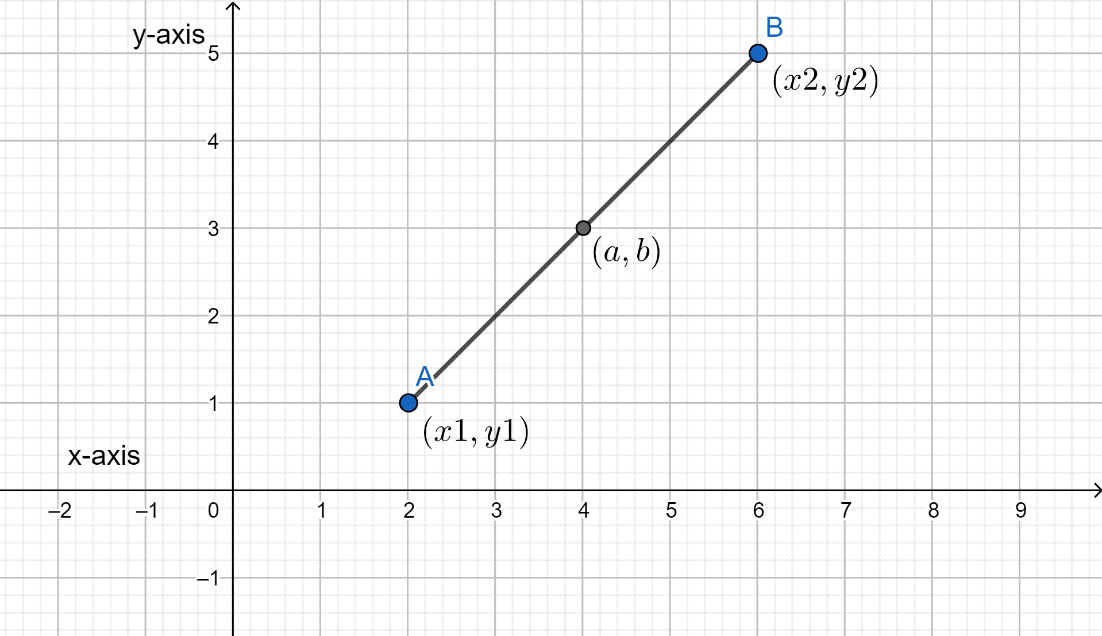
From the figure, let’s understand the concept of midpoint. Here, 2 endpoints $\left( {{x}_{1}},{{y}_{1}} \right)$ and $\left( {{x}_{2}},{{y}_{2}} \right)$ are given. The midpoint of the line is (a, b). So the formula for obtaining the midpoint is:
$\Rightarrow \left( a,b \right)=\left[ \left( \dfrac{{{x}_{1}}+{{x}_{2}}}{2} \right),\left( \dfrac{{{y}_{1}}+{{y}_{2}}}{2} \right) \right]$
But as per question, it is said that if we are given one of the end point and the midpoint then how we have to obtain the other end point. Let’s say that $\left( {{x}_{1}},{{y}_{1}} \right)$ and (a, b) is given but we need to find $\left( {{x}_{2}},{{y}_{2}} \right)$. For that we will obtain the equation from given coordinates.
There are two coordinates of midpoint i.e. a and b. To find ${{x}_{2}}$, we will use ‘a’ coordinate:
$\Rightarrow a=\dfrac{{{x}_{1}}+{{x}_{2}}}{2}$
Now, 2 will get multiplied by ‘a’:
$\Rightarrow 2a={{x}_{1}}+{{x}_{2}}$
Find ${{x}_{2}}$:
$\Rightarrow 2a-{{x}_{1}}={{x}_{2}}$
Similarly for ${{y}_{2}}$, we will use ‘b’ coordinate:
$\Rightarrow b=\dfrac{{{y}_{1}}+{{y}_{2}}}{2}$
Now, 2 will get multiplied by ‘b’:
$\Rightarrow 2b={{y}_{1}}+{{y}_{2}}$
Find ${{y}_{2}}$:
$\Rightarrow 2b-{{y}_{1}}={{y}_{2}}$
So, for finding $\left( {{x}_{2}},{{y}_{2}} \right)$, we will use the following equations:
$\Rightarrow 2a-{{x}_{1}}={{x}_{2}}$
$\Rightarrow 2b-{{y}_{1}}={{y}_{2}}$
This is the final answer.
Note: Midpoint formula is not only used for straight lines but also used for finding the midpoints of the length of the triangles. Any one of the end points can be obtained by applying the formulae taken out in the final step above. The midpoints can be found just by taking the average of two coordinates of each axis.
Midpoint formula is:
$\Rightarrow \left( a,b \right)=\left[ \left( \dfrac{{{x}_{1}}+{{x}_{2}}}{2} \right),\left( \dfrac{{{y}_{1}}+{{y}_{2}}}{2} \right) \right]$
Where ‘a’ and ‘b’ are coordinates of midpoint, ${{x}_{1}}$ and ${{x}_{2}}$ are coordinates of x-axis and, ${{y}_{1}}$ and ${{y}_{2}}$ are coordinates of y-axis.
Complete step by step answer:
Let’s discuss the question now.
If we are given a straight line having two end points and there is one midpoint of that line, we can find the midpoint of that line by using the midpoint formula.
From the figure, let’s understand the concept of midpoint. Here, 2 endpoints $\left( {{x}_{1}},{{y}_{1}} \right)$ and $\left( {{x}_{2}},{{y}_{2}} \right)$ are given. The midpoint of the line is (a, b). So the formula for obtaining the midpoint is:
$\Rightarrow \left( a,b \right)=\left[ \left( \dfrac{{{x}_{1}}+{{x}_{2}}}{2} \right),\left( \dfrac{{{y}_{1}}+{{y}_{2}}}{2} \right) \right]$
But as per question, it is said that if we are given one of the end point and the midpoint then how we have to obtain the other end point. Let’s say that $\left( {{x}_{1}},{{y}_{1}} \right)$ and (a, b) is given but we need to find $\left( {{x}_{2}},{{y}_{2}} \right)$. For that we will obtain the equation from given coordinates.
There are two coordinates of midpoint i.e. a and b. To find ${{x}_{2}}$, we will use ‘a’ coordinate:
$\Rightarrow a=\dfrac{{{x}_{1}}+{{x}_{2}}}{2}$
Now, 2 will get multiplied by ‘a’:
$\Rightarrow 2a={{x}_{1}}+{{x}_{2}}$
Find ${{x}_{2}}$:
$\Rightarrow 2a-{{x}_{1}}={{x}_{2}}$
Similarly for ${{y}_{2}}$, we will use ‘b’ coordinate:
$\Rightarrow b=\dfrac{{{y}_{1}}+{{y}_{2}}}{2}$
Now, 2 will get multiplied by ‘b’:
$\Rightarrow 2b={{y}_{1}}+{{y}_{2}}$
Find ${{y}_{2}}$:
$\Rightarrow 2b-{{y}_{1}}={{y}_{2}}$
So, for finding $\left( {{x}_{2}},{{y}_{2}} \right)$, we will use the following equations:
$\Rightarrow 2a-{{x}_{1}}={{x}_{2}}$
$\Rightarrow 2b-{{y}_{1}}={{y}_{2}}$
This is the final answer.
Note: Midpoint formula is not only used for straight lines but also used for finding the midpoints of the length of the triangles. Any one of the end points can be obtained by applying the formulae taken out in the final step above. The midpoints can be found just by taking the average of two coordinates of each axis.
Recently Updated Pages
Master Class 11 Social Science: Engaging Questions & Answers for Success

Master Class 11 Physics: Engaging Questions & Answers for Success
Master Class 11 Maths: Engaging Questions & Answers for Success
Master Class 11 Economics: Engaging Questions & Answers for Success
Master Class 11 Computer Science: Engaging Questions & Answers for Success
Master Class 11 Chemistry: Engaging Questions & Answers for Success
Trending doubts
One Metric ton is equal to kg A 10000 B 1000 C 100 class 11 physics CBSE
There are 720 permutations of the digits 1 2 3 4 5 class 11 maths CBSE
1 Quintal is equal to a 110 kg b 10 kg c 100kg d 1000 class 11 physics CBSE
State and prove Bernoullis theorem class 11 physics CBSE
Difference Between Prokaryotic Cells and Eukaryotic Cells
Which among the following are examples of coming together class 11 social science CBSE