




How do I use DeMoivre's theorem to find out \[{{\left( -3+3i \right)}^{3}}\]?
Answer
 Verified
546.9k+ views
Hint: To solve this complex expression, first assume \[z=-3+3i\] and then change this complex number into trigonometric form that is \[z=\rho \left[ \cos \left( \theta \right)+i\sin \left( \theta \right) \right]\] and then apply DeMoivre’s theorem which is \[{{z}^{n}}={{\rho }^{n}}\left[ \cos \left( n\theta \right)+i\sin \left( n\theta \right) \right]\] to get the value of \[{{z}^{3}}={{\left( -3+3i \right)}^{3}}\].
Complete step by step solution:
Let us suppose given complex number to be as follows:
\[z=-3+3i\]
\[\Rightarrow {{z}^{3}}={{\left( -3+3i \right)}^{3}}\]
To change this complex number into trigonometric form that is
\[z=\rho \left[ \cos \left( \theta \right)+i\sin \left( \theta \right) \right]...\left( 1 \right)\]
we need to find the value of \[\theta \] and \[\rho \] . We know that \[\rho =\sqrt{{{\left( x \right)}^{2}}+{{\left( y \right)}^{2}}}\]here \[x=-3\] and \[y=3\]. After applying these values, we get:
\[\Rightarrow \rho =\sqrt{{{\left( -3 \right)}^{2}}+{{\left( 3 \right)}^{2}}}\]
\[\Rightarrow \rho =\sqrt{9+9}\]
\[\Rightarrow \rho =3\sqrt{2}\]
To find the value of \[\theta \] formula is \[\theta =\arctan \left( \dfrac{y}{x} \right)\] here \[x=-3\] and \[y=3\]. After applying these values, we get:
\[\Rightarrow \theta =\arctan \left( \dfrac{3}{-3} \right)\]
\[\Rightarrow \theta =\arctan \left( -1 \right)\]
\[\Rightarrow \theta =\dfrac{3\pi }{4}\]
Now substitute the value of \[\theta \] and \[\rho \] in equation \[\left( 1 \right)\] to convert in trigonometry form we get:
\[\Rightarrow z=3\sqrt{2}\left[ \cos \left( \dfrac{3\pi }{4} \right)+i\sin \left( \dfrac{3\pi }{4} \right) \right]\]
And apply DeMoivre’s theorem which is \[{{z}^{n}}={{\rho }^{n}}\left[ \cos \left( n\theta \right)+i\sin \left( n\theta \right) \right]\] in equation \[{{z}^{3}}={{\left( -3+3i \right)}^{3}}\] we get:
\[\Rightarrow {{z}^{3}}={{\left( 3\sqrt{2} \right)}^{3}}\left[ \cos \left( 3\cdot \dfrac{3\pi }{4} \right)+i\sin \left( 3\cdot \dfrac{3\pi }{4} \right) \right]\]
\[\Rightarrow {{z}^{3}}={{\left( 3\sqrt{2} \right)}^{3}}\left[ \cos \left( \dfrac{9\pi }{4} \right)+i\sin \left( \dfrac{9\pi }{4} \right) \right]\]
\[\Rightarrow {{z}^{3}}=54\sqrt{2}\left[ \cos \left( \dfrac{9\pi }{4} \right)+i\sin \left( \dfrac{9\pi }{4} \right) \right]\]
We can further split this angle as \[\dfrac{9\pi }{4}=2\pi +\dfrac{\pi }{4}\] and replace it in the above equation we get:
\[\Rightarrow {{z}^{3}}=54\sqrt{2}\left[ \cos \left( 2\pi +\dfrac{\pi }{4} \right)+i\sin \left( 2\pi +\dfrac{\pi }{4} \right) \right]\]
According to the one of the trigonometric properties of cosine and sine one of them is \[\cos \left( 2\pi +\theta \right)=\cos \left( \theta \right)\] and \[\sin \left( 2\pi +\theta \right)=\sin \left( \theta \right)\] using these in the above equation we get:
\[\Rightarrow {{z}^{3}}=54\sqrt{2}\left[ \cos \left( \dfrac{\pi }{4} \right)+i\sin \left( \dfrac{\pi }{4} \right) \right]\]
We know that value of \[\cos \left( \dfrac{\pi }{4} \right)=\sin \left( \dfrac{\pi }{4} \right)=\dfrac{1}{\sqrt{2}}\], by substituting this value we get:
\[\Rightarrow {{z}^{3}}=54\sqrt{2}\left[ \dfrac{1}{\sqrt{2}}+i\dfrac{1}{\sqrt{2}} \right]\]
Now we take LCM within the brackets and simplify we get:
\[\Rightarrow {{z}^{3}}=54\sqrt{2}\left[ \dfrac{1+i}{\sqrt{2}} \right]\]
As we can see \[\sqrt{2}\] is there in both numerator and denominators. So, it gets cancelled. Hence, we are left with the following:
\[\Rightarrow {{z}^{3}}=54\left[ 1+i \right]\]
After solving the bracket, we get:
\[\Rightarrow {{z}^{3}}=54+54i\]
Therefore, value of \[{{z}^{3}}={{\left( -3+3i \right)}^{3}}\] is \[{{z}^{3}}=54+54i\].
Note:
Students can go wrong by using wrong DeMoivre’s formula that is some students use \[{{z}^{n}}={{\rho }^{n}}\left[ n\cos \left( \theta \right)+n\sin \left( \theta \right)i \right]\] instead of \[{{z}^{n}}={{\rho }^{n}}\left[ \cos \left( n\theta \right)+i\sin \left( n\theta \right) \right]\] which further leads to the wrong result. Hence, it’s important to remember DeMoivre’s theorem which is \[{{z}^{n}}={{\rho }^{n}}\left[ \cos \left( n\theta \right)+i\sin \left( n\theta \right) \right]\] right. Also, you can find the value of \[\theta \] by observing the graph of given complex no. that is:
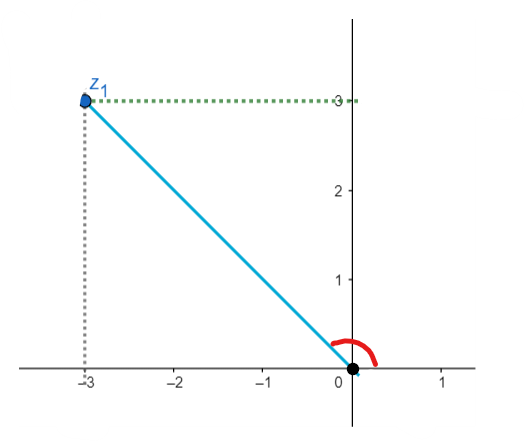
Clearly you can see the angle is equal to \[\dfrac{\pi }{2}+\dfrac{\pi }{4}=\dfrac{3\pi }{4}\]. Which implies \[\theta =\dfrac{3\pi }{4}\]
Complete step by step solution:
Let us suppose given complex number to be as follows:
\[z=-3+3i\]
\[\Rightarrow {{z}^{3}}={{\left( -3+3i \right)}^{3}}\]
To change this complex number into trigonometric form that is
\[z=\rho \left[ \cos \left( \theta \right)+i\sin \left( \theta \right) \right]...\left( 1 \right)\]
we need to find the value of \[\theta \] and \[\rho \] . We know that \[\rho =\sqrt{{{\left( x \right)}^{2}}+{{\left( y \right)}^{2}}}\]here \[x=-3\] and \[y=3\]. After applying these values, we get:
\[\Rightarrow \rho =\sqrt{{{\left( -3 \right)}^{2}}+{{\left( 3 \right)}^{2}}}\]
\[\Rightarrow \rho =\sqrt{9+9}\]
\[\Rightarrow \rho =3\sqrt{2}\]
To find the value of \[\theta \] formula is \[\theta =\arctan \left( \dfrac{y}{x} \right)\] here \[x=-3\] and \[y=3\]. After applying these values, we get:
\[\Rightarrow \theta =\arctan \left( \dfrac{3}{-3} \right)\]
\[\Rightarrow \theta =\arctan \left( -1 \right)\]
\[\Rightarrow \theta =\dfrac{3\pi }{4}\]
Now substitute the value of \[\theta \] and \[\rho \] in equation \[\left( 1 \right)\] to convert in trigonometry form we get:
\[\Rightarrow z=3\sqrt{2}\left[ \cos \left( \dfrac{3\pi }{4} \right)+i\sin \left( \dfrac{3\pi }{4} \right) \right]\]
And apply DeMoivre’s theorem which is \[{{z}^{n}}={{\rho }^{n}}\left[ \cos \left( n\theta \right)+i\sin \left( n\theta \right) \right]\] in equation \[{{z}^{3}}={{\left( -3+3i \right)}^{3}}\] we get:
\[\Rightarrow {{z}^{3}}={{\left( 3\sqrt{2} \right)}^{3}}\left[ \cos \left( 3\cdot \dfrac{3\pi }{4} \right)+i\sin \left( 3\cdot \dfrac{3\pi }{4} \right) \right]\]
\[\Rightarrow {{z}^{3}}={{\left( 3\sqrt{2} \right)}^{3}}\left[ \cos \left( \dfrac{9\pi }{4} \right)+i\sin \left( \dfrac{9\pi }{4} \right) \right]\]
\[\Rightarrow {{z}^{3}}=54\sqrt{2}\left[ \cos \left( \dfrac{9\pi }{4} \right)+i\sin \left( \dfrac{9\pi }{4} \right) \right]\]
We can further split this angle as \[\dfrac{9\pi }{4}=2\pi +\dfrac{\pi }{4}\] and replace it in the above equation we get:
\[\Rightarrow {{z}^{3}}=54\sqrt{2}\left[ \cos \left( 2\pi +\dfrac{\pi }{4} \right)+i\sin \left( 2\pi +\dfrac{\pi }{4} \right) \right]\]
According to the one of the trigonometric properties of cosine and sine one of them is \[\cos \left( 2\pi +\theta \right)=\cos \left( \theta \right)\] and \[\sin \left( 2\pi +\theta \right)=\sin \left( \theta \right)\] using these in the above equation we get:
\[\Rightarrow {{z}^{3}}=54\sqrt{2}\left[ \cos \left( \dfrac{\pi }{4} \right)+i\sin \left( \dfrac{\pi }{4} \right) \right]\]
We know that value of \[\cos \left( \dfrac{\pi }{4} \right)=\sin \left( \dfrac{\pi }{4} \right)=\dfrac{1}{\sqrt{2}}\], by substituting this value we get:
\[\Rightarrow {{z}^{3}}=54\sqrt{2}\left[ \dfrac{1}{\sqrt{2}}+i\dfrac{1}{\sqrt{2}} \right]\]
Now we take LCM within the brackets and simplify we get:
\[\Rightarrow {{z}^{3}}=54\sqrt{2}\left[ \dfrac{1+i}{\sqrt{2}} \right]\]
As we can see \[\sqrt{2}\] is there in both numerator and denominators. So, it gets cancelled. Hence, we are left with the following:
\[\Rightarrow {{z}^{3}}=54\left[ 1+i \right]\]
After solving the bracket, we get:
\[\Rightarrow {{z}^{3}}=54+54i\]
Therefore, value of \[{{z}^{3}}={{\left( -3+3i \right)}^{3}}\] is \[{{z}^{3}}=54+54i\].
Note:
Students can go wrong by using wrong DeMoivre’s formula that is some students use \[{{z}^{n}}={{\rho }^{n}}\left[ n\cos \left( \theta \right)+n\sin \left( \theta \right)i \right]\] instead of \[{{z}^{n}}={{\rho }^{n}}\left[ \cos \left( n\theta \right)+i\sin \left( n\theta \right) \right]\] which further leads to the wrong result. Hence, it’s important to remember DeMoivre’s theorem which is \[{{z}^{n}}={{\rho }^{n}}\left[ \cos \left( n\theta \right)+i\sin \left( n\theta \right) \right]\] right. Also, you can find the value of \[\theta \] by observing the graph of given complex no. that is:
Clearly you can see the angle is equal to \[\dfrac{\pi }{2}+\dfrac{\pi }{4}=\dfrac{3\pi }{4}\]. Which implies \[\theta =\dfrac{3\pi }{4}\]
Recently Updated Pages
Master Class 11 Computer Science: Engaging Questions & Answers for Success

Master Class 11 Business Studies: Engaging Questions & Answers for Success
Master Class 11 Economics: Engaging Questions & Answers for Success
Master Class 11 English: Engaging Questions & Answers for Success
Master Class 11 Maths: Engaging Questions & Answers for Success
Master Class 11 Biology: Engaging Questions & Answers for Success
Trending doubts
There are 720 permutations of the digits 1 2 3 4 5 class 11 maths CBSE
Discuss the various forms of bacteria class 11 biology CBSE
Explain zero factorial class 11 maths CBSE
What organs are located on the left side of your body class 11 biology CBSE
Draw a labelled diagram of the human heart and label class 11 biology CBSE
What is 1s 2s 2p 3s 3p class 11 chemistry CBSE