



How do you use area models to divide $ 845 \div 13 $ ?
Answer
 Verified
589.5k+ views
Hint: Make a table of rows and columns in which in the left outer area write the denominator or divisor given, that is $ 13 $ and in the 1st row 1st column write $ 845 $ the dividend, then think of any random multiple of $ 13 $ which gives the product nearest to the dividend, write that in top of first column and then subtract the product of $ 13 $ and its multiple in the 2nd row 1st column and then write the output in the 2nd column 1st row. Repeat the same until the remainder or the last row last column comes zero.
Complete step by step solution:
We are given with the value $ 845 \div 13 $ .
To solve it using area models make a table of some rows and columns, in which in the left outer area write the denominator or divisor given is $ 13 $ and in the 1st row 1st column write $ 845 $ the dividend.
Let’s take $ 50 $ as multiple of $ 13 $ , then subtract the product of $ 13 $ and $ 50 $ in the 2nd row, 1st column and we get $ 195 $ .
Then write $ 195 $ next to $ 845 $ , then repeating the same steps as 1st, take $ 10 $ and subtract the product and we get $ 65 $ , then we know that $ 13 \times 5 = 65 $ then directly write the term and we get remainder as zero and we will stop here.
Table according to the steps are:
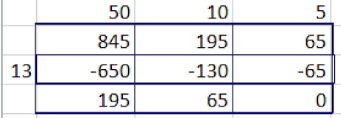
Add the 2nd row and we get: $ 650 + 130 + 65 = 845 $ , which is our dividend, $ 13 $ is our divisor. Add the factors written above and we get: $ 50 + 10 + 5 = 65 $ , which is our Quotient obtained. Therefore, using area models we get that for $ 845 \div 13 $ , $ 65 $ is the Quotient with remainder zero.
So, the correct answer is “ $ 65 $ ”.
Note: Same steps to be followed when dividing any other terms.
There are less chances or errors when moving step by step, so follow that.
Along with division, multiplication can also be done with the area model.
Complete step by step solution:
We are given with the value $ 845 \div 13 $ .
To solve it using area models make a table of some rows and columns, in which in the left outer area write the denominator or divisor given is $ 13 $ and in the 1st row 1st column write $ 845 $ the dividend.
Let’s take $ 50 $ as multiple of $ 13 $ , then subtract the product of $ 13 $ and $ 50 $ in the 2nd row, 1st column and we get $ 195 $ .
Then write $ 195 $ next to $ 845 $ , then repeating the same steps as 1st, take $ 10 $ and subtract the product and we get $ 65 $ , then we know that $ 13 \times 5 = 65 $ then directly write the term and we get remainder as zero and we will stop here.
Table according to the steps are:
Add the 2nd row and we get: $ 650 + 130 + 65 = 845 $ , which is our dividend, $ 13 $ is our divisor. Add the factors written above and we get: $ 50 + 10 + 5 = 65 $ , which is our Quotient obtained. Therefore, using area models we get that for $ 845 \div 13 $ , $ 65 $ is the Quotient with remainder zero.
So, the correct answer is “ $ 65 $ ”.
Note: Same steps to be followed when dividing any other terms.
There are less chances or errors when moving step by step, so follow that.
Along with division, multiplication can also be done with the area model.
Recently Updated Pages
Master Class 12 Economics: Engaging Questions & Answers for Success

Master Class 12 Social Science: Engaging Questions & Answers for Success
Master Class 12 English: Engaging Questions & Answers for Success
Master Class 12 Maths: Engaging Questions & Answers for Success
Master Class 12 Physics: Engaging Questions & Answers for Success
Master Class 12 Biology: Engaging Questions & Answers for Success
Trending doubts
How many sides does a circle have a 10 sides b 20 sides class 8 maths CBSE
What is BLO What is the full form of BLO class 8 social science CBSE
What does the color green in the national flag of India class 8 social science CBSE
Citizens of India can vote at the age of A 18 years class 8 social science CBSE
Full form of STD, ISD and PCO
One cusec is equal to how many liters class 8 maths CBSE