




How do you use a triple integral to find the volume of the given tetrahedron enclosed by the coordinate planes $2x + y + z = 3$ ?
Answer
 Verified
528.9k+ views
Hint: To do this question with the help of triple integral, first you have to integrate one variable by taking limits in terms of other two variables. When we go for the second integral only one variable left which we can put on limits and on third time integration there would be no variable on the constant left.
Complete step by step solution:
In the given question, we have
The equation of coordinate planes is $2x + y + z = 3$.
We can also write it as $z = 3 - 2x - y$ .
Now, by setting $z = 0$ , we know that it cuts the x-y plane to $2x + y = 3$.
By setting $\left( {x,y} \right)\, = \,0$, we know that the plane hits the z axis at z $ = \,3$.
Similarly, it hits the x axis at $x\, = \,\dfrac{3}{2}$and y axis at $y\, = \,3$
So, we can draw it in the first octant
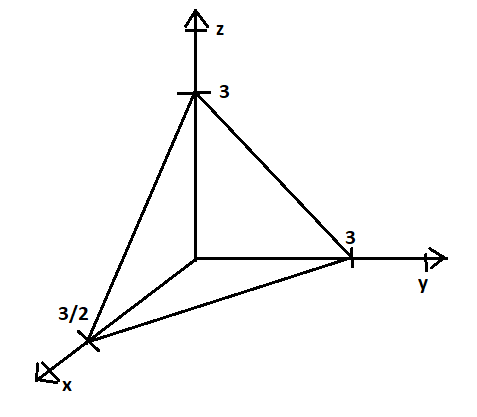
Now, we can put the limits as follows $z = 0\,\,to\,\,z = \,3 - 2x - y$
$y = 0\,\,to\,\,y = 3 - 2x$
$x\, = \,0\,\,to\,\,x = \dfrac{3}{2}$
The triple integral is
$ \Rightarrow \int\limits_{x = 0}^{\dfrac{3}{2}} {\int\limits_{y = 0}^{3 - 2x} {\int\limits_{z = 0}^{3 - 2x - y} {dzdydx} } } $
$=\int\limits_{x = 0}^{\dfrac{3}{2}} {\int\limits_{y = 0}^{3 - 2x} {\left[ z \right]_0^{3 - 2x - y}} } dydx$
$= \int\limits_{x = 0}^{\dfrac{3}{2}} {\int\limits_{y = 0}^{3 - 2x} {\left( {3 - 2x - y} \right)} } dydx$
$= \int\limits_{x = 0}^{\dfrac{3}{2}} {\left( {3y - 2xy - \dfrac{{{y^2}}}{2}} \right)} _0^{3 - 2x}dx$
\[= \int\limits_{x = 0}^{\dfrac{3}{2}} {\left[ {3\left( {3 - 2x} \right) - 2x\left( {3 - 2x} \right) - \dfrac{{{{\left( {3 - 2x} \right)}^2}}}{2}} \right] - } \left[ {3\left( 0 \right) - 2x\left( 0 \right) - \dfrac{{{{\left( 0 \right)}^2}}}{2}} \right]dx\]
$= \int\limits_0^{\dfrac{3}{2}} {\left( {9 - 6x - 6x + 4{x^2} - \dfrac{{9 + 4{x^2} - 12x}}{2}} \right)dx} $
\[= \dfrac{1}{2}\int\limits_0^{\dfrac{3}{2}} {\left( {18 - 24x + 8{x^2} - 9 - 4{x^2} + 12x} \right)dx} \]
$= \dfrac{1}{2}\left( {18x - \dfrac{{24{x^2}}}{2} + \dfrac{{8{x^3}}}{3} - 9x - \dfrac{{4{x^3}}}{3} + \dfrac{{12{x^2}}}{2}} \right)_0^{\dfrac{3}{2}}$
$= \dfrac{1}{2}\left( {18\left( {\dfrac{3}{2}} \right) - 12{{\left( {\dfrac{3}{2}} \right)}^2} + \dfrac{8}{3}{{\left( {\dfrac{3}{2}} \right)}^3} - 9\left( {\dfrac{3}{2}} \right) - \dfrac{4}{3}{{\left( {\dfrac{3}{2}} \right)}^3} + 6{{\left( {\dfrac{3}{2}} \right)}^2}} \right)$
$= \dfrac{1}{2}\left( {27 - 27 + 9 - \dfrac{{27}}{2} - \dfrac{9}{2} + \dfrac{{27}}{2}} \right)$
$= \dfrac{9}{4}$
Therefore, the volume of tetrahedron is $\dfrac{9}{4}$ cubic units.
Note: This is a very useful application of triple integral. We can easily find the volume of three-dimensional bodies using triple integration by knowing the limits from where to where they are varying. In triple integration when we solve the integral for one variable then we have to eliminate that variable in limits for further integration.
Complete step by step solution:
In the given question, we have
The equation of coordinate planes is $2x + y + z = 3$.
We can also write it as $z = 3 - 2x - y$ .
Now, by setting $z = 0$ , we know that it cuts the x-y plane to $2x + y = 3$.
By setting $\left( {x,y} \right)\, = \,0$, we know that the plane hits the z axis at z $ = \,3$.
Similarly, it hits the x axis at $x\, = \,\dfrac{3}{2}$and y axis at $y\, = \,3$
So, we can draw it in the first octant
Now, we can put the limits as follows $z = 0\,\,to\,\,z = \,3 - 2x - y$
$y = 0\,\,to\,\,y = 3 - 2x$
$x\, = \,0\,\,to\,\,x = \dfrac{3}{2}$
The triple integral is
$ \Rightarrow \int\limits_{x = 0}^{\dfrac{3}{2}} {\int\limits_{y = 0}^{3 - 2x} {\int\limits_{z = 0}^{3 - 2x - y} {dzdydx} } } $
$=\int\limits_{x = 0}^{\dfrac{3}{2}} {\int\limits_{y = 0}^{3 - 2x} {\left[ z \right]_0^{3 - 2x - y}} } dydx$
$= \int\limits_{x = 0}^{\dfrac{3}{2}} {\int\limits_{y = 0}^{3 - 2x} {\left( {3 - 2x - y} \right)} } dydx$
$= \int\limits_{x = 0}^{\dfrac{3}{2}} {\left( {3y - 2xy - \dfrac{{{y^2}}}{2}} \right)} _0^{3 - 2x}dx$
\[= \int\limits_{x = 0}^{\dfrac{3}{2}} {\left[ {3\left( {3 - 2x} \right) - 2x\left( {3 - 2x} \right) - \dfrac{{{{\left( {3 - 2x} \right)}^2}}}{2}} \right] - } \left[ {3\left( 0 \right) - 2x\left( 0 \right) - \dfrac{{{{\left( 0 \right)}^2}}}{2}} \right]dx\]
$= \int\limits_0^{\dfrac{3}{2}} {\left( {9 - 6x - 6x + 4{x^2} - \dfrac{{9 + 4{x^2} - 12x}}{2}} \right)dx} $
\[= \dfrac{1}{2}\int\limits_0^{\dfrac{3}{2}} {\left( {18 - 24x + 8{x^2} - 9 - 4{x^2} + 12x} \right)dx} \]
$= \dfrac{1}{2}\left( {18x - \dfrac{{24{x^2}}}{2} + \dfrac{{8{x^3}}}{3} - 9x - \dfrac{{4{x^3}}}{3} + \dfrac{{12{x^2}}}{2}} \right)_0^{\dfrac{3}{2}}$
$= \dfrac{1}{2}\left( {18\left( {\dfrac{3}{2}} \right) - 12{{\left( {\dfrac{3}{2}} \right)}^2} + \dfrac{8}{3}{{\left( {\dfrac{3}{2}} \right)}^3} - 9\left( {\dfrac{3}{2}} \right) - \dfrac{4}{3}{{\left( {\dfrac{3}{2}} \right)}^3} + 6{{\left( {\dfrac{3}{2}} \right)}^2}} \right)$
$= \dfrac{1}{2}\left( {27 - 27 + 9 - \dfrac{{27}}{2} - \dfrac{9}{2} + \dfrac{{27}}{2}} \right)$
$= \dfrac{9}{4}$
Therefore, the volume of tetrahedron is $\dfrac{9}{4}$ cubic units.
Note: This is a very useful application of triple integral. We can easily find the volume of three-dimensional bodies using triple integration by knowing the limits from where to where they are varying. In triple integration when we solve the integral for one variable then we have to eliminate that variable in limits for further integration.
Recently Updated Pages
Master Class 12 Economics: Engaging Questions & Answers for Success

Master Class 12 English: Engaging Questions & Answers for Success
Master Class 12 Social Science: Engaging Questions & Answers for Success
Master Class 12 Maths: Engaging Questions & Answers for Success
Master Class 12 Physics: Engaging Questions & Answers for Success
Master Class 9 General Knowledge: Engaging Questions & Answers for Success
Trending doubts
Which are the Top 10 Largest Countries of the World?
Draw a labelled sketch of the human eye class 12 physics CBSE
Differentiate between homogeneous and heterogeneous class 12 chemistry CBSE
Why is the cell called the structural and functional class 12 biology CBSE
Draw ray diagrams each showing i myopic eye and ii class 12 physics CBSE
Which is the correct genotypic ratio of mendel dihybrid class 12 biology CBSE