




How many unpaired electrons are there in \[{\text{N}}{{\text{i}}^{{\text{2 + }}}}\] \[\left( {{\text{Z = 28}}} \right)\] ?
A 0
B 8
C 2
D 4
Answer
 Verified
600.9k+ views
Hint: From the atomic number of nickel, write its electronic configuration. Also write the electronic configuration of \[{\text{N}}{{\text{i}}^{{\text{2 + }}}}\] cation. From the electronic configuration, determine the number of unpaired electrons.
Complete Step by step answer: The atomic number of nickel is 28. Its electronic configuration is \[\left[ {{\text{Ar}}} \right]3{d^8}4{s^2}\]
Nickel atoms lose two electrons to form \[{\text{N}}{{\text{i}}^{{\text{2 + }}}}\]cation. The electronic configuration of \[{\text{N}}{{\text{i}}^{{\text{2 + }}}}\] cation is \[\left[ {{\text{Ar}}} \right]3{d^8}\] .
8 electrons are present in 3d subshell.
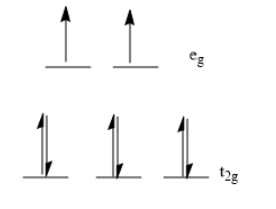
Six electrons are present in lower \[{t_{2g}}\] level and two electrons are present in upper \[{e_g}\] level.
Thus, the number of unpaired electrons in \[{\text{N}}{{\text{i}}^{{\text{2 + }}}}\] ion is 2.
Hence, the correct option is the option (C).
Additional information: When 8 electrons are present in the d orbitals, 6 electrons will pair and two remain unpaired. This is irrespective of if strong field ligand is present or weak field ligand is present. Due to presence of unpaired electrons, \[{\text{N}}{{\text{i}}^{{\text{2 + }}}}\] ion shows paramagnetic behaviour. If all the electrons were paired, then the ion would have been diamagnetic.
Note: The five d orbitals of a metal are degenerate. They have the same energy level. This is true in absence of ligands. In the presence of an octahedral field of ligands, the five degenerate d orbitals of metal split into two energy levels. The lower energy level contains three d orbitals and is called \[{t_{2g}}\] level. The upper energy level contains two d orbitals and is called \[{e_g}\] level.
Complete Step by step answer: The atomic number of nickel is 28. Its electronic configuration is \[\left[ {{\text{Ar}}} \right]3{d^8}4{s^2}\]
Nickel atoms lose two electrons to form \[{\text{N}}{{\text{i}}^{{\text{2 + }}}}\]cation. The electronic configuration of \[{\text{N}}{{\text{i}}^{{\text{2 + }}}}\] cation is \[\left[ {{\text{Ar}}} \right]3{d^8}\] .
8 electrons are present in 3d subshell.
Six electrons are present in lower \[{t_{2g}}\] level and two electrons are present in upper \[{e_g}\] level.
Thus, the number of unpaired electrons in \[{\text{N}}{{\text{i}}^{{\text{2 + }}}}\] ion is 2.
Hence, the correct option is the option (C).
Additional information: When 8 electrons are present in the d orbitals, 6 electrons will pair and two remain unpaired. This is irrespective of if strong field ligand is present or weak field ligand is present. Due to presence of unpaired electrons, \[{\text{N}}{{\text{i}}^{{\text{2 + }}}}\] ion shows paramagnetic behaviour. If all the electrons were paired, then the ion would have been diamagnetic.
Note: The five d orbitals of a metal are degenerate. They have the same energy level. This is true in absence of ligands. In the presence of an octahedral field of ligands, the five degenerate d orbitals of metal split into two energy levels. The lower energy level contains three d orbitals and is called \[{t_{2g}}\] level. The upper energy level contains two d orbitals and is called \[{e_g}\] level.
Recently Updated Pages
Master Class 12 Economics: Engaging Questions & Answers for Success

Master Class 12 English: Engaging Questions & Answers for Success
Master Class 12 Social Science: Engaging Questions & Answers for Success
Master Class 12 Maths: Engaging Questions & Answers for Success
Master Class 12 Physics: Engaging Questions & Answers for Success
Master Class 9 General Knowledge: Engaging Questions & Answers for Success
Trending doubts
One Metric ton is equal to kg A 10000 B 1000 C 100 class 11 physics CBSE
Difference Between Prokaryotic Cells and Eukaryotic Cells
Two of the body parts which do not appear in MRI are class 11 biology CBSE
1 ton equals to A 100 kg B 1000 kg C 10 kg D 10000 class 11 physics CBSE
Draw a diagram of nephron and explain its structur class 11 biology CBSE
10 examples of friction in our daily life