




Unlike poles _________ while like poles __________ each other.
A. Attract, attract
B. Repel, repel
C. Repel, attract
D. Attract, repel
Answer
 Verified
646.5k+ views
Hint: It is a well known fact that opposite poles attract each other just like opposite charges attract each other.
Complete step by step answer:
Magnetic pole is the region of a magnet where the magnetic field is strongest. A bar magnet suspended in Earth's magnetic field orients itself along the north–south direction. The pole pointing towards the north is called the north pole, while the one seeking south is called the south pole. The orientation of any magnetic dipole (unlike electrostatics, magnetic monopoles don't exist) is along the magnetic lines of force.
The attraction and repulsion of poles can be understood using magnetic lines of force and their properties. It is known to us that the lines of force never intersect each other. As such say when poles are brought together, the line of force or the flux lines move and bend away from each other. When they are brought too close, the lines avoid intersecting each
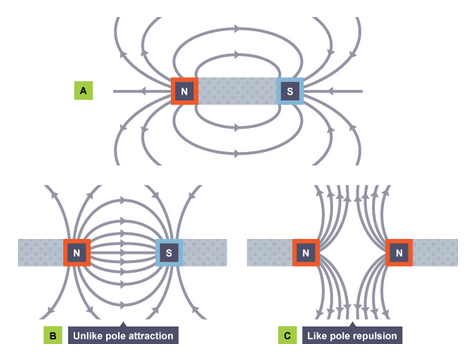
and bend so much away that it puts constraint to the motion of either poles and results in repelling each other. However, when opposite poles are brought together, the lines join each other, moving from one pole to the other, further aiding in bringing them closer.
Therefore, unlike poles attract while poles repel each other.
Hence, the correct option is D.
Note: It can also be explained using the idea that opposite poles when brought together cancel each other’s magnetic field, and in doing so also reduces the potential energy of the system bringing them close to a stable equilibrium. However, like poles, their fields add up, increasing the potential energy of the system, moving them further away from stable equilibrium.
Complete step by step answer:
Magnetic pole is the region of a magnet where the magnetic field is strongest. A bar magnet suspended in Earth's magnetic field orients itself along the north–south direction. The pole pointing towards the north is called the north pole, while the one seeking south is called the south pole. The orientation of any magnetic dipole (unlike electrostatics, magnetic monopoles don't exist) is along the magnetic lines of force.
The attraction and repulsion of poles can be understood using magnetic lines of force and their properties. It is known to us that the lines of force never intersect each other. As such say when poles are brought together, the line of force or the flux lines move and bend away from each other. When they are brought too close, the lines avoid intersecting each
and bend so much away that it puts constraint to the motion of either poles and results in repelling each other. However, when opposite poles are brought together, the lines join each other, moving from one pole to the other, further aiding in bringing them closer.
Therefore, unlike poles attract while poles repel each other.
Hence, the correct option is D.
Note: It can also be explained using the idea that opposite poles when brought together cancel each other’s magnetic field, and in doing so also reduces the potential energy of the system bringing them close to a stable equilibrium. However, like poles, their fields add up, increasing the potential energy of the system, moving them further away from stable equilibrium.
Recently Updated Pages
Match columnI with columnII and choose the correct class 12 biology NEET_UG

Match columnI with columnII and choose the correct class 12 biology NEET_UG
Match columnI with columnII and choose the correct class 12 biology NEET_UG
Which plant will lose its economic value if its fruits class 12 biology NEET_UG
The given figure shows two endocrine glands marked class 11 biology NEET_UG
Human insulin is being commercially produced from a class 12 biology NEET_UG
Trending doubts