




Union of stamens with carpels form a complex called
(A) Gynostegium
(B) Syngenesious
(C) Gynandrium
(D) None of the above
Answer
 Verified
660.9k+ views
Hint: In flowers the gynoecium is the female reproductive organ of the plant where the androecium is the male reproductive organ. The gynoecium includes style, stigma, ovary and ovule. The androecium includes anther, filaments and pollen grains of the flower.
Complete Answer:
Gynostegium is defined as the unit in which the stamens, style and the stigmatic surface of the carpels are united together. This is the specialized cap-like tissue which acts as the protective membrane for the gynoecium by covering it.
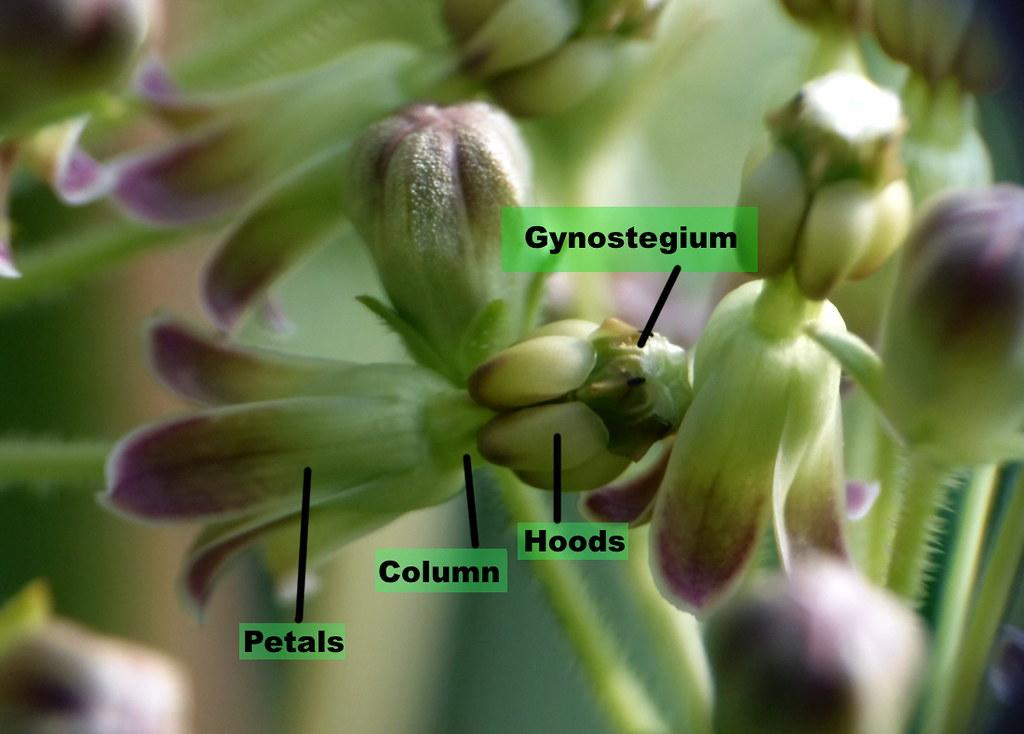
This is mainly common in the plants of the Asclepiadaceae. Syngenesious is defined as the condition in which the filaments are left free but the anthers are fused to the tubular mass as the single unit. This type of arrangement is found in the plants belonging to the family of the asteraceae.
The sunflower, dahlia etc. are included in this family. Gynandrium is the condition in which the stamens are united along the length. This is the combined structure of the male and female stamens. Hence in the gynostegium, the stamens and the carpels form the complex.
Thus, the option (A) is correct.
Note: The condition of the gynostegium is present in the plants that come under the family of Asclepiadaceae. These are also called milkweed. They possess the leafless stem. Asclepius syriaca, Ceropegia stapeliiformis, Burkina Faso, Microloma calycinum etc. are included in this family.
Complete Answer:
Gynostegium is defined as the unit in which the stamens, style and the stigmatic surface of the carpels are united together. This is the specialized cap-like tissue which acts as the protective membrane for the gynoecium by covering it.
This is mainly common in the plants of the Asclepiadaceae. Syngenesious is defined as the condition in which the filaments are left free but the anthers are fused to the tubular mass as the single unit. This type of arrangement is found in the plants belonging to the family of the asteraceae.
The sunflower, dahlia etc. are included in this family. Gynandrium is the condition in which the stamens are united along the length. This is the combined structure of the male and female stamens. Hence in the gynostegium, the stamens and the carpels form the complex.
Thus, the option (A) is correct.
Note: The condition of the gynostegium is present in the plants that come under the family of Asclepiadaceae. These are also called milkweed. They possess the leafless stem. Asclepius syriaca, Ceropegia stapeliiformis, Burkina Faso, Microloma calycinum etc. are included in this family.
Recently Updated Pages
Which will be the least stable resonating structure class 11 chemistry CBSE

How many 5 digit telephone numbers can be construc-class-11-maths-CBSE
How do you find the angle of the resultant vector class 11 physics CBSE
Draw labelled diagram of the following i Gram seed class 11 biology CBSE
1 Quintal is equal to a 110 kg b 10 kg c 100kg d 1000 class 11 physics CBSE
What is the need and importance of classification class 11 biology CBSE
Trending doubts
Find the value of the expression given below sin 30circ class 11 maths CBSE
Difference between physical and chemical change class 11 chemistry CBSE
Draw a diagram showing the external features of fish class 11 biology CBSE
Draw a diagram of nephron and explain its structur class 11 biology CBSE
Draw a labelled diagram of the neuron and describe class 11 biology CBSE
Draw a labelled diagram of Ruminant stomach class 11 biology CBSE