




What do you understand by ductless glands? Describe the structure and functions of the thyroid gland.
Answer
 Verified
656.7k+ views
Hint: Endocrine glands secrete their hormones directly into the bloodstream. The thyroid gland is unusual in its structure in the way that its hormones are stored in cavities surrounded by secretory cells. Under secretion or oversecretion of thyroid hormones adversely affects the body physiology.
Complete Answer:
Let's begin the explanation by understanding what ductless glands are.
- An organised collection of secretory epithelial cells is called a ‘gland.’ During development, the majority of the glands are formed by the proliferation of epithelial cells so that they project into the underlying connective tissue.
- Some glands form a duct and retain their continuity with the surface through it, these are called ‘exocrine glands.’ But in other glands, the duct degenerates during development.
- As a result, they lose their continuity with the surface. Such ductless glands are called ‘endocrine glands.’ Different endocrine glands present in our body are pituitary, pineal, parathyroid, thymus, thyroid, adrenal, pancreas and gonads (testis in males and ovary in females).
Now let's see the structure of the thyroid gland in detail.
The thyroid gland is made up of two lobes which are situated on either side of the trachea. There exists a skinny flap of animal tissue called isthmus which joins both the lobes. There are follicles and stromal tissues present within the thyroid gland. Each thyroid follicle is constituted by follicular cells enclosing a cavity.
The various functions of the thyroid gland are:
-The follicle cells in thyroid gland synthesise two hormones namely tetraiodothyronine or thyroxine and triiodothyronine.
-These hormones play a very crucial role in the regulation of basal metabolic rate (BMR).
-Thyroid hormones also aid the process of formation of red blood cells.
-They control the metabolism of biomolecules like carbohydrates, proteins and fats.
-Thyroid hormones are also responsible for the maintenance of water and electrolyte balance.
-Thyroid gland plays a vital role in secreting a protein hormone called thyrocalcitonin (TCT). This hormone regulates blood calcium levels.
Note: -Adequate intake of iodine is crucial to the normal rate of thyroid hormone synthesis. Thus, deficiency of iodine results in hypothyroidism and enlargement of the thyroid gland. This condition is called ‘goitre.’
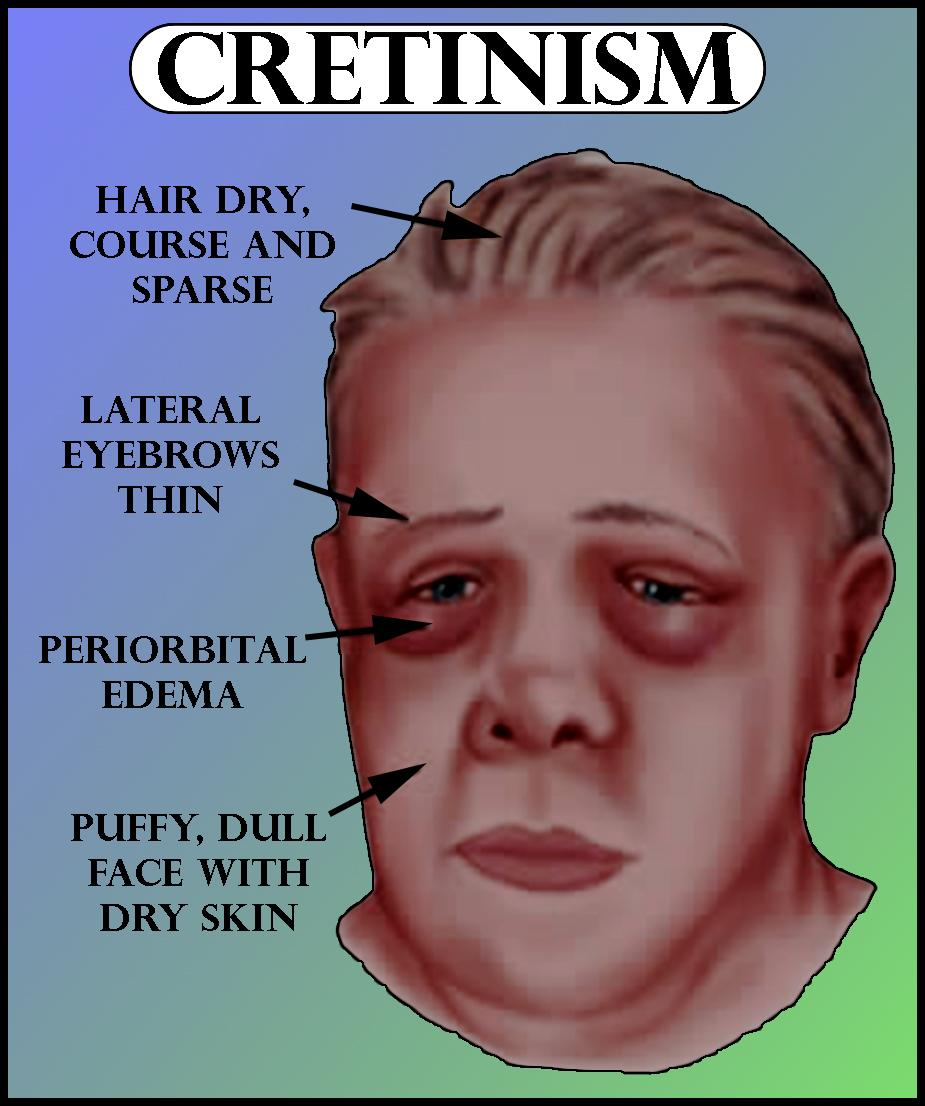
-Hypothyroidism during pregnancy can cause stunted growth (cretinism), abnormal skin, low IQ mental retardation etc.
-Over secretion of thyroid hormones due to associated abnormalities is called ‘hyperthyroidism.’
Complete Answer:
Let's begin the explanation by understanding what ductless glands are.
- An organised collection of secretory epithelial cells is called a ‘gland.’ During development, the majority of the glands are formed by the proliferation of epithelial cells so that they project into the underlying connective tissue.
- Some glands form a duct and retain their continuity with the surface through it, these are called ‘exocrine glands.’ But in other glands, the duct degenerates during development.
- As a result, they lose their continuity with the surface. Such ductless glands are called ‘endocrine glands.’ Different endocrine glands present in our body are pituitary, pineal, parathyroid, thymus, thyroid, adrenal, pancreas and gonads (testis in males and ovary in females).
Now let's see the structure of the thyroid gland in detail.
The thyroid gland is made up of two lobes which are situated on either side of the trachea. There exists a skinny flap of animal tissue called isthmus which joins both the lobes. There are follicles and stromal tissues present within the thyroid gland. Each thyroid follicle is constituted by follicular cells enclosing a cavity.
The various functions of the thyroid gland are:
-The follicle cells in thyroid gland synthesise two hormones namely tetraiodothyronine or thyroxine and triiodothyronine.
-These hormones play a very crucial role in the regulation of basal metabolic rate (BMR).
-Thyroid hormones also aid the process of formation of red blood cells.
-They control the metabolism of biomolecules like carbohydrates, proteins and fats.
-Thyroid hormones are also responsible for the maintenance of water and electrolyte balance.
-Thyroid gland plays a vital role in secreting a protein hormone called thyrocalcitonin (TCT). This hormone regulates blood calcium levels.
Note: -Adequate intake of iodine is crucial to the normal rate of thyroid hormone synthesis. Thus, deficiency of iodine results in hypothyroidism and enlargement of the thyroid gland. This condition is called ‘goitre.’
-Hypothyroidism during pregnancy can cause stunted growth (cretinism), abnormal skin, low IQ mental retardation etc.
-Over secretion of thyroid hormones due to associated abnormalities is called ‘hyperthyroidism.’
Recently Updated Pages
Which of the following graphs shows the variation of class 12 physics CBSE

Draw a labelled diagram of the human male reproductive class 12 biology CBSE
Describe the experiment to compare the emf of two cells class 12 physics CBSE
What is standard hydrogen electrode
What is conventional current and electric current class 12 physics CBSE
2Bromopentane is treated with an alcoholic KOH solution class 12 chemistry CBSE
Trending doubts
Draw a labelled sketch of the human eye class 12 physics CBSE
Which are the Top 10 Largest Countries of the World?
Differentiate between homogeneous and heterogeneous class 12 chemistry CBSE
Draw ray diagrams each showing i myopic eye and ii class 12 physics CBSE
Which is the correct genotypic ratio of mendel dihybrid class 12 biology CBSE
What is the Full Form of PVC, PET, HDPE, LDPE, PP and PS ?