



Under what condition will a set of gears produce:
(1). A gain in speed
(2). A gain in torque
Answer
 Verified
627.3k+ views
Hint: Define gear system. In the simplest gear system, we have two gears with teeth on it to make the movement of the gear on each other smooth. Obtain the mathematical expression relating the number of teeth in the gears to the speed and torque. Use this information to find the answer to the question.
Complete step by step answer:
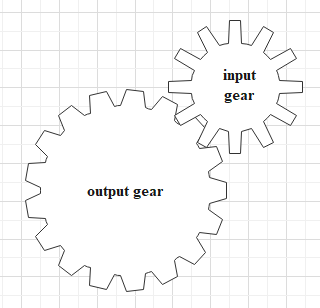
In a gear system we have two gears. One is called the driven gear and the other is called the driving gear. The driving gear can be called the input gear and the driven gear can be called the output gear. He input gear or the driving gear is connected to the power source and the driven gear or the output gear gives us the result.
The output of rotational speed or angular velocity and torque is dependent on the dimension or properties of these two gears.
The two gears have teeth on it, which are designed in such a way that the gears can move each other. Generally, the radius of the input gear is less than the radius of the output gear.
1. The ratio of the angular velocity of the gears can be defined in terms of the number of teeth in the gears. We can write,
$\dfrac{{{\omega }_{i}}}{{{\omega }_{o}}}=\dfrac{{{T}_{o}}}{{{T}_{i}}}$
Where, ${{\omega }_{i}}$ and ${{T}_{i}}$ are the angular speed and the number of teeth of the input gear & ${{\omega }_{o}}$ and ${{T}_{o}}$ are the angular velocity and number of teeth of the output gear.
So, we can say that, if the number of teeth of the input gear or the driving gear is more than the number of teeth of the output gear or the driven gear, then the set of gear will produce a gain in speed.
2. Again, we can write the torque ratio as,
$\dfrac{{{\tau }_{o}}}{{{\tau }_{i}}}=\dfrac{{{N}_{o}}}{{{N}_{i}}}$
So, we can say that, if the number of teeth of the output gear or the driven gear is more than the input gear or the driving gear, then the set of gear will produce a gain in torque.
Note:
In a gear system the speed ratio is also defined as the ratio of the speed of the out gear to the speed of the input gear. This is also called the mechanical advantage of the gear system. The more is the mechanical advantage of the gear system, the less is the force required to do the same work.
Complete step by step answer:
In a gear system we have two gears. One is called the driven gear and the other is called the driving gear. The driving gear can be called the input gear and the driven gear can be called the output gear. He input gear or the driving gear is connected to the power source and the driven gear or the output gear gives us the result.
The output of rotational speed or angular velocity and torque is dependent on the dimension or properties of these two gears.
The two gears have teeth on it, which are designed in such a way that the gears can move each other. Generally, the radius of the input gear is less than the radius of the output gear.
1. The ratio of the angular velocity of the gears can be defined in terms of the number of teeth in the gears. We can write,
$\dfrac{{{\omega }_{i}}}{{{\omega }_{o}}}=\dfrac{{{T}_{o}}}{{{T}_{i}}}$
Where, ${{\omega }_{i}}$ and ${{T}_{i}}$ are the angular speed and the number of teeth of the input gear & ${{\omega }_{o}}$ and ${{T}_{o}}$ are the angular velocity and number of teeth of the output gear.
So, we can say that, if the number of teeth of the input gear or the driving gear is more than the number of teeth of the output gear or the driven gear, then the set of gear will produce a gain in speed.
2. Again, we can write the torque ratio as,
$\dfrac{{{\tau }_{o}}}{{{\tau }_{i}}}=\dfrac{{{N}_{o}}}{{{N}_{i}}}$
So, we can say that, if the number of teeth of the output gear or the driven gear is more than the input gear or the driving gear, then the set of gear will produce a gain in torque.
Note:
In a gear system the speed ratio is also defined as the ratio of the speed of the out gear to the speed of the input gear. This is also called the mechanical advantage of the gear system. The more is the mechanical advantage of the gear system, the less is the force required to do the same work.
Recently Updated Pages
Master Class 12 Economics: Engaging Questions & Answers for Success

Master Class 12 English: Engaging Questions & Answers for Success
Master Class 12 Social Science: Engaging Questions & Answers for Success
Master Class 12 Maths: Engaging Questions & Answers for Success
Master Class 12 Physics: Engaging Questions & Answers for Success
Master Class 12 Business Studies: Engaging Questions & Answers for Success
Trending doubts
Which are the Top 10 Largest Countries of the World?
Draw a labelled sketch of the human eye class 12 physics CBSE
Differentiate between homogeneous and heterogeneous class 12 chemistry CBSE
Why is the cell called the structural and functional class 12 biology CBSE
Draw ray diagrams each showing i myopic eye and ii class 12 physics CBSE
Which is the correct genotypic ratio of mendel dihybrid class 12 biology CBSE