




Under what condition in an arrangement of two plane mirrors, incident ray and reflected ray will always be parallel to each other, whatever may be angle of incidence. Show with the help of a ray diagram.
Answer
 Verified
533.4k+ views
Hint: To solve the problem we first got to imagine the situation and draw the diagram. Given there are two plane mirrors we have to use. It is to keep in mind that plane mirrors always produce a virtual, upright and the same sized image. The focal length of a plane mirror is zero.
Complete step by step solution:
We see that we want the incident and reflected rays to be parallel using two mirrors irrespective of the angle of incidence. (Hence, we cannot answer that if the light falls perpendicular to the mirror, we get same angle for reflected and incident ray)
We see that if we arrange the two plane mirrors perpendicular to each other then we can get the incident and reflected rays parallel to each other, irrespective of the given angle of incidence of the light ray.
Let us draw a diagram illustrating the answer:
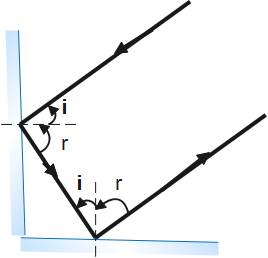
Additional Information: This same phenomenon of incident and reflected rays parallel to each other is used in many daily essential equipment such as we use this in real image mirrors, in solar cookers and also in vehicle headlights. Also, the applications are used in various scientific instruments.
Note: It is important to know the different angles of reflection we can get when we use two or more plane mirrors in a setup and the applications of these setups. Note that we always get an upright, same sized image from a plane mirror, that is the distance between the object and mirror and between image and mirror is always the same (most important property).
Complete step by step solution:
We see that we want the incident and reflected rays to be parallel using two mirrors irrespective of the angle of incidence. (Hence, we cannot answer that if the light falls perpendicular to the mirror, we get same angle for reflected and incident ray)
We see that if we arrange the two plane mirrors perpendicular to each other then we can get the incident and reflected rays parallel to each other, irrespective of the given angle of incidence of the light ray.
Let us draw a diagram illustrating the answer:
Additional Information: This same phenomenon of incident and reflected rays parallel to each other is used in many daily essential equipment such as we use this in real image mirrors, in solar cookers and also in vehicle headlights. Also, the applications are used in various scientific instruments.
Note: It is important to know the different angles of reflection we can get when we use two or more plane mirrors in a setup and the applications of these setups. Note that we always get an upright, same sized image from a plane mirror, that is the distance between the object and mirror and between image and mirror is always the same (most important property).
Recently Updated Pages
Master Class 12 Economics: Engaging Questions & Answers for Success

Master Class 12 English: Engaging Questions & Answers for Success
Master Class 12 Social Science: Engaging Questions & Answers for Success
Master Class 12 Maths: Engaging Questions & Answers for Success
Master Class 12 Physics: Engaging Questions & Answers for Success
Master Class 9 General Knowledge: Engaging Questions & Answers for Success
Trending doubts
Which are the Top 10 Largest Countries of the World?
Draw a labelled sketch of the human eye class 12 physics CBSE
Differentiate between homogeneous and heterogeneous class 12 chemistry CBSE
Why is the cell called the structural and functional class 12 biology CBSE
Draw ray diagrams each showing i myopic eye and ii class 12 physics CBSE
Which is the correct genotypic ratio of mendel dihybrid class 12 biology CBSE